A white label crypto exchange is a ready-built trading platform that a business licenses from a technology provider and runs under its own brand. The provider supplies the matching engine, user interface, wallet connections and back office. The operator supplies the clients, the license, the liquidity relationships and the brand.
The model is getting a second look because the economics of running a crypto exchange changed in 2026. Spot volume on the top 20 centralized exchanges fell from $9.35 trillion to $5.79 trillion in the first half of 2026, a 38% decline year over year, and more than 100 crypto firms declared bankruptcy or paused operations over the same period, according to our review of H1 2026 earnings. Institutional flow moved the other way. Across more than 16 million institutional spot trades on our technology platform in the first nine months of 2026, OTC volume grew 57% year on year while top-20 exchange volume fell 47%.
So the question for a broker, payment provider, bank or OTC desk is less whether to launch its own cryptocurrency exchange and more which kind of venue, for which clients. What follows explains what a white label crypto exchange includes, how it differs from custom cryptocurrency exchange development, what it costs, what regulation requires, and how to evaluate a white label provider.
What is a white label crypto exchange?
A white label crypto exchange is exchange software built and maintained by one company and deployed under another company's name, domain and design. The operator configures trading pairs, fees, user accounts and compliance rules, and its clients never see the provider. It is the fastest route to a fully functional trading platform without writing the trading engine in house. For most firms entering the crypto market it is also the more cost effective solution, because the provider spreads its development cost across many operators.
The term covers two different products. A retail white label exchange is a consumer crypto exchange platform with sign-up, card deposits, spot trading, multi currency support and sometimes margin trading or futures contracts. A B2B white label platform serves companies: brokers, desks, payment firms and funds that trade larger tickets through an API, on credit lines, and expect firm prices. Most white label solutions sold today target the first group, while most of the growth in 2026 sits with the second.
What a white label crypto exchange does not include matters as much. The license, the banking partners, the client contracts and the regulatory responsibility stay with the operator. A provider can supply a know-your-customer module, but it cannot hold the authorization on the operator's behalf.
How a white label crypto exchange works
Every centralized exchange, branded or not, needs the same essential components, and the key features of any white label offer map onto them. A white label solution packages them so the operator configures each layer instead of building it.
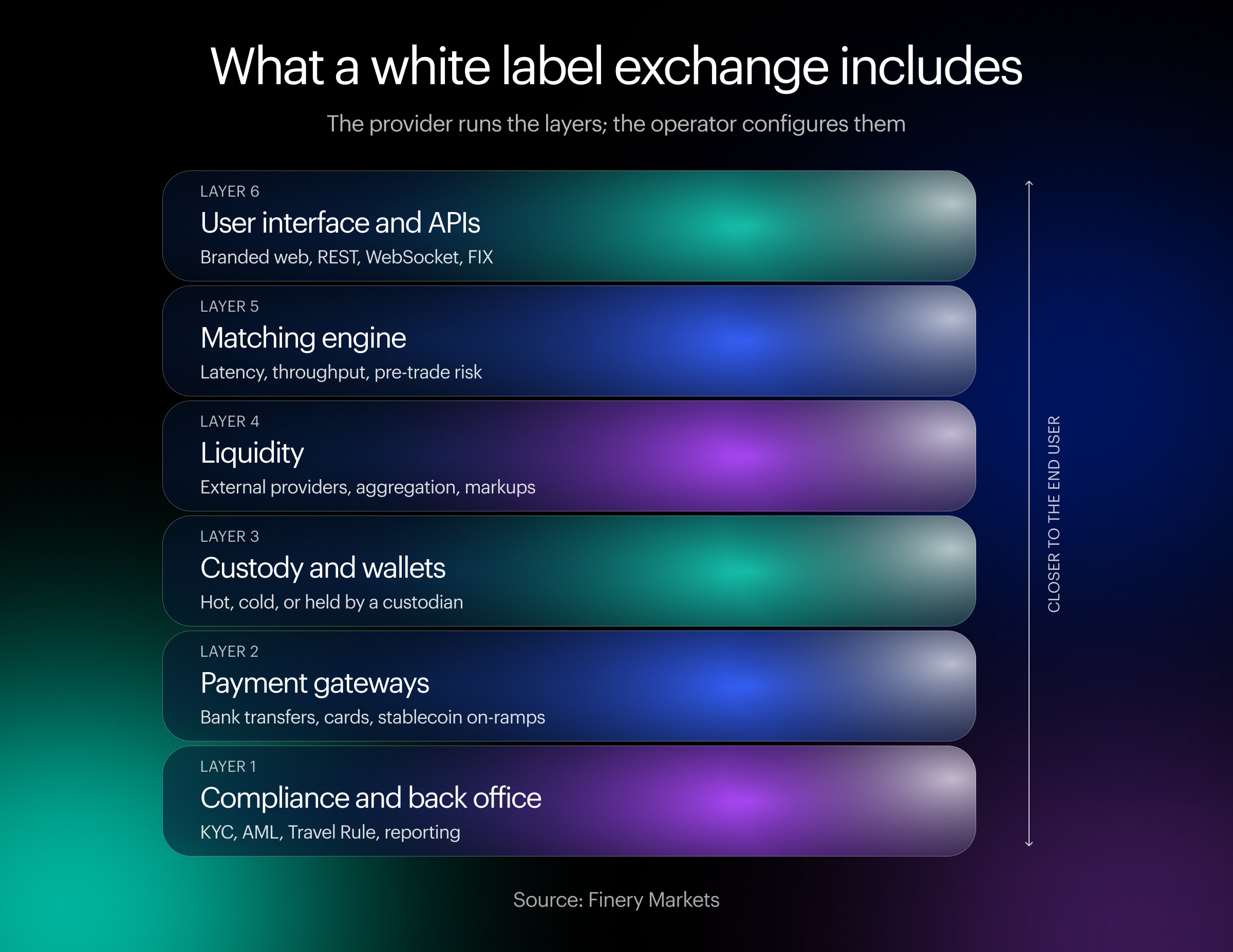
User interface and API integration
The user interface is the web and mobile front end in the operator's brand and on its domain. Institutional clients rarely use it for size. They connect through API integration, usually REST and WebSocket for retail flows and FIX for professional desks, and the quality of those APIs decides how fast clients go live.
Matching engine and trading engine
The matching engine pairs buy and sell orders and is the core of the trading engine. Latency and throughput are decided here, along with the scalable infrastructure the engine runs on. A provider should publish a measured figure for each, not a marketing range.
Liquidity management
A new exchange has no order flow of its own, so on day one its order book is empty. Liquidity integration connects the platform to external liquidity providers or other exchanges, and liquidity management decides how their prices are aggregated and marked up before they reach clients. Without high liquidity, spreads widen and clients leave, which is why this layer deserves more diligence than the interface.
Custody and wallets
Retail platforms hold user funds in hot wallets for withdrawals and keep reserves in cold wallet storage, often secured with multi signature wallets or MPC signing. B2B platforms increasingly avoid pooled custody altogether: assets stay with a qualified custodian or with each counterparty, and the platform only records positions and settlement instructions. Our article on institutional custody models compares the main key-management setups.
Payment gateways and fiat rails
Payment gateways handle bank transfers, card deposits and stablecoin on-ramps. The white label provider usually integrates them, but the operator signs the banking and payment contracts, and those relationships often take longer to secure than the software.
Compliance and back office
The back office covers user management, KYC and anti money laundering checks, transaction monitoring, Travel Rule messaging, reporting and the admin dashboard. Security measures belong here too: two factor authentication for clients, multi factor authentication for administrators, documented security protocols and regular security audits.
White label solutions vs custom cryptocurrency exchange development
The choice between buying white label software and custom development comes down to time, cost, control and who carries the maintenance.
Custom development gives complete control over the code and the roadmap. It also means hiring a team for the matching engine, wallets, security and compliance, running a development process that takes months before the first trade, then keeping that team. Torben Friis, Managing Director of the proprietary trading firm Match Liquidity, put the cost of building institutional trading infrastructure in house at "anywhere between 250,000 and a few million" in a case study with us, and added that it "comes with significant operational risks."
A white label exchange trades some of that control for faster deployment. The provider maintains the core, ships updates and carries the security testing, which is how operators save time and reach the market quickly. The operator can fine tune the platform within the provider's configuration options, but deep changes to the trading engine depend on the provider's roadmap.
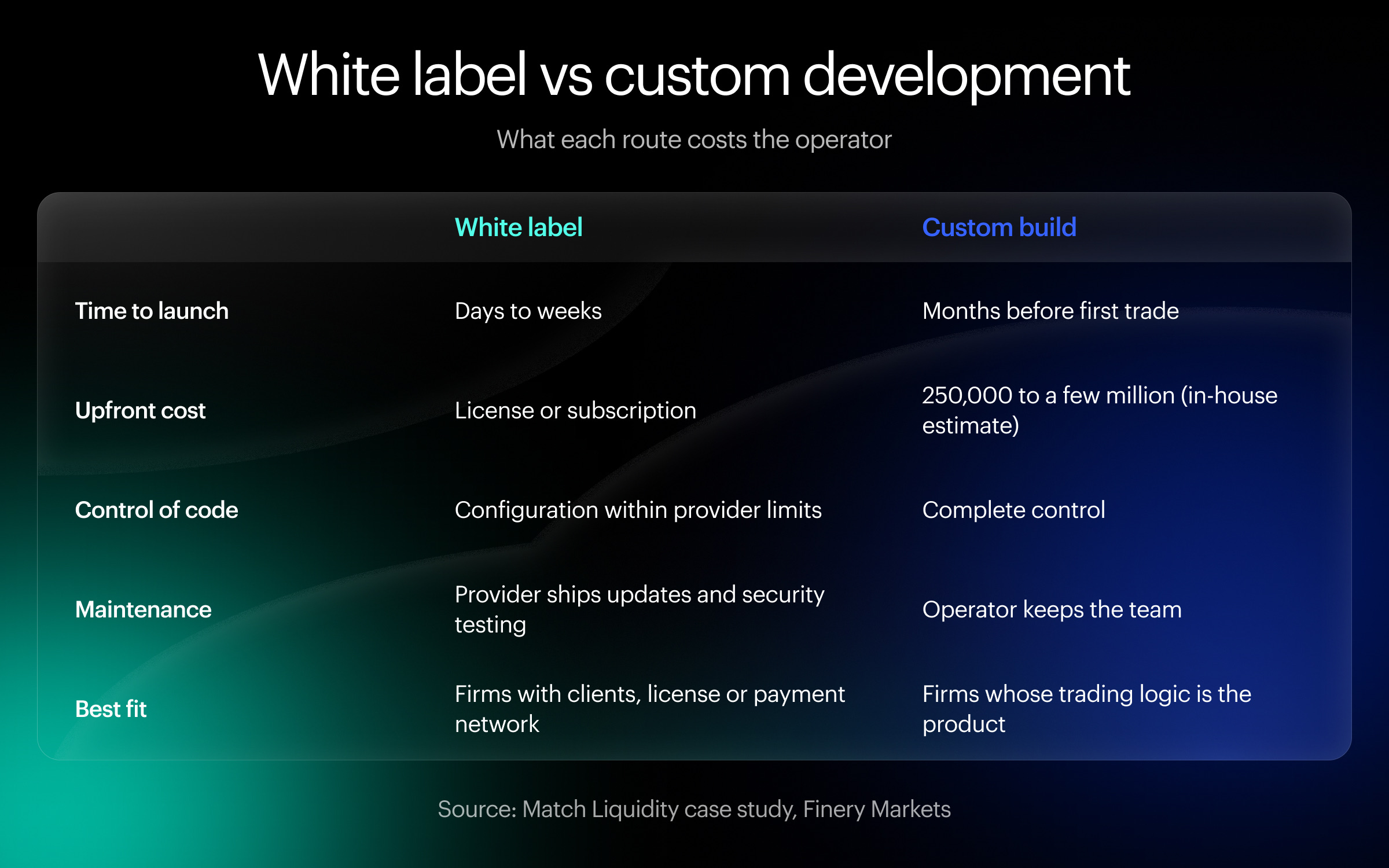
In short: custom development suits firms whose trading logic is their product and who can fund a multi-year build. White label suits firms whose advantage is distribution, a client base, a license or a payment network, and who need the venue to support that business.
How much does a white label crypto exchange cost?
There is no single price, because the development cost depends on the model and the scope. Vendors in the search results quote anything from a one-off license fee for source code to a monthly SaaS subscription with a revenue share. The figures worth comparing are the total cost over three years and what is excluded from the quote.
The main cost lines are:
- License or subscription fees, and whether the operator owns the code or rents access
- Setup and customization, including branding, trading pairs and integrations
- Liquidity costs: spreads, provider minimums and any pre-funding held on external venues
- Custody and wallet infrastructure, including insurance where required
- Licensing, legal opinions and compliance staff
- KYC, transaction monitoring and Travel Rule vendors, usually priced per check
- Hosting, ongoing support and maintenance services after launch
- Security audits and penetration tests, repeated at least yearly
Pre-funding is the line most budgets miss. A platform that hedges client trades on external exchanges must keep balances on each of them, and that capital earns nothing while it waits. Trading on credit lines with post-trade settlement reduces it, which is one reason B2B operators look at ECN-based models.
Retail exchange or B2B venue: why the model matters in 2026
The retail exchange business still earns far more per dollar traded than institutional business. Our H1 2026 earnings review found a retail take rate near 1.4% to 1.6% at both Coinbase and Gemini, against about 5 basis points on institutional flow. That margin is why so many crypto startups launched consumer exchanges, and why the crypto exchange business drew so many white label buyers.
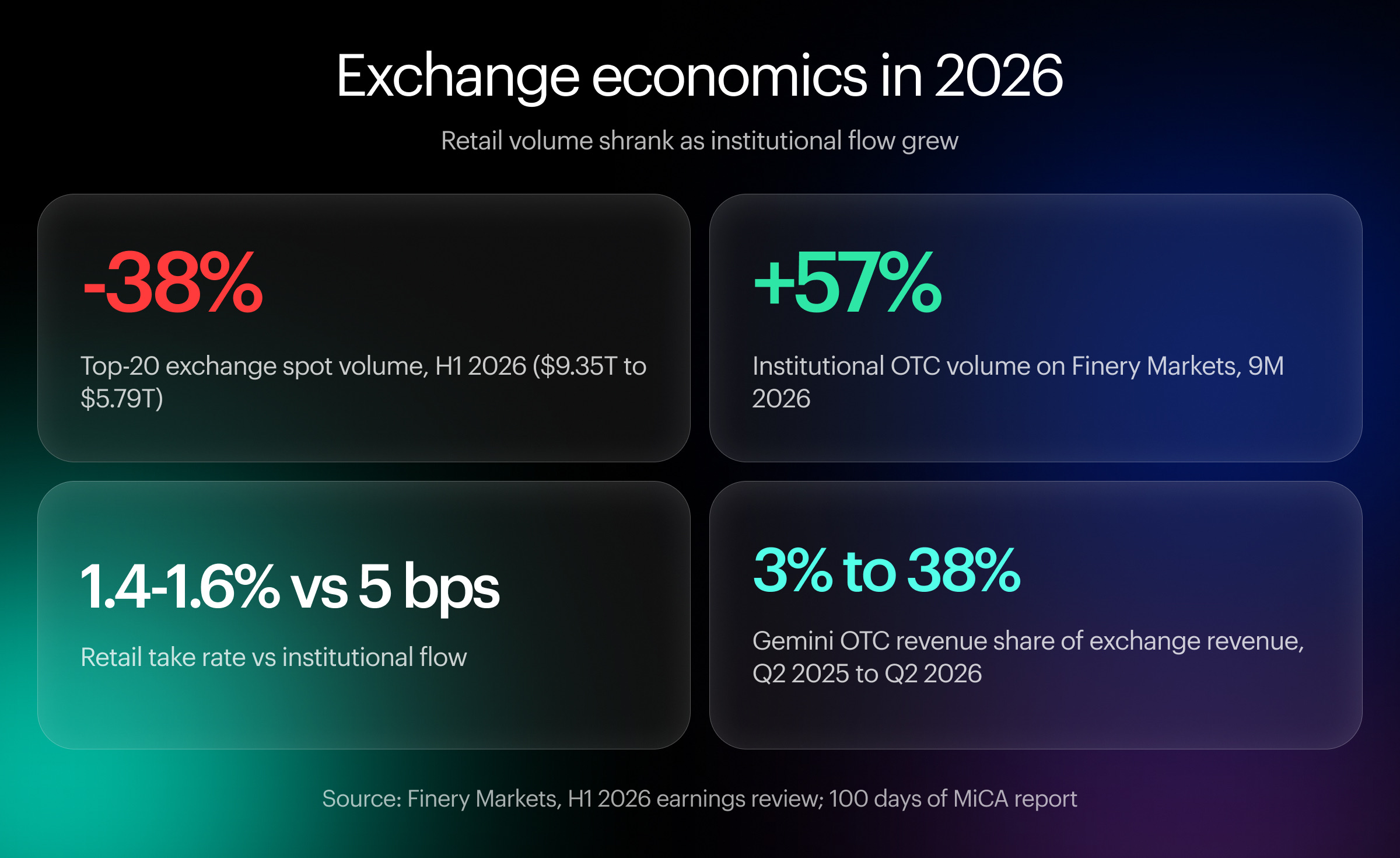
The retail volume behind that margin shrank in 2026. With top-20 exchange spot volume down 38% in the first half, the large exchanges themselves shifted toward institutional and OTC business: Gemini's OTC revenue grew from 3% to 38% of exchange revenue in a single year. A new retail exchange now competes with incumbents for a smaller pool of traders, and pays for marketing, referral programs and support to win them.
A B2B venue works the other way round. Its clients are companies that already have end customers: a payment provider converting merchant flow, a broker adding crypto pairs, a bank whose custody clients want to trade digital assets. Volume per client is higher and client acquisition costs less. The platform's value lies in liquidity and settlement rather than in a consumer app. Our guide to launching a crypto OTC desk covers that business model in detail.
The choice shapes almost every later decision. A retail exchange needs custody of user funds, card payment gateways, a mobile app and consumer protection rules. A B2B venue needs a crypto ECN or similar matching model, credit limits per counterparty, and settlement workflows that keep assets out of a pooled wallet.
Regulatory compliance for a white label exchange
Regulatory compliance is the part of a launch that software cannot shorten. In the European Union, operating a trading platform for crypto-assets is a regulated service under the Markets in Crypto-Assets Regulation (MiCA). The rules for crypto-asset service providers (CASPs) applied from December 30, 2024, and the transitional period for firms registered under national regimes ended on July 1, 2026. Our MiCA explainer covers the CASP regime and passporting across the EU.
The deadline cut the market sharply. Of the 2,747 crypto registrations under national regimes in 2024, only 280 firms appeared on ESMA's first post-deadline list, as our 100 days of MiCA report shows. Fipto told us that many firms that missed the deadline stayed in business by partnering with a licensed CASP, which contracts directly with the end client and carries the regulatory responsibility.
That gives an operator three routes: obtain its own authorization, launch under a licensed partner, or choose a model where clients trade directly with one another so the operator does not act as an intermediary. Each route changes the capital and timing of the launch, so settle it with counsel before choosing a white label provider. Outside the EU, requirements depend on the jurisdiction and the target market, and the same three questions apply.
Whatever the route, the operator remains responsible for know-your-customer and anti money laundering controls, transaction monitoring, Travel Rule data, record keeping and reporting. The platform should produce that data in a form the operator can hand to a regulator.
How to choose a white label cryptocurrency exchange provider
Most white label platforms show the same essential features in a demo. The differences show up in contracts, liquidity and operations, not in the list of trading features. These are the questions that separate them:
- Who owns the code, and what happens to the platform if the provider raises prices or shuts down?
- What is the measured latency of the matching engine, and how many orders per minute has it handled in production?
- Where does liquidity come from on day one, are prices firm or indicative, and can the operator add its own liquidity providers?
- Does the platform hold client assets, and if so, under which custody arrangement?
- Which compliance modules are included, and which require separate vendors?
- What uptime is published, and is there a public status page?
- Which security features, certifications and penetration tests can the provider show, and how recent are they?
- Is there a test environment with realistic market conditions before launch?
- Are there fixed-term commitments, exit fees or data export limits?
Liquidity deserves the most attention. A platform that streams indicative prices may reject or requote orders when markets move, which our article on last look execution explains in detail. For a B2B venue, firm executable prices and per-counterparty credit limits outweigh the number of supported tokens.
Custody is the second test. Holding client assets is where an exchange concentrates risk, and our analysis of counterparty risk after recent breaches shows how post-trade settlement and non-custodial models limit that exposure.
Running a B2B venue under your own brand
A payment provider or broker that wants its own venue usually has the clients and the license. What it lacks is the liquidity network and the post-trade tooling, which take years to build and are hard to run alongside a core business.
FM White Label is our answer to that gap. It gives an operator a branded web interface and its own API endpoints (WebSocket, REST and FIX 4.4) on its own domain, connected to aggregated liquidity from the institutional providers on our network. The operator runs a master account and opens sub-accounts for its clients. Each sub-account has its own balance, positions, trading history and risk limits, and settles with the master account. The operator sets markups by client and by asset pair, can trade on behalf of clients and hedge automatically, and can resell external liquidity, build its own pool or internalize client flow.
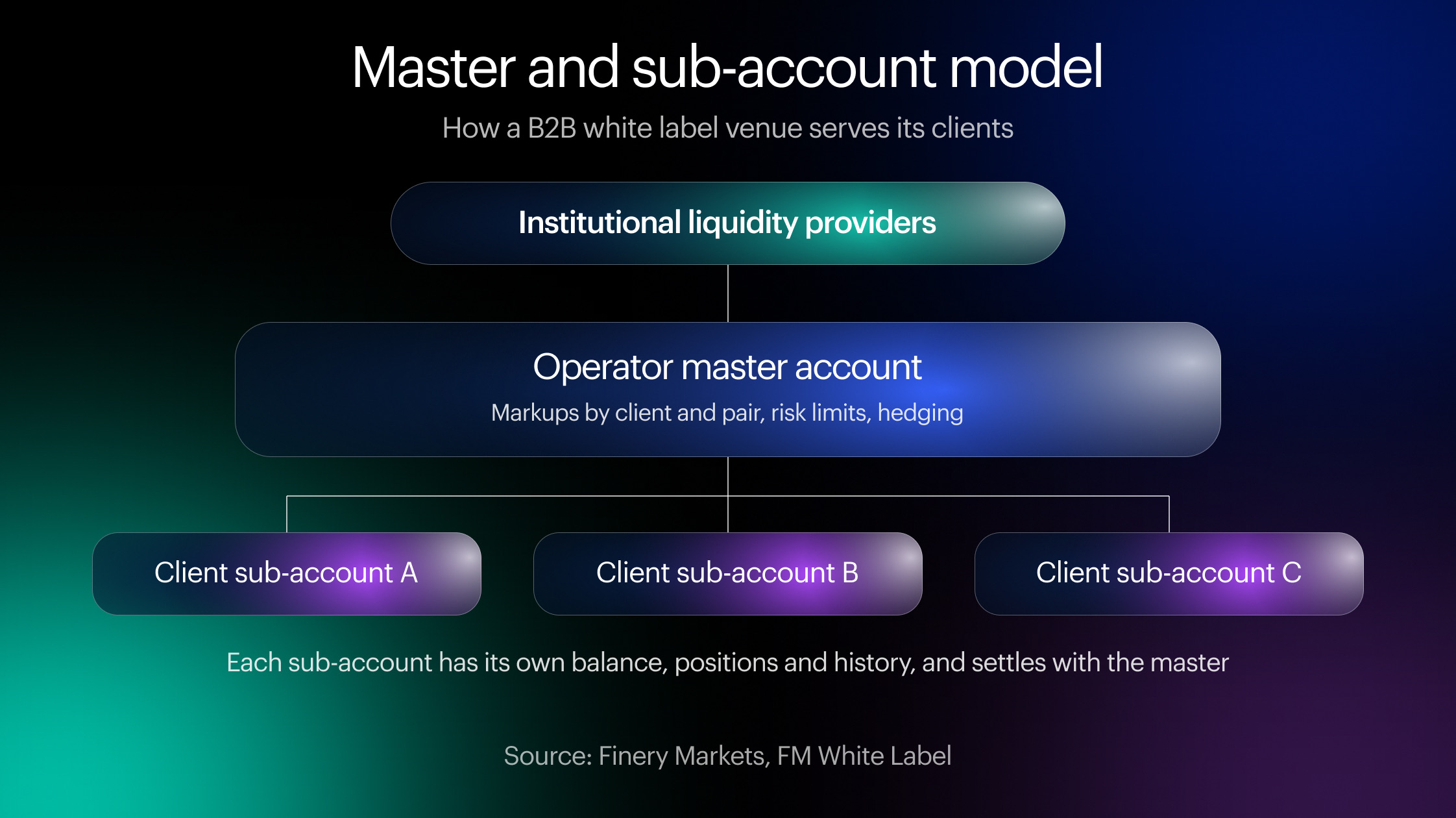
The infrastructure behind it runs on AWS with 99.99% uptime, a sub-1 millisecond matching engine with pre-trade risk checks, and capacity for more than 2 million orders per minute. Our platform is SOC 2 Type 1 and Type 2 certified, and operators get a demo environment for their clients before going live. A branded B2B trading platform can launch in under a week, with no fixed-term obligations.
We are a non-custodial technology provider. We do not hold client assets, act as a counterparty or replace the operator's license, custodian or bank.
Risks and limitations of the white label model
A white label exchange shortens the build, not the business. The main risks sit outside the software.
- Vendor dependency: the operator's product roadmap is tied to the provider's, and migrating later is expensive.
- Thin differentiation: many retail platforms run on the same few code bases, so the brand and the liquidity become the only differences.
- Liquidity risk: mirrored order books from a single exchange can fail when that exchange halts or reprices during volatility.
- Custody risk: holding user funds, even mostly in cold storage, concentrates operational and security risk on the operator, whoever wrote the wallet code.
- Regulatory risk: authorization timelines can outlast the technical launch by months, and a platform that goes live first operates outside the rules.
Due diligence on the provider should therefore cover its finances and its incident history, not only the feature list.
Outlook: from exchange software to market infrastructure
Three trends in the crypto industry will shape demand for white label platforms through 2027. Regulation now sorts operators by authorization, so platforms that produce audit trails and regulatory reports out of the box will win buyers in the EU and in jurisdictions that follow its model. Stablecoins carry most institutional flow: they accounted for 83% of trades by number on our platform in the first nine months of 2026, which makes stablecoin pairs and fiat corridors core requirements. And incumbent exchanges are moving into institutional and OTC business themselves, which raises the bar for anyone entering it.
The firms that come through this cycle will treat the exchange as a distribution channel for liquidity they can stand behind. A branded interface takes a week to launch. The credit lines, liquidity relationships and settlement discipline behind it decide whether clients trade on it a year later.
FAQ
What is a white label crypto exchange?
A white label crypto exchange is trading software built by one company and run under another company's brand. The provider supplies the matching engine, interface, wallet connections and back office. The operator brings the clients, the license, banking partners and liquidity relationships, and remains responsible for regulatory compliance.
How much does it cost to launch a white label crypto exchange?
It depends on the model. Quotes range from one-off source code licenses to monthly subscriptions with revenue sharing. Total cost also includes liquidity, custody, licensing, compliance vendors, hosting and audits. Building institutional infrastructure in house was put at 250,000 to a few million by one trading firm.
How long does it take to launch a white label exchange?
The software can go live in days or weeks. Some B2B platforms launch a branded venue in under a week. Licensing, banking partners and liquidity agreements usually take longer, so the realistic timeline is set by authorization and contracts rather than by the technology.
Do I need a license to run a white label crypto exchange?
Usually, yes. In the EU, operating a crypto trading platform requires MiCA authorization as a CASP, and the transitional period ended on July 1, 2026. Some operators launch under a licensed partner instead. Requirements outside the EU depend on the jurisdiction.
Is a white label exchange better than building from scratch?
For most firms whose advantage is distribution, yes. White label software costs less and launches faster. Custom development makes sense when the trading engine itself is the product and the firm can fund and staff a long build and its maintenance.
Why is liquidity important for a new crypto exchange?
A new exchange starts with an empty order book. Without connected liquidity providers, spreads are wide, large orders move the price, and clients leave. Firm prices from several providers, aggregated into one order book, give clients predictable execution from the first trade.
Can a white label crypto exchange be non-custodial?
Yes, particularly in B2B models. Assets can stay with a qualified custodian or with each counterparty, while the platform records trades, positions and settlement instructions. This reduces the concentration of risk that comes with pooled exchange wallets.


 LinkedIn
 Youtube
 Medium
 Twitter