Regulated spot Bitcoin ETFs have pulled tens of billions of dollars into products that depend on institutional digital asset custody, and 2026 became the year global banks moved in. Citi confirmed plans to launch native Bitcoin custody for institutions before year-end, and Standard Chartered became the first Global Systemically Important Bank (G SIB) to power institutional crypto custody in Hong Kong. Custody has shifted from a back-office concern to core market infrastructure.
Institutional crypto custody is the specialized, high-security safekeeping of digital assets for financial institutions, funds, and corporations, built around secure private key management, regulatory compliance, and governance rather than a single wallet app. An institutional crypto custody provider holds and protects the private keys that control client assets, segregates those holdings from its own balance sheet, and operates under strict security measures and audits.
This guide covers what institutional digital asset custody means, how digital asset custody works, the custody models, the security and regulatory framework, how custody integrates with trading and operations, and how to choose a qualified custodian across the digital asset landscape.
What Institutional Crypto Custody Means
Institutional crypto custody refers to specialized, high-security digital asset storage services for organizations that cannot rely on consumer wallets. Where an individual holds a seed phrase on a device, financial institutions must safeguard client assets at scale, prove control to auditors, and split duties across multiple employees. This form of custody is integral to the lifecycle of digital assets in financial markets, applying the rigor used for traditional assets.
Institutional custodians act as qualified third-party financial intermediaries for cryptocurrency. A crypto custodian manages the cryptographic keys that authorize movement of digital assets on a blockchain, controls who can approve transactions, and provides insurance and regulatory standing that individual investors and asset managers cannot easily build in-house.
What Does Cryptocurrency Custody Mean?
Cryptocurrency custody means holding and protecting the private keys that control on-chain assets, not the assets themselves. On a blockchain, whoever controls the private keys controls the funds, and losing those keys means losing the cryptocurrency assets permanently, because blockchain transactions cannot be reversed. Custody services therefore center on private key management: generating, storing, and using multiple private keys in ways that prevent private key exposure while still allowing legitimate transactions. Securing digital assets is fundamentally about key management, not physical storage.
Qualified vs Non-Qualified Custodians
A key distinction runs through institutional custody: qualified versus non-qualified custodians. A qualified custodian is a regulated entity — a bank, trust company, or registered broker-dealer — that meets specific legal standards for holding client assets, including segregation and reporting.
Under the SEC framework, registered investment advisers are generally required to place client assets with a qualified custodian, which is why the label matters for regulated funds. A non-qualified custodian may offer strong technology and security but lacks that regulatory standing, leaving certain institutional investors unable to use it for regulated mandates. For an asset manager, choosing between the two is less about features than about whether the custody arrangement satisfies its own compliance obligations.
Why Institutional Crypto Custody Matters Now
Institutional adoption has moved from experimentation to operational scale, and custody is the foundation. Asset managers, hedge funds, family offices, and corporate treasurers cannot hold digital assets without a custody model that satisfies compliance, accounting, and risk management teams. The FBI reported $9.3 billion in cryptocurrency fraud losses in 2024, a reminder that operational failures expose assets to theft or loss and that advanced security measures are not optional.
Regulation has been the accelerant. In January 2025 the SEC rescinded SAB 121, the accounting guidance that had forced institutions to record custodied crypto as a balance-sheet liability and effectively kept most banks out of the market. Removing that barrier reopened digital asset custody to regulated banks almost overnight. Since 2025, at least fifteen digital asset firms have applied for U.S. national trust bank charters, and major banks have expanded custody offerings. Institutional investors no longer want to manage digital assets in isolation, and secure custody has become the gateway to the digital asset space, from ETFs to stablecoin settlement.
How Institutional Digital Asset Custody Works
Institutional digital asset custody combines technical security, operational controls, and governance to safeguard client assets against attackers, collusion, and error while keeping assets usable. Institutional custody helps prevent fraud or loss of assets by managing private keys securely and requiring multiple parties to approve transactions. Most institutional crypto custodians layer several of the technologies below, not any single method.
The Storage Spectrum: Hot, Warm, and Cold Wallets
Custodians do not store all assets the same way. They tier holdings across a spectrum from hot to cold, trading access against security. Hot wallets stay online for instant execution and daily settlement, but their connectivity is also the largest attack surface. Warm wallets sit on private or restricted networks, releasing funds in minutes to hours for rebalancing and scheduled settlement. Cold storage keeps private keys completely offline and air-gapped, the highest-security tier used for long-term holdings. Leading digital asset custody solutions keep roughly 90% of assets offline in cold storage, with a smaller share in warm or hot wallets for active trading. This tiered approach to secure storage remains the baseline for securing digital assets at institutional scale.
Hardware Security Modules
Hardware security modules are tamper-resistant devices that generate and store cryptographic keys inside a sealed environment. Hardware security modules store cryptographic keys securely, so keys are never exposed in plain form even to the operators running the system, giving a custodian auditable protection for its most sensitive material. HSMs are certified to recognized standards and form the physical root of trust beneath a custody stack.
Multi-Party Computation
Multi-party computation has become a defining technology for institutional cryptocurrency custody. It splits keys into multiple shares held by different parties, so a full private key is never assembled in one place; the parties jointly compute a signature to sign transactions without seeing the complete key. Because multi-party computation can eliminate single points of failure without creating a new address whenever approval rules change, many crypto custody providers treat it as core to their key stack. MPC also lets custodians adjust approval thresholds dynamically, which multi-signature schemes cannot do without migrating funds to new addresses.
Multi-Signature Wallets
Multi-signature wallets require multiple approvals for transactions before assets can move. Rather than one key, several private keys must sign, and a defined threshold is needed to authorize a transfer. Multi-signature wallets require multiple keys for transaction approval, spreading control across multiple parties so no single person can move client funds alone. Multi-sig is transparent and enforced on-chain, but it is blockchain-specific and less flexible than MPC, which is why many custodians combine the two with HSMs and cold storage in a layered design.
The Pillars of Custody Security
Technology alone does not make custody safe. Institutional-grade security is a defense-in-depth system: several independent layers, so that defeating one does not compromise the assets. These pillars are what separate a custody provider from a well-configured wallet.
Air-Gapping and Defense in Depth
Air-gapped systems physically isolate the deepest cold storage from any network, so keys that never touch an internet-connected machine cannot be reached remotely. Around that core, custodians layer HSMs, MPC or multi-signature signing, network segmentation, and continuous monitoring. Defense in depth assumes any single control can fail and ensures the next layer still holds, which is the security posture institutional investors expect before entrusting client assets.
Operational Controls: Approvals, Whitelisting, and Time-Locks
Governance and multi-user workflows are critical for institutional crypto custody transactions. Custodians enforce m-of-n approval policies — for example, three of five authorized officers must sign before a withdrawal executes — so no individual can move funds alone. Address whitelisting restricts transfers to pre-approved destinations, blunting the impact of a compromised account. Time-locked withdrawals impose a mandatory delay between a request and its execution, creating a detection window in which a fraudulent transfer can be caught and cancelled. Role-based permissions, transaction limits, and approval hierarchies map these controls to a firm's internal financial controls, letting multiple employees take part in transferring assets while ensuring no one can unilaterally sign transactions.
SOC Attestations and Independent Audits
On the verification side, SOC 1 Type II and SOC 2 Type II certifications verify custodians' controls through independent audits. SOC 1 addresses controls relevant to financial reporting, while SOC 2 covers security, availability, processing integrity, confidentiality, and privacy. A Type II report tests that those controls operated effectively over a period of time, not just on one date, which is why SOC 2 Type II certification has become a baseline expectation for any institutional crypto custody provider. Penetration test results and, increasingly, proof-of-reserves attestations round out the independent evidence a serious buyer reviews.
Disaster Recovery and Key Ceremonies
Security also means surviving failure. Institutional custodians run formal key-generation ceremonies with recorded procedures and multiple witnesses, and they maintain disaster-recovery plans so that keys and access can be reconstituted if a data center, device, or key shard is lost. Geographically distributed key shares, backup signing quorums, and tested recovery runbooks are what keep an operational failure from becoming an irreversible loss of client assets — a dimension many buyers overlook until it matters.
Custody Models: Self Custody, Hybrid, and Full Custody
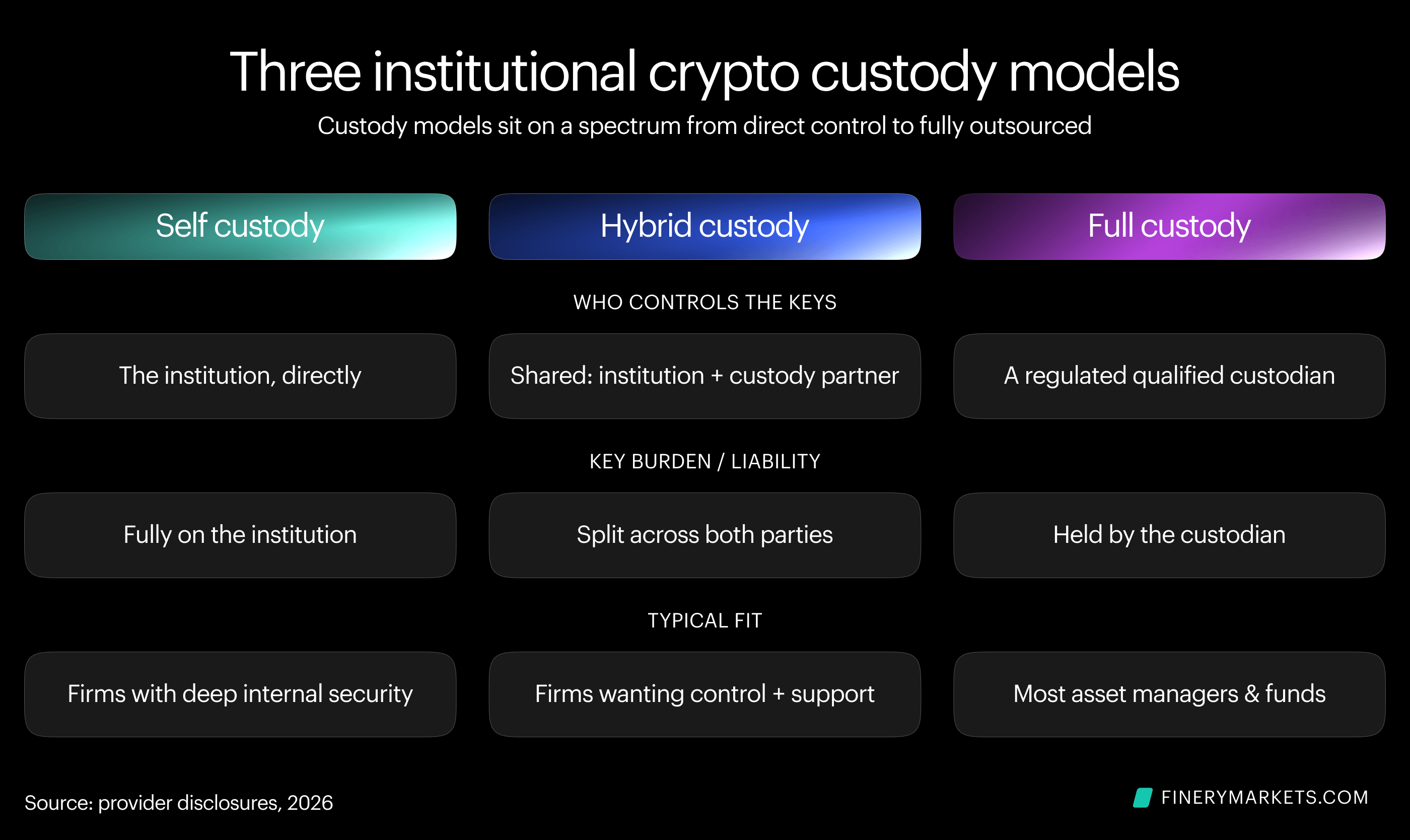
Institutions choose among custody models based on control, liability, regulatory requirements, and internal capacity, on a spectrum from direct control to fully outsourced.
Self Custody
Self custody means institutions control their private keys directly. Under a self custody model, the firm holds the cryptographic keys and takes direct control of its crypto assets, using its own hardware security modules, cold storage, and governance. Self custody offers maximum control, but places the full burden of security, recovery, and key management on the institution. Loss of private keys under self custody can lead to irreversible asset loss, so this model demands serious internal security infrastructure.
Hybrid Custody
Hybrid custody shares key control between custodians and asset managers. Multiple private keys are distributed so neither the institution nor the custody partner can move assets alone. Hybrid custody appeals to firms that want to reduce counterparty risk and retain influence over transactions while still using a custodian's technology, insurance, and regulatory standing.
Full Custody
Full custody is managed entirely by a regulated custodian that holds the keys, manages transactions, and takes responsibility for safeguarding client assets. It is the model most asset managers and financial institutions choose, because a qualified custodian provides compliance coverage, audits, insurance, and bankruptcy protection costly to build in-house. Full custody lets custody integrate with traditional financial infrastructure, so firms can treat digital assets more like traditional financial assets.
Provider Categories: Exchanges, Banks, and Custody Technology
The providers behind these models fall into three broad groups. Exchange-affiliated custodians grew out of trading venues and offer deep asset coverage and connectivity. Regulated banks and trust companies — now including global names such as BNY, Anchorage Digital, Citi, and Standard Chartered — bring balance-sheet strength and familiar regulatory standing. Custody technology providers such as Fireblocks supply the infrastructure that lets institutions run self or hybrid custody while keeping direct control of keys. Many institutions use more than one, matching each asset and mandate to the model and provider that fit.
Qualified Custodians and Regulatory Compliance
Regulatory compliance is crucial for the operational viability of digital asset strategies. Institutional custodians operate under strict regulatory frameworks ensuring compliance with laws. Regulatory compliance failures can result in significant penalties, and regulatory standing is often the first thing a professional counterparty checks before entrusting client funds to a crypto custodian.
The Qualified Custodian Standard
A qualified custodian is a regulated institution that meets defined standards for holding client assets, and qualified custodians must meet SEC standards for asset management under the Investment Advisers Act. The SEC Custody Rule requires registered investment advisers to hold client assets with a qualified custodian, and custodians must segregate client assets from their own under these regulations. That segregation is what makes customer assets bankruptcy-remote if the custodian fails.
Charters, Licenses, and Trust Companies
In the United States, digital asset custody providers operate as OCC-chartered national trust banks, as a federally chartered crypto bank such as Anchorage Digital, or as state chartered trust companies overseen by New York's DFS. State chartered trust companies and NYDFS regulatory licenses such as the BitLicense remain a common route to regulated custody services. In Europe, MiCA now mandates legal segregation and bankruptcy remoteness for client holdings, giving cross-border institutional investors a clearer framework than existed even a year ago.
KYC, AML, and Certifications
Custodians must perform KYC and AML checks on all clients, and these checks are mandatory for all crypto custodians. Anti-money-laundering monitoring increasingly relies on blockchain analytics to screen deposits and withdrawals for illicit activity. On the security side, SOC 1 Type II and SOC 2 Type II certifications verify custodians' controls through independent audits, a baseline expectation for any institutional crypto custody provider.
Asset Segregation: Omnibus vs Segregated Accounts
How a custodian holds client assets matters as much as whether it is regulated. In an omnibus model, client holdings are pooled in shared wallets and tracked on the custodian's internal ledger, which is efficient but relies on the provider's records. In a segregated model, each client's assets sit in dedicated wallets, giving cleaner on-chain proof of ownership and simpler treatment if the custody provider fails. Segregation is what makes customer assets bankruptcy-remote, keeping them off the custodian's own balance sheet so they are not treated as company property in insolvency. For many institutional investors, the segregation model is a gating question, not a detail.
Insurance Coverage and Asset Segregation
Insurance is essential for institutional investors in digital assets, and crypto custody providers feature robust insurance policies to cover potential losses. Policies may cover theft, internal collusion, and administrative errors, though scope and limits vary widely, and coverage for hot-wallet assets often differs from cold storage.
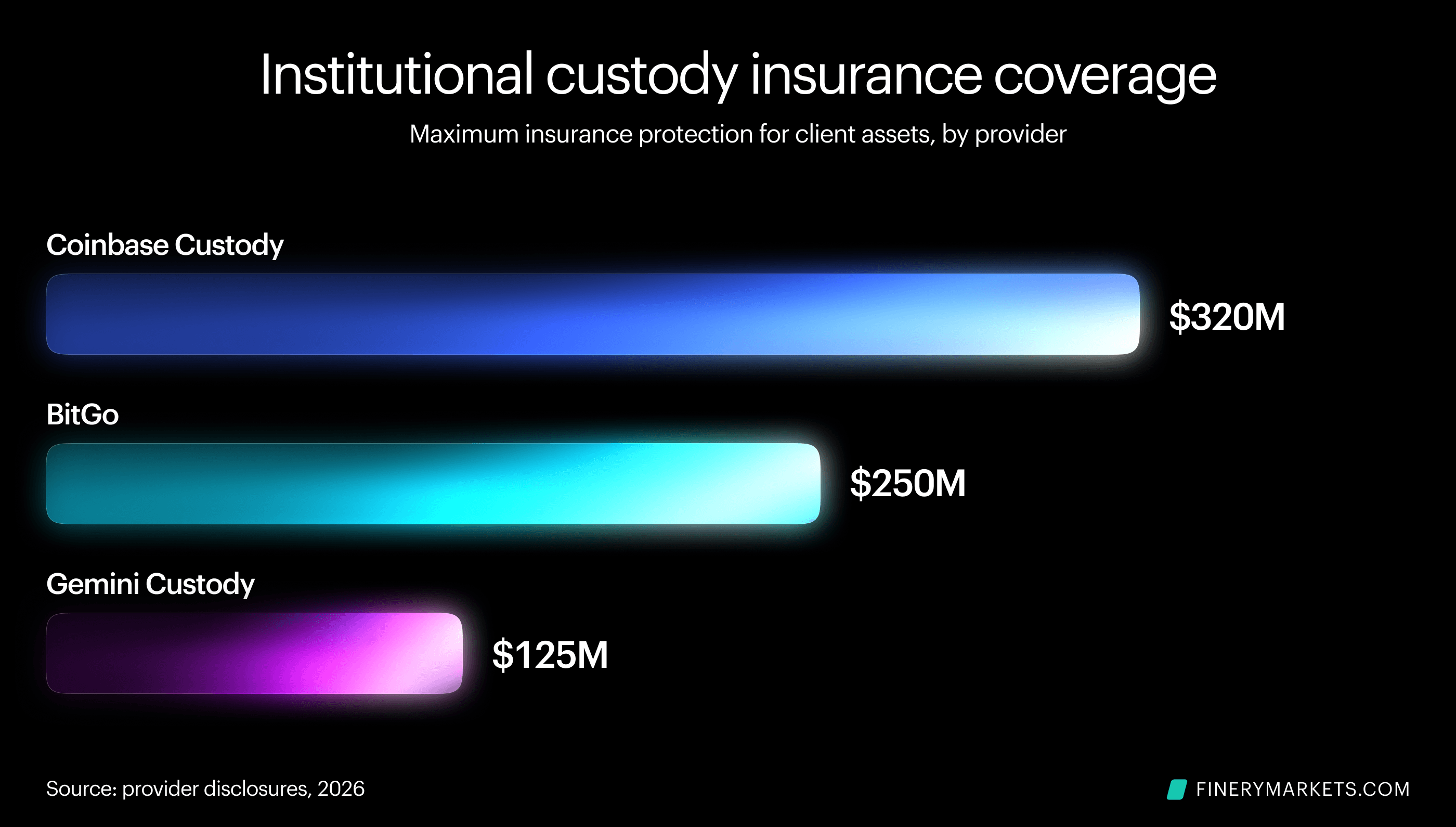
BitGo maintains up to $250 million in insurance coverage, and Coinbase Custody offers a $320 million insurance policy for client funds, but cover is only part of the picture. Buyers should read the underwriter, policy limits, and any co-insurance closely rather than assume full protection, and pair insurance with the asset segregation that keeps client funds recoverable if the provider becomes insolvent.
Integrating Custody into Operations
Custody does not sit in isolation. For an institutional business, its value depends on how cleanly it connects to the rest of the operation — trading, treasury, accounting, and reporting. This is where many custody projects succeed or stall.
Connecting Custody to Trading, Treasury, and Reporting
APIs are the connective tissue. Through them, custody links to execution venues so assets can be traded, to portfolio and treasury management systems for a real-time view of holdings, and to accounting and reconciliation tools that keep the books accurate. A payment provider or fund needs custody that reports positions, produces an audit trail, and reconciles automatically, not a vault that has to be queried by hand. The quality of these integrations — uptime, latency, completeness of reporting — often matters more day to day than the underlying key-management technology.
Putting Custodied Assets to Work: Staking, Yield, and DeFi
Custodied assets need not sit idle. Many institutional custodians let clients stake proof-of-stake assets, access yield, or interact with vetted DeFi protocols from within the custody environment, so assets earn without leaving secure storage. These features widen what a treasury or fund can do, but they add smart-contract and counterparty risk, and reward mechanics can obscure where yield actually comes from — so they belong inside the same governance and risk controls as any other transaction.
Real-World Workflows
In practice, custody underpins concrete workflows: a corporate treasury holding Bitcoin on its balance sheet, a fund managing tokenized securities and real world assets, a payment provider settling stablecoin flows, or an OTC desk moving between fiat and digital assets. Each needs custody that fits its existing operations rather than a standalone silo, which is why integration and workflow support have become central to how institutions evaluate providers.
Custody in the Stablecoin Economy
Custody is central to how stablecoins function. Issuers depend on custodians and regulated banks to hold the fiat and short-term reserves that back tokens, to support issuance and redemption, and to provide the attestations that prove reserves exist. Secure treasury management underneath a stablecoin is what keeps its peg credible. As stablecoins move deeper into payments and settlement, the custody and reserve layer becomes systemically important, and the line between custody, reserve management, and settlement continues to blur, a shift that matters directly to payment providers, EMIs, and issuers building on stablecoin rails.
Can I Lose My Crypto With a Custodian?
Yes, loss is possible, which is why the choice of custody provider matters. Custodians face insolvency and internal breaches, and operational failures can expose assets to theft or loss. The collapses of FTX, Celsius, and BlockFi showed how weak custody terms and commingled client funds devastate institutional claims. Loss of private keys can lead to irreversible asset loss, and even well-run custodians carry operational risk and counterparty risk. Where a custodian relies on a sub-custodian for certain assets or jurisdictions, that dependency adds another layer of counterparty risk to assess.
The mitigations are why the model exists: asset segregation, insurance, third-party audits, qualified custodian status, and strong governance all reduce the probability and impact of loss. A custody provider that segregates client funds, maintains SOC 2 Type II controls, carries meaningful insurance, and undergoes regular independent audits offers materially better protection than self custody without institutional-grade infrastructure.
How to Choose an Institutional Crypto Custody Provider
Which institutional custody provider is best for crypto depends on the institution, not a single ranking. The right custody partner for a stablecoin issuer differs from one for a hedge fund or a payment provider. Evaluate crypto custody providers against criteria that map to your own operational and regulatory needs, across three dimensions.
Security and technology: key-management architecture across cold storage, HSMs, MPC, and multi-signature wallets; the cold-to-hot allocation; air-gapping; SOC 1 and SOC 2 reports; and penetration-test results.
Regulatory and compliance: qualified custodian status and charter type; licenses in the jurisdictions you operate in; and auditable KYC and AML programs backed by blockchain analytics.
Operational and financial stability: insurance scope and asset segregation; SLAs and transaction processing times; API reliability and uptime; balance-sheet transparency; sub-custodian arrangements; and how well its custody solutions connect to trading, settlement, and reporting.
A short checklist to take into provider conversations:
-
Is the provider a qualified custodian, and under which charter or license?
-
Are client assets segregated and bankruptcy-remote, or held omnibus?
-
What share of assets sits in cold storage, and how are approvals and withdrawals controlled?
-
What do the SOC 2 Type II report and latest penetration test show?
-
What exactly does the insurance policy cover, and up to what limit?
-
How does custody connect to your trading, treasury, and reporting systems?
A provider that safeguards client funds well but cannot connect to execution venues can still leave a gap in your operations. The 2026 landscape is broad: established digital asset custodians such as BitGo, Coinbase, Fireblocks, Fidelity Digital Assets, Gemini, Anchorage Digital, and Sygnum now compete with global banks. Citi is launching Bitcoin custody for institutions before year-end 2026, folding digital asset custody into the same account structure as traditional securities, and Standard Chartered launched Hong Kong's first G-SIB institutional crypto custody service. This convergence of institutional cryptocurrency custodians and regulated banks widens choice and raises the security baseline.
Unlocking Future Value: Connecting Custody to Trading
Custody solves safekeeping, not execution. Institutional participants increasingly need custody that connects to trading, liquidity, and settlement, because holding digital assets securely is only valuable if those assets can also be traded efficiently. The Financial Stability Board's 2025 review found significant gaps in how these workflows fit together, and fragmentation between custody and execution is a real operational cost.
To let client assets trade without leaving custody, custody providers and their clients need a non-custodial trading layer that connects to institutional liquidity without requiring assets to be pre-funded or moved off-platform. This is the layer Finery Markets provides. Our institutional digital asset trading infrastructure connects liquidity takers and liquidity makers through RFQ, order book, and quote-stream execution.
For a crypto custodian, this means white-label trading infrastructure can be added on top of existing custody services, letting clients trade assets already held in custody under the custodian's own brand. Assets stay within the custodian's ecosystem, reducing asset movements to external venues, while the custodian connects its chosen liquidity providers and adds a new revenue stream. Because the layer is non-custodial and roles are segregated, technology and trading stay separate. Custody keeps the assets safe; the trading layer makes them useful and expands the custodian's digital asset services.
The Future of Institutional Digital Asset Custody
Custody offerings will keep converging with traditional finance as more banks treat digital asset custody as a standard service rather than an experiment, while frameworks such as MiCA and evolving U.S. charters define what secure custody and a qualified custodian look like. The line between custody, execution, and settlement will keep blurring, because institutions want operational efficiency across the full lifecycle of their crypto assets. As real world assets and stablecoins move on-chain, demand for custody solutions that span multiple asset types under one governance model will grow, and the winning institutional crypto custodians will pair advanced security measures with the operational integrations they need to manage digital assets end to end.
Frequently Asked Questions
What does institutional custody mean?
Institutional custody means the regulated safekeeping of digital assets for financial institutions, funds, and corporations. An institutional custodian secures the private keys that control client assets, enforces multi-user governance, and operates under regulatory compliance, insurance, and audits that individual investors cannot easily replicate.
What does cryptocurrency custody mean?
Cryptocurrency custody means holding and protecting the private keys that control crypto assets on a blockchain, not storing physical coins. Because control of the private keys equals control of the funds, securing digital assets relies on secure key management using cold storage, HSMs, multi-party computation, and multi-signature approvals.
What is the difference between a qualified and non-qualified custodian?
A qualified custodian is a regulated entity — a bank, trust company, or broker-dealer — that meets legal standards for holding client assets, including segregation and reporting, and is required for many regulated investment funds. A non-qualified custodian may offer strong security and technology but lacks that regulatory standing, so certain institutions cannot use it for regulated mandates.
Can I put custodied crypto to work through staking or DeFi?
Often, yes. Many institutional custodians let clients stake proof-of-stake assets or access yield and vetted DeFi protocols from within the custody environment, so assets earn without leaving secure storage. These features add smart-contract and counterparty risk, so they should sit inside the same governance and risk controls as any other transaction.
Can I lose my crypto with a custodian?
Yes. Custodians face insolvency, internal breaches, and operational failures, and loss of private keys can be irreversible. But a qualified custodian that segregates client assets, carries insurance, maintains SOC 2 Type II controls, and undergoes independent audits significantly reduces that risk versus self custody or an unregulated venue.
Which institutional custody provider is best for crypto?
There is no single best crypto custody provider. The right choice depends on your regulatory jurisdiction, asset coverage, security requirements, insurance expectations, and how well the custody solution integrates with trading and settlement. Providers such as BitGo, Coinbase, Fireblocks, Anchorage Digital, and Fidelity, and increasingly banks like Citi and Standard Chartered, suit different profiles.







 LinkedIn
 Youtube
 Medium
 Twitter