A brief on crypto firms' H1 2026 earnings by Sergey Klinkov, Managing Director at Finery Markets
Highlights
-
Crypto went through a shutdown cycle. More than 100 firms declared bankruptcy or paused operations, and top-20 exchange volume fell 38% YoY.
-
The longer-term bet across the industry is a pivot from "crypto as an asset class" to market infrastructure: real-world-asset tokenization, stablecoins, and AI agentic payments.
-
Non-transaction revenue now makes up the majority of income at several platforms, 61% at Gemini and 60% at Payward (Kraken's parent company), and a near-majority at Coinbase (48%), driven largely by interest income on cash reserves.
-
High-margin retail trading, with a take rate near 1.4% to 1.6% at both Coinbase and Gemini, continues to fund exchange operating costs, while institutional flows yield about 5 bps.
-
Institutional and OTC flow is the fastest-growing counterweight to a shrinking retail base: Gemini's OTC revenue grew from 3% to 38% of exchange revenue in a single year, and Coinbase's institutional transaction revenue rose from 8% to a 2026 peak near 19% of the total.
The wave of IPOs and pre-IPOs introduced crypto to the routine of financial reporting. For the first time, market data was joined by the financial disclosures and earnings calls of firms across the exchange, custody, and tokenization businesses.
That opened a window into how industry leaders are rebuilding their growth models, in their own numbers.
The shutdown cycle
Every CEX shared the same growth model over the past decade: capitalize on a retail base that hunted fast rich opportunities. By the end of the latest cycle, the idea had curdled into farce, and the memecoin season was its manifesto. Exchanges appear to have hit the classic “greater-fool problem”.
Crypto exchange closures and staff cuts have been recurring headlines in 2026. More than 100 crypto projects declared bankruptcy or paused operations in the first half of of the year. BitMEX and BitMart are the latest. Layoffs at Coinbase, Bitwise, and BitGo point to firms rightsizing for the new market reality.
Data shows top-20 exchange spot volume fell from $9.35 trillion to $5.79 trillion in H1’26, a 38% decline year over year.
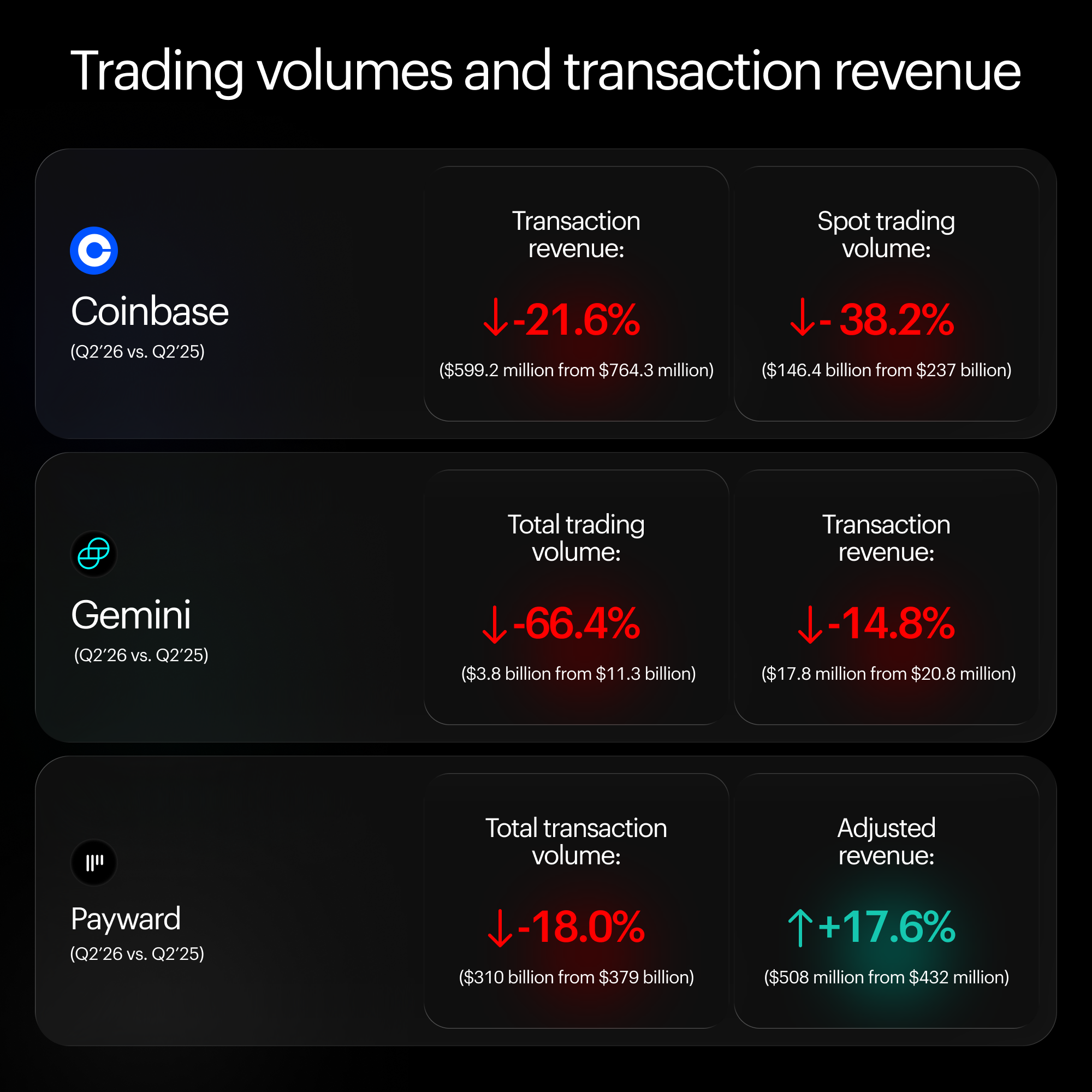
Corporate disclosures reflect this (Q2’26 vs Q2’25, see full data in the spreadsheet):
-
Coinbase: transaction revenue fell 21.6% year over year to $599.2 million, spot trading volume dropped 38.2% to $146.4 billion.
-
Gemini: total trading volume collapsed 66.4% year over year to $3.8 billion and transaction revenue fell 14.8% to $17.8 million.
-
Payward: Total platform transaction volume fell 18% year over year to $310 billion, yet adjusted revenue still grew 17.6% to $508 million as asset-based and services revenue rose to 60% of the total.
Multi-asset venues vs. market infrastructure
Retail still generates 5-7 times more revenue per dollar traded than institutional flow does. But that model alone will not deliver the growth shareholders and the industry expect going forward. Companies are responding to the squeeze by repositioning, each in its own way.
Growth in non-trading fees is the one thread common: crypto trading alone has stopped being enough fuel for growth on its own. Custody fees, staking, advisory services, credit cards, and interest income are attempts to sell clients something beyond their trading activity.
Non-trading revenue expanded across every reporting venue. Subscription and services revenue at Coinbase grew from 32% to 48% of net revenue between Q1 2024 and Q2 2026. Gemini showed a steeper shift: non-trading revenue rose from 32% to 61% of total revenue between Q1 2025 and Q2 2026.
.png)
On the trading side, there's a convergence Payward describes as a major market trend: adding new asset classes to the same venue that used to be crypto-only. Coinbase and Gemini are pursuing a similar path, expanding from crypto into a wider menu of high-risk, high-reward products largely aimed at retail: prediction markets, equities, ETF products, pre-IPO shares, derivatives, equity perpetuals, metals, whatever a trading "super app" needs to offer.
The numbers show how fast that menu is growing. According to the Q2 earnings call, Gemini now offers more than 5,000 tradable markets across equities, crypto, and event contracts, up from fewer than 100 a year earlier.
Institutional turn in numbers
Institutional business is the one place that fuel isn't running out. At Coinbase, institutional transaction revenue rose from 8% of transaction fees in Q1 2024 to a 2026 peak near 19% in Q4 2025, and still sat around 17% in Q2 2026.
Retail clients trade roughly a quarter of the volume institutions do, yet generate almost seven times more revenue. Based on Coinbase's full-year 2025 figures, that works out to an effective retail take rate near 1.4%, against about 5 basis points on the institutional side.
Gemini shows the same pattern independently: in Q2 2026, retail traded $0.7 billion against $3.1 billion from institutions, yet retail fees of $10.95 million dwarfed the $1.55 million institutions paid, for an effective take rate near 1.6% on the retail side and 5 basis points on the institutional side.
.png)
Payward's asset-based and services revenue grew from 55% to 60% of adjusted revenue between Q2 2025 and Q2 2026, in line with its strategy of running a single infrastructure for matching, risk, and compliance, backed by more than 100 regulatory licenses across the markets it serves.
OTC markets in reports
Gemini's disclosures show OTC revenue growing from 3.0% of exchange revenue in Q2 2025 to 37.7% in Q2 2026, a jump from $0.6 million to $4.7 million in a single year.
Coinbase describes a similar build-out of institutional relationships, of which OTC-style flow is one part. Institutional transaction revenue grew 64.5% year over year in Q2 2026, even as total transaction revenue fell 21.6% over the same period.
Neither company breaks out OTC volume as its own reported line, so the segment can't be sized independently.
Self-reported data from OTC market participants adds more color to the trend. Wintermute, a global algorithmic trading firm, said that in H1 2026 institutions drove 72% of its OTC desk spot flow.
Binance's March report put trading volume for the first two months of the year at 25% of the total OTC volume recorded in all of 2025.
Finery Markets has felt the same pull from the inside: trading volume grew 114% year over year in Q2 2026, to $10.4 billion, growing from about half the size of Gemini's institutional flow a year earlier to more than three times it today.
All of this lines up with the institutional migration to OTC execution observed in "The 2030 Institutional Crypto Cycle," Finery Markets' survey of tier-1 liquidity providers, market makers, institutional OTC desks, and prime brokers. In it, 40% of surveyed firms name OTC as their primary execution layer, routing more than half of total trades off-screen.
Post-crypto horizon
Altcoin season, or memecoin season if you prefer, is not coming back. The longer-term bet for what used to be called "crypto exchanges" lies in bigger things: real-world assets, capital markets tokenization, stablecoins, and AI agentic payments. Large crypto companies are testing different models to capture that shift.
Securitize is a pure-play bet on that shift: the tokenization platform, backed by BlackRock, listed on the NYSE in July 2026 and raised roughly $400 million, with clients including Apollo, KKR, VanEck, and Hamilton Lane. Its own Q2 2026 revenue still slipped 5.4% year over year to $14.4 million, evidence that tokenization's build-out is real but not yet a straight line up.
The traditionally boring crypto custody business is evolving past simple asset holding. BitGo now frames itself as a "critical infrastructure layer" spanning banking, stablecoins, tokenized capital markets, and DeFi, positioning itself to capture value no matter where growth comes from first.
Retail's get-rich-quick markets will not return to where crypto started as an asset class. But they funded these businesses for years, buying them room to reshape their models. In our view, the crypto narrative is shifting from a newly emerged asset class to financial market infrastructure serving both institutional and retail flow, tokenizing capital markets and built for an era where AI runs a growing share of finance.
.png)
.png)
.png)
Sources:
-
Shutdown cycle / 100+ crypto projects folded in 2026 | CoinDesk: Crypto Is Going Through a Massive Dot-Com-Style Shakeout
-
Top-20 exchange spot volume ($9.35T → $5.79T, −38% YoY) | The Block: Crypto Markets — Spot
-
Coinbase figures (transaction revenue, spot volume, take rate, institutional mix, subscription & services) | Coinbase Second Quarter 2026 Earnings
-
Gemini figures (trading volume, transaction revenue, non-trading revenue, OTC revenue, 5,000+ markets, take rates) | Gemini Reports Second Quarter 2026 Results
-
Payward / Kraken figures (transaction volume, adjusted revenue, asset-based & services revenue, 100+ licenses) | Payward Q2 2026 Financial Highlights
-
Wintermute — institutions drove 72% of OTC desk spot flow in H1 2026 | TradingView / NewsBTC
-
Binance — first-two-months OTC volume at 25% of all-2025 OTC volume | Binance Square: Binance OTC Volume Surges
-
40% of firms name OTC as primary execution layer | Finery Markets: The 2030 Institutional Crypto Cycle survey
-
Securitize (NYSE listing, ~$400M raised, Q2 2026 revenue) | Securitize Second Quarter 2026 Results
-
BitGo positioning as a "critical infrastructure layer" | BitGo Announces Second Quarter 2026 Financial Results







 LinkedIn
 Youtube
 Medium
 Twitter