Yield farming is the practice of depositing crypto assets into decentralized finance (DeFi) protocols to earn a return, paid as a share of trading fees, as lending interest, or as newly issued tokens. It began as a way for protocols to rent liquidity they could not otherwise attract. For a period in 2020 and 2021, it was the main reason capital moved onchain at all.
The scale is still large, but smaller than it was. DefiLlama put total value locked in DeFi at about $90 billion on October 21, 2026, against an all-time peak of nearly $174 billion in November 2021. Lending and liquid staking hold the largest shares: Aave held about $18.2 billion and Lido about $23.7 billion on the same date. The returns on offer have also changed character, from triple-digit token emissions to single-digit fee and interest income that competes directly with tokenized treasuries paying 3.5% to 4.5%.
For a professional reader, the question is less whether yield farming pays and more what it is as a market activity: liquidity provision, with the risks that liquidity provision carries anywhere. This article explains how yield farming works, where the yield comes from, how it differs from staking, what impermanent loss does to a position, who uses it and why, how to evaluate an opportunity, and where onchain liquidity meets the institutional digital assets market.
What is yield farming in decentralized finance?
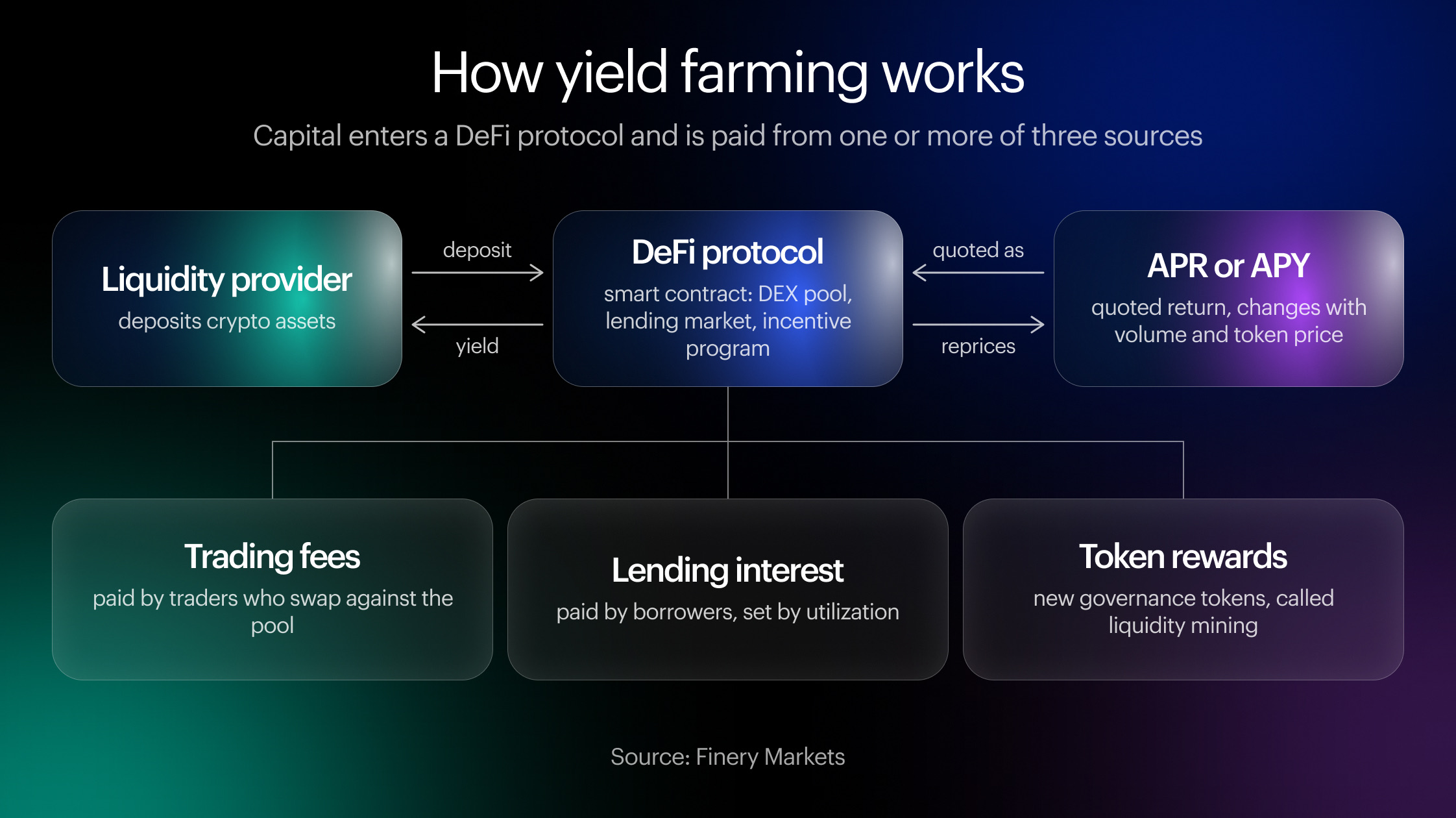
Yield farming is the deployment of crypto assets into DeFi protocols, such as decentralized exchanges and lending markets, in exchange for fees, interest, or token rewards. The depositor, called a liquidity provider or yield farmer, supplies capital that the protocol uses to facilitate trading or lending, and earns a return in proportion to the share supplied.
The term covers several distinct activities. Supplying two assets to a liquidity pool on a decentralized exchange earns a share of trading fees. Lending crypto assets on a money market earns interest paid by borrowers. Depositing into a protocol that distributes its own governance tokens to users earns token rewards on top of either. Many yield farming strategies stack these layers, for example by lending an asset, borrowing against it, and supplying the borrowed asset to a pool on other DeFi protocols.
"Liquidity mining" is often used as a synonym. Strictly, liquidity mining describes the token reward component: a protocol paying newly minted tokens to the people who supply liquidity. Yield farming is the broader activity of moving capital between DeFi protocols in search of the best risk-adjusted return, whether that return comes from fees, interest, emissions, or all three.
Yield farming excludes a few things it is often confused with. Running a validator and earning staking rewards for securing a blockchain network is staking, not farming, although liquid staking tokens blur the line (covered below). Holding a yield-bearing stablecoin whose return comes from treasury bills is closer to a money market fund than to farming. Earning interest on a centralized exchange is a loan to that exchange, with the counterparty risk that implies, and no smart contract in between.
How does yield farming work?
Every yield farming position has the same three parts: a protocol that needs capital, a smart contract that holds it, and a reward mechanism that pays for it. The differences lie in what the capital does once deposited.
Liquidity pools and the automated market maker model
A decentralized exchange does not run an order book. It runs liquidity pools: smart contracts that hold two assets, say ETH and USDC, and quote prices from the ratio between them using a formula. This is the automated market maker (AMM) model. Stablecoin-focused AMMs such as Curve Finance use a different formula that keeps prices near parity for assets expected to trade at the same value. Traders swap against the pool, and each swap pays a fee, typically between 0.05% and 1% of the trade, which accrues to the liquidity providers in proportion to their share of the pool.
Providing liquidity means depositing both assets in the pool's current ratio; the provider receives a receipt token representing the position. Redeeming the receipt returns the provider's share of whatever the pool holds at that moment, plus accumulated fees. Because the pool's ratio moves with the market price, the withdrawn mix can differ sharply from the deposited one. That difference is impermanent loss, discussed below.
Lending markets and interest
Lending protocols such as Aave and Compound, also called decentralized money markets, pool deposits of one asset and lend them to borrowers who post other assets as collateral. Interest rates adjust algorithmically with utilization: as more of the pool is borrowed, the rate rises to attract deposits and discourage further borrowing. The depositor earns the interest paid by borrowers, less a protocol reserve, and can withdraw as long as the pool holds unborrowed liquidity.
Lending is the lower-volatility end of yield farming. A single-asset deposit carries no impermanent loss. The risks are different: smart contract bugs, bad debt from collateral that cannot be liquidated fast enough, and the chance that the pool is fully borrowed when the depositor wants out.
Token rewards and liquidity mining
The third source of yield is the one that gave the activity its name. In June 2020, Compound began distributing its COMP governance token to lenders and borrowers, initially at 0.50 COMP per Ethereum block, roughly 2,880 tokens a day. Users could now earn interest and a token with a market price at the same time, and the token often paid more than the interest did. Capital moved to Compound, then to the many DeFi protocols that copied the model, in what became known as DeFi summer.
Token emissions let a new protocol buy liquidity before its fee revenue justified it. They also made the advertised yield partly a function of the token's price, which in turn depended on how many yield farmers were selling the rewards they received. Many yield farming projects from 2020 and 2021 collapsed once emissions fell or token prices did. The DeFi protocols that survived are those where fees and interest, rather than new tokens, now pay most of the return.
How is DeFi yield measured? APR vs APY
Protocols and dashboards quote returns as an annual percentage rate (APR) or an annual percentage yield (APY). APR is the simple annualized rate without compounding. APY assumes the rewards are reinvested at the same rate and includes the compounding effect. A 10% APR compounded daily is about 10.5% APY. At 100% APR the gap widens to roughly 171% APY, which is one reason high-emission farms prefer to advertise APY.
Neither figure is a forecast. Both are snapshots of the current rate, which changes with trading volume, pool utilization, token price, and how much capital is competing for the same rewards. A pool offering a high rate because it is small will offer a lower one as soon as more liquidity arrives, which is why the highest rates last only for short periods. For analysis, the useful decomposition is the one a single percentage hides: how much of the return is trading fees or interest paid by users, how much is token emissions, and what those emissions are worth after the farmer sells them.
Yield farming vs crypto staking: key differences
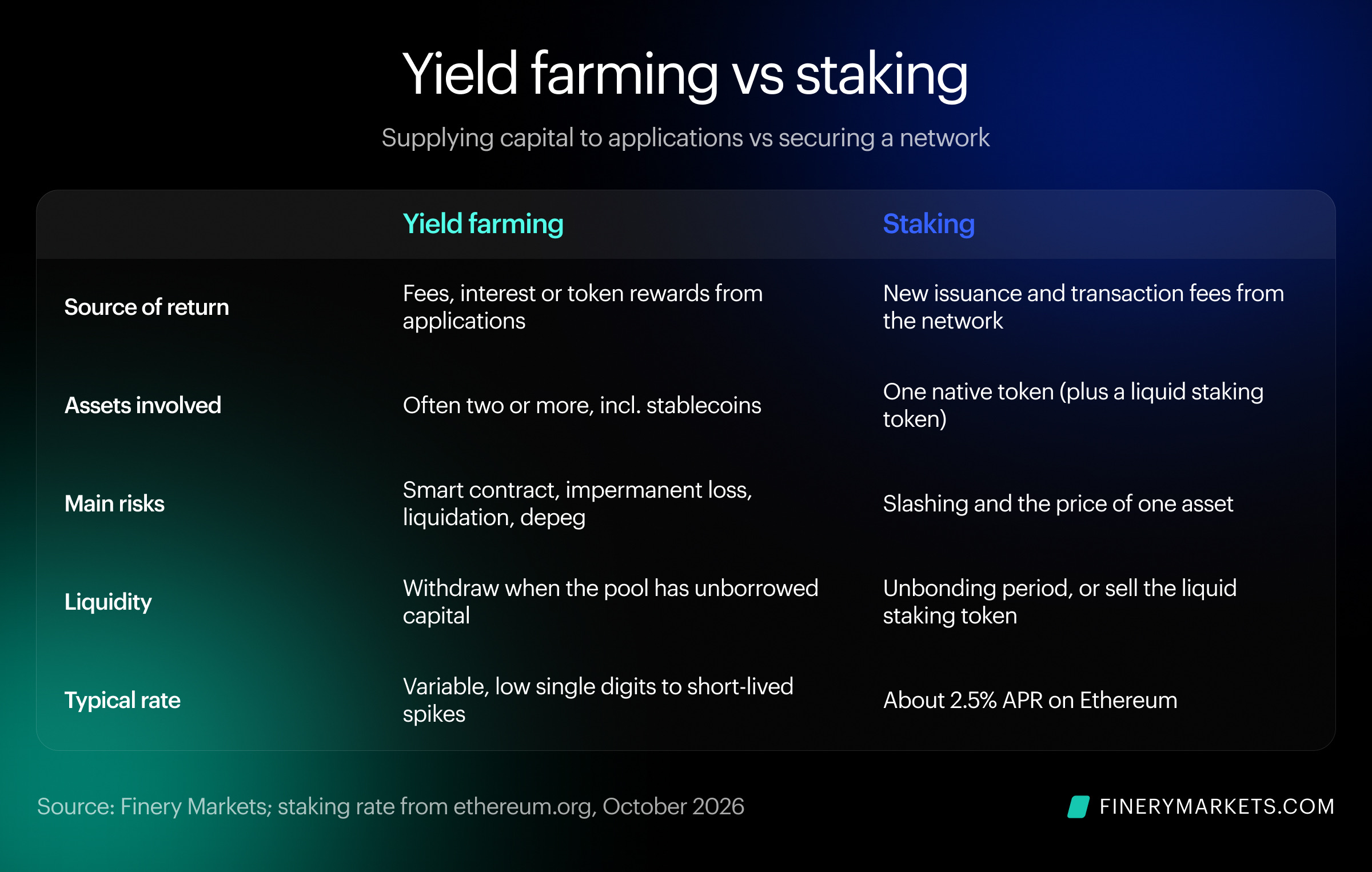
Yield farming and crypto staking are often grouped together as ways to earn yield on idle assets, but they do different jobs. Staking locks a network's native token to secure a proof-of-stake blockchain, and validators earn rewards in new issuance plus a share of transaction fees. On Ethereum, about 35% of the ETH supply is staked, and the ethereum.org staking page shows a current rate of about 2.5% APR.
Yield farming supplies capital to decentralized applications built on top of the network, and the reward is paid by the users of those applications (as fees or interest) or by the protocol's treasury (as tokens). Staking rewards come from the base layer; farming rewards come from the application layer. The risks follow the same split. A staker faces slashing and the price risk of one asset. A farmer faces smart contract risk, impermanent loss, liquidation risk on leveraged positions, and the price risk of several assets at once. Flexible staking products that allow withdrawal at any time sit between the two, since the flexibility is usually provided by an intermediary's balance sheet.
In practice the two are often combined. Liquid staking protocols issue a token, such as Lido's stETH, that represents staked ETH and keeps earning staking rewards. That token can then be deposited in a lending market or liquidity pool to earn additional yield. The position is now both staked and farmed, and it carries both sets of risk.
Modern yield farming strategies
The first generation of farms paid liquidity providers evenly for capital spread across every possible price. The current generation is more selective about where capital sits and what it is made of.
Concentrated liquidity
Uniswap v3, announced in March 2021 and launched on Ethereum mainnet that May, let liquidity providers choose a price range for their capital instead of covering the whole curve. Uniswap Labs claimed up to 4,000 times the capital efficiency of v2 for liquidity placed in a single narrow range. A provider who concentrates ETH/USDC liquidity between $2,500 and $3,000 earns fees on every trade inside that range with far less capital committed. If the market price leaves the range, the position stops earning and is left holding only the less valuable asset until the price returns. Concentrated liquidity turned passive deposits into something closer to active market making, with the monitoring that implies.
Liquid staking tokens and restaking
Liquid staking tokens let staked ETH keep working elsewhere in the DeFi ecosystem. Restaking goes a step further, pledging the same staked collateral to secure additional networks or services in exchange for extra rewards and extra slashing exposure across multiple networks. Both grew quickly and then shrank. According to Arkham Intelligence, citing DefiLlama data, liquid staking TVL reached an all-time high of $89 billion in late 2025 before falling to $30 billion in June 2026, and liquid restaking TVL peaked near $18 billion in December 2024 before slipping to $3.8 billion.
Yield aggregators
Yield aggregators automate the farming. Yearn describes its vaults as "capital pools that automatically generate yield based on opportunities present in the market," socializing gas costs and rebalancing between strategies. The depositor holds one vault token and outsources the strategy choice, the harvesting, and the compounding. The trade-off is one more layer of smart contracts between the depositor and the underlying assets, and a performance fee on the way out.
Delta-neutral and real-world asset yield
The newest designs blur the line between farming and structured products. Ethena's USDe is "a synthetic dollar, backed with crypto assets and corresponding short futures positions," and part of its yield comes from funding rates on delta-neutral basis trades in perpetual and futures markets. Tokenized treasury products bring government bill yields onchain and, according to Arkham, paid between 3.5% and 4.5% APY in 2026. In August 2025, Aave Labs launched Aave Horizon, a lending market where qualified institutions borrow stablecoins against tokenized real-world assets; by February 2026 it held more than $440 million in deposits. These products set the floor against which the extra yield of any farm is judged.
What impermanent loss means for liquidity providers
Impermanent loss is the difference between the value of assets left in a liquidity pool and the value of the same assets simply held. It arises because an AMM rebalances the pool as prices move: when one asset rises, arbitrageurs buy it from the pool at the stale price until the pool catches up, leaving providers with more of the asset that fell and less of the one that rose. The loss is "impermanent" only in the sense that it reverses if the price ratio returns to where it was at deposit. On withdrawal it is realized.
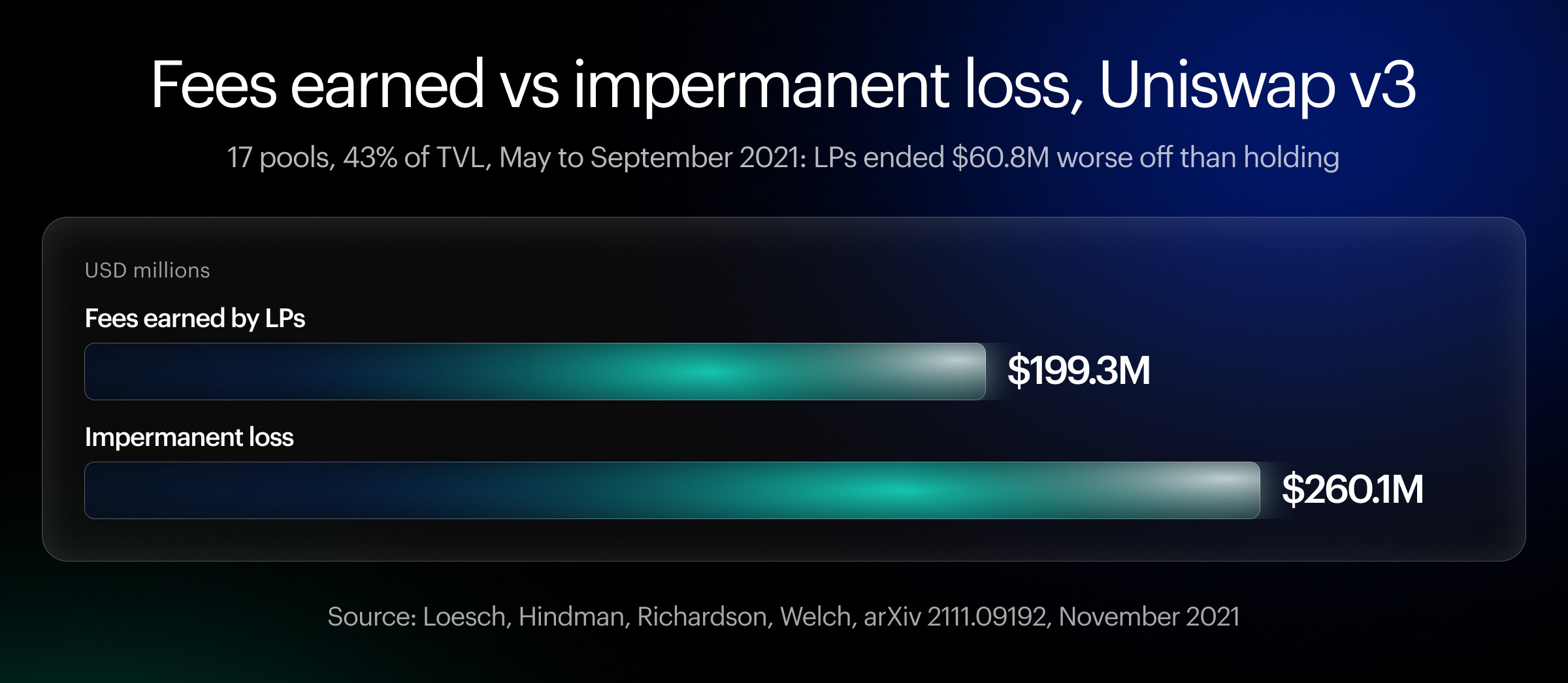
For a standard two-asset pool the magnitude depends on the relative price change alone. A doubling of one asset's price against the other produces a loss of about 5.7% versus holding; a fourfold move produces about 20%. Trading fees are meant to compensate. Often they do not. A study of Uniswap v3 by Loesch, Hindman, Richardson, and Welch, covering 17 pools and 43% of the exchange's TVL between May and September 2021, found that providers earned $199.3 million in fees against $260.1 million of impermanent loss, leaving them $60.8 million worse off than if they had held, and that 49.5% of providers had negative returns.
Who earns the fees matters as much as how large they are. A BIS working paper on Uniswap v3 liquidity provision, published in November 2024, found that sophisticated participants submit orders that "mimic bids and asks" and "extract significantly higher profits" than their unsophisticated counterparts. Onchain liquidity provision rewards the same skills as market making anywhere else: inventory management, pricing, and speed.
Why yield farming matters now
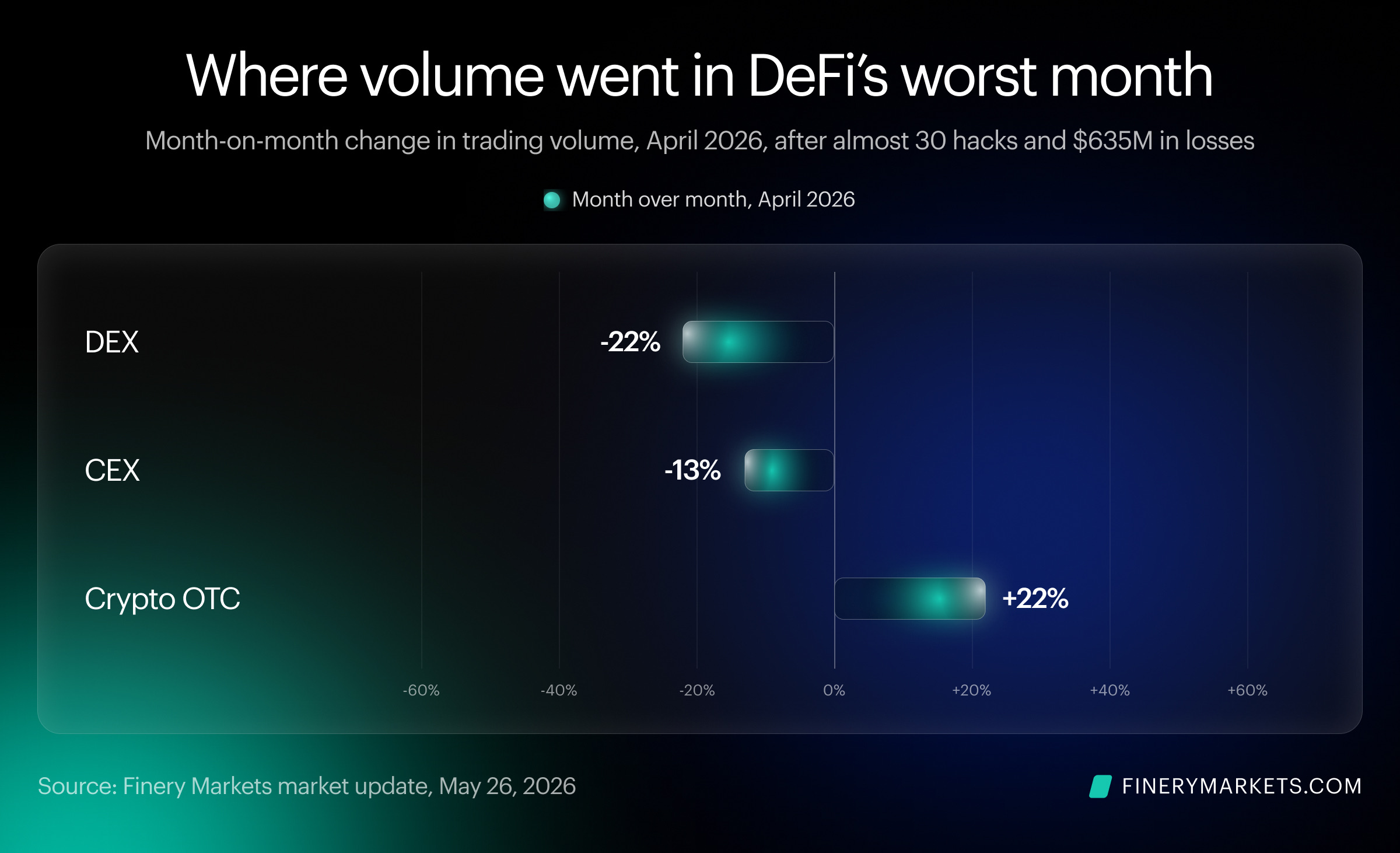
Yield farming no longer sets the pace of crypto markets, but it still sets the price of onchain liquidity, and its failures still move capital. April 2026 was a case in point. Our market update of May 26, 2026 at Finery Markets counted almost 30 hacks and $635 million in losses that month, the worst month in DeFi history. Withdrawals removed about $13.5 billion of total value locked within 48 hours. Aave lost $17 billion in deposits, 38% of its total, and $5.5 billion, or 31%, of its active loans.
The same update found no spillover into centralized exchange or OTC markets: DEX volumes fell 22% month on month, CEX volumes fell 13%, and the crypto OTC market grew 22%. Konstantin Shulga, our CEO and co-founder, described the market as "highly interconnected, yet structurally isolated." The liquidity that left DeFi pools moved to venues with a different risk profile rather than leaving crypto.
The broader institutional shift points the same way. According to our Crypto OTC Trading Report 2026, institutional spot OTC volumes grew 109% year over year in 2025 against 9% for the top 20 centralized exchanges, and stablecoins' share of institutional OTC volume rose from 23% in 2023 to 78% in 2025. In the first nine months of 2026, stablecoins accounted for 83% of trades by number across our network. Yield farming remains the main use of onchain stablecoin balances, which makes the health of DeFi pools relevant to any firm whose settlement runs on stablecoins.
Who uses yield farming, and for what
Different participants farm for different reasons, and the operational requirements differ with them.
Market makers and professional liquidity providers run concentrated liquidity positions as an extension of their market-making books, hedging inventory on centralized or OTC venues. For them, farming is active trading with onchain settlement, and the requirement is real-time position and risk monitoring across venues.
Crypto-native treasuries, including DAOs and protocol foundations, place stablecoin reserves in lending markets or tokenized treasuries to generate returns on idle assets. Their requirement is withdrawal liquidity and smart contract diligence rather than return maximization.
Funds and asset managers use farming selectively, often through yield aggregators or structured products, and increasingly through permissioned markets such as Aave Horizon that accept tokenized securities as collateral. Their requirements are custody compatibility, auditability, and a defensible regulatory position.
Stablecoin issuers watch yield farming from the other side. The pools and lending markets that hold their tokens are a large part of their secondary market, and a sudden exit from DeFi, as in April 2026, is a redemption event for them.
Brokers, payment providers, and OTC desks are mostly not farmers. Their clients need a firm price in size and settlement in fiat or stablecoins, which a liquidity pool does not provide. Their interest in DeFi yield is as a benchmark for what idle client balances could earn, and as a source of the stablecoin liquidity they route.
How to evaluate a yield farming opportunity
Advertised APY is the least informative number on the dashboards of DeFi platforms. A professional evaluation of yield farming platforms and pools looks at the following:
- Source of yield: how much of the return is fees or interest paid by users, and how much is token emissions whose value depends on selling pressure and future token supply.
- Smart contract risk: audit history, time in production, the size of the bug bounty, and whether the contracts are upgradeable and by whom.
- Pool depth and exit liquidity: total value locked, utilization in lending markets, and how much the position could withdraw without moving the price.
- Impermanent loss exposure: the correlation between the pool's assets and, for concentrated positions, the width of the range and the monitoring it requires.
- Counterparty and custody: who controls the contract keys, whether a custodian can hold the position, and what happens to user funds if a protocol pauses.
- Oracle and liquidation design: how prices feed the protocol, and how fast collateral is liquidated under stress.
- Regulatory status: whether the arrangement has an identifiable responsible person, and whether the depositor's own license permits the activity.
None of these is captured by a dashboard rate. All of them explain why two pools quoting the same APY can be very different positions.
Onchain yield and institutional liquidity: two different markets
Capital in a DeFi pool earns on the pool's terms. The fee tier is fixed by the contract, every taker receives the same price, and the provider's only controls are the range and the size. The institutional counterparties of the same liquidity provider, the brokers, payment providers, and OTC desks that need a firm price in size and settlement in fiat or stablecoins, cannot be served from a pool.
At Finery Markets, we provide the infrastructure for that second market. Our institutional liquidity network connects liquidity takers with liquidity providers through a single API or GUI connection, with order book, RFQ, and quote stream execution across 200+ crypto and fiat pairs. Takers access liquidity aggregated from institutional OTC providers and centralized exchanges. Liquidity providers receive flow from payment providers, desks, and brokers, adjust spreads, limits, and lending and borrowing conditions per counterparty, and operate with built-in protection against toxic flow. Trading runs on bilateral credit lines with reduced or zero pre-funding and flexible post-trade settlement, in a non-custodial environment. Since September 2025, a gateway built with Yield.xyz has also given our clients access to DeFi yields and staking through protocols including Aave, Morpho and Compound, inside the same interface they trade in.
The two markets priced the April 2026 stress differently. While DEX volumes fell 22% month on month, our clients traded $2.8 billion in the same month, a record at the time, and institutional client trading activity across the first four months of 2026 was up 48%.
We are a software and ICT provider. We do not hold client assets, supply liquidity to DeFi pools, or execute, clear, or settle trades. Our clients do, through the infrastructure we provide.
Risks of yield farming
The risks of yield farming are the risks of liquidity provision plus the risks of the software that hosts it. In rough order of how often they cost money:
- Smart contract vulnerabilities. Bugs and exploits can drain a pool entirely. Chainalysis counted over $2.17 billion stolen from crypto services in the first half of 2025 alone, and April 2026 added $635 million across almost 30 DeFi hacks in one month.
- Impermanent loss. As the Uniswap v3 data above shows, fees do not reliably cover it, and in concentrated positions the exposure is larger.
- Liquidation. Leveraged farming strategies that borrow against collateral can be liquidated during market volatility, often at the moment network congestion makes it hardest to add margin.
- Depegging. Stablecoin pools and synthetic dollars assume a peg. When one asset in a pool loses its peg, the AMM sells providers the asset that is failing.
- Governance and emission risk. Token rewards can be cut by a vote, and projects with anonymous teams have abandoned pools after collecting deposits, the so-called rug pull.
- Composability risk. Stacked strategies fail together. A fault in one protocol propagates to every position built on top of its receipt tokens, which is how a single exploit becomes a $13.5 billion withdrawal.
Regulatory risk sits across all of these. The Financial Stability Board concluded in February 2023 that DeFi "inherits and may amplify the vulnerabilities" of traditional finance, including "operational fragilities, liquidity and maturity mismatches, leverage, and interconnectedness." IOSCO's December 2023 final report set out nine policy recommendations for DeFi, built around identifying the "Responsible Persons" behind a purported DeFi arrangement. In the EU, MiCA's recital 22 states that services provided "in a fully decentralised manner without any intermediary" fall outside the regulation, which leaves a licensed firm to determine, protocol by protocol, whether the exemption applies to what it is doing. None of this makes yield farming risk free, and none of it is meant to.
Outlook
Three trends show in the data. First, the composition of DeFi yield is shifting from emissions to fees, interest, and tokenized treasury returns, which compresses headline rates toward money market levels and makes the remaining premium easier to price as compensation for smart contract and liquidity risk. Second, permissioned onchain markets built for qualified participants, of which Aave Horizon is an early example, are growing while open liquid staking and restaking pools have shrunk. Third, the April 2026 episode showed that stress in DeFi now redistributes volume across venues rather than draining the market, with OTC the beneficiary.
The structural point is the one the liquidity isolation data makes. Crypto has one price for an asset and several unconnected places to trade it, each with its own liquidity, its own failure modes, and its own participants. Yield farming is the mechanism that prices liquidity in one of those places. Firms that can see all of them at once can move capital between them before a stress event moves it for them.
FAQ
What is yield farming?
Yield farming is depositing crypto assets into DeFi protocols, such as decentralized exchanges and lending markets, to earn a return. The return comes from trading fees paid by users of the pool, interest paid by borrowers, token rewards distributed by the protocol, or a combination of the three.
How risky is yield farming?
Considerably riskier than holding the same assets. The main risks are smart contract exploits, impermanent loss in liquidity pools, liquidation of leveraged positions, stablecoin depegging, and reward cuts or abandonment by the protocol team. A 2021 study of Uniswap v3 found that about half of liquidity providers earned less than if they had simply held.
Is yield farming the same as staking?
No. Staking locks a network's native token to secure a proof-of-stake blockchain and earns protocol issuance. Yield farming supplies capital to applications built on the network and earns fees, interest, or tokens from those applications. Liquid staking tokens let one position do both, with both sets of risk.
What is impermanent loss in yield farming?
Impermanent loss is the shortfall between the value of assets held in an AMM liquidity pool and the value of the same assets simply held, caused by the pool rebalancing as prices move. A doubling of one asset's relative price costs about 5.7% versus holding. It becomes permanent on withdrawal.
What does APY mean in yield farming?
Annual percentage yield is the annualized return assuming rewards are reinvested at the current rate. It differs from APR, which excludes compounding. Both are snapshots that change with volume, utilization, token price, and competing capital, so neither is a forecast of what a position will earn.
Which platform is best for yield farming?
There is no single best platform. Lending markets suit single-asset deposits with no impermanent loss. Decentralized exchanges suit providers who can manage price ranges. Yield aggregators suit depositors who want the strategy automated. The right choice depends on the assets, the time horizon, and the diligence the depositor can perform.
Can crypto yield farming earn passive income?
Rarely in the literal sense. Lending stablecoins is close to passive. Providing concentrated liquidity requires active range management, and token-reward farms require tracking emission schedules and selling rewards. Most yield farming strategies that outperform holding involve ongoing work, and the ones advertised as effortless usually carry the largest hidden risks.


 LinkedIn
 Youtube
 Medium
 Twitter