What is DeFi? Decentralized finance, commonly referred to as DeFi, is a set of financial services that run as software on public blockchains. Lending, trading, stablecoin issuance, and derivatives are coded into smart contracts that execute automatically, so transactions occur between users and a protocol rather than through a bank, broker, or centralized exchange.
The scale is no longer theoretical. DeFi protocols held about $88 billion in total value locked on October 15, 2026, according to DefiLlama, and decentralized exchanges handled spot volume equal to 24% of centralized exchange volume in July 2026, the highest ratio since tracking began in 2019. In July 2026, the FATF reported that 132 of 143 jurisdictions had not yet applied its standards to DeFi arrangements, and April 2026 produced 28 exploits and $635 million in losses in a single month.
That combination of real scale, thin regulation, and concentrated operational risk is why the question matters to brokers, payment providers, banks, and trading firms rather than only to retail users. This article explains how DeFi works, what the main DeFi applications do, how it compares with traditional finance, where regulators stand in 2026, and what an institution needs in place before its treasury, trading, or product teams touch it.
What is DeFi?
Decentralized finance (DeFi) is a category of financial applications built on public blockchains, where smart contracts replace intermediaries. Users keep custody of their own digital assets, interact with open-source protocols on a peer to peer basis, and settle onchain. Lending, borrowing, trading, stablecoins, and derivatives are the core DeFi applications, anyone with an internet connection can access them, and no central authority can block a transaction.
The World Economic Forum's Global Future Council on Decentralized Finance, writing in October 2025, defined DeFi by five characteristics: a digitally native, immutable record; exchange of value; peer to peer operation and settlement; programmable, open, and composable architecture; and the option of self-hosted custody. That definition is useful because it separates the technology from the marketing. A product can run on blockchain technology and still be centralized if an operator controls the keys, the upgrades, or the order flow.
What DeFi excludes matters as much. Centralized exchanges, custodial wallets, and bank-issued tokens on private ledgers are not DeFi, even when they hold crypto assets. Non-fungible tokens are tokenized collectibles rather than financial services, and sit outside it too. Nor is decentralized finance the same as crypto. Bitcoin is digital money with no financial applications layered on top; DeFi is the set of financial services built on programmable chains such as Ethereum and Solana.
How does DeFi work?
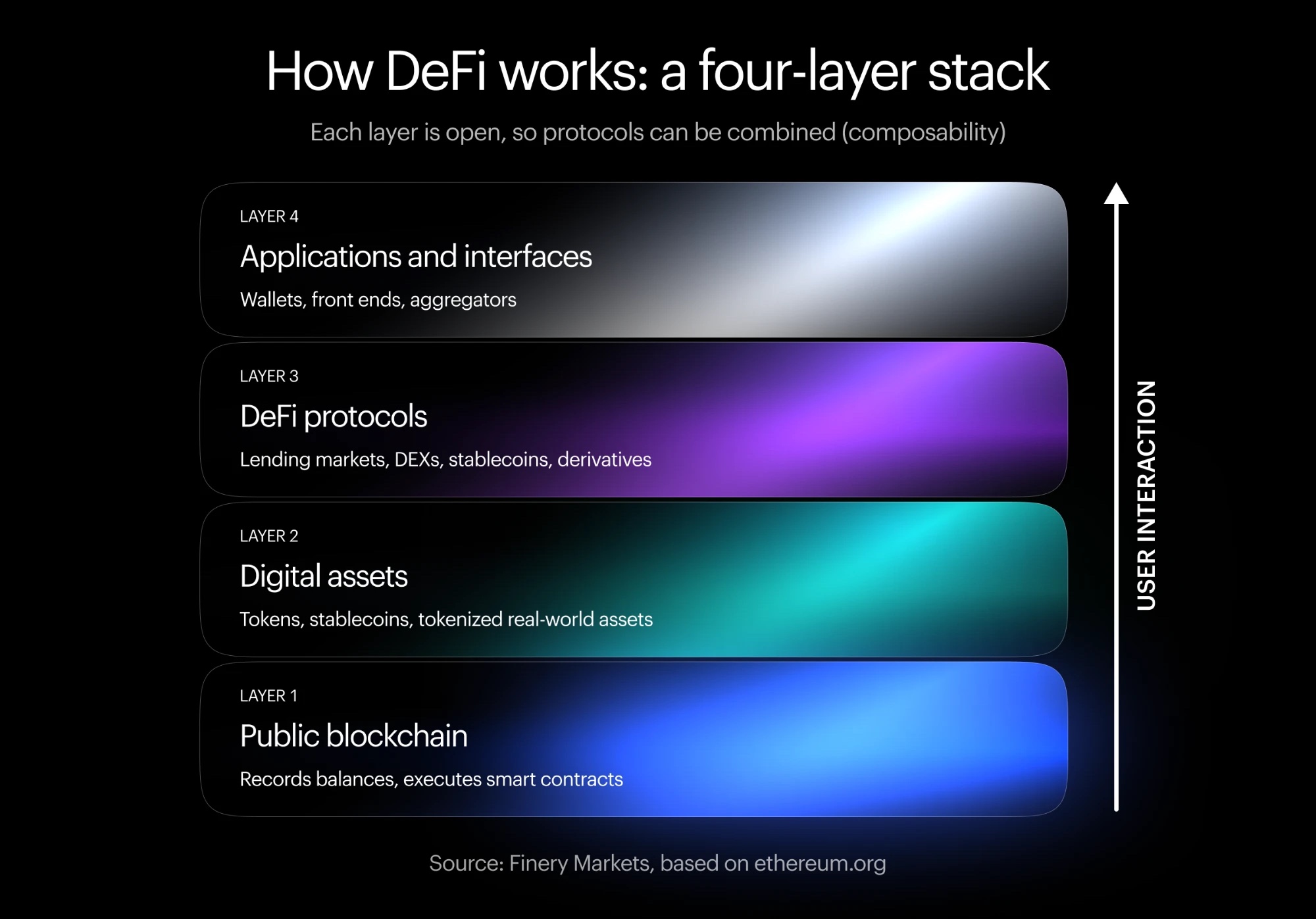
To understand DeFi, start with the stack. At the base sits a public blockchain that records balances and executes code. On top of it sit tokens, stablecoins, and other assets, then protocols (the smart contracts that define a lending market or an exchange), then the decentralized applications and interfaces through which users interact. Each layer is open, which lets developers combine protocols the way a desk combines instruments.
Smart contracts and blockchain technology
Smart contracts are programs stored on a blockchain that run when their conditions are met. In a DeFi lending market, the contract holds collateral, calculates interest rates from utilization, and liquidates positions when collateral falls below a threshold. No loan officer approves the borrower, and no clearing house nets the trade. The code is the counterparty, and the blockchain is the ledger.
Because DeFi smart contracts run on a public chain, every transaction, balance, and contract parameter is visible. That transparency is real, and so is its cost. Every transaction pays transaction fees to the network, and every error in DeFi contracts is visible to attackers as well as auditors.
Liquidity pools and automated market makers
Decentralized exchanges rarely run an order book. Most use automated market makers (AMMs), where liquidity providers deposit two assets into a liquidity pool and a pricing formula quotes against the pool's balances. Traders swap against the pool, pay a fee, and the fee accrues to the depositors. Larger trades move the price further along the curve, which is why price impact on a DEX scales with size rather than with the depth of a quoted book.
Oracles, cross chain bridges, and composability
Smart contracts cannot see prices outside their own chain, so DeFi protocols rely on oracles to import market data. Cross chain bridges move assets between networks. Both are infrastructure that users rarely notice until they fail, and both sit behind a large share of the industry's losses.
DeFi inherited its norms from the open source movement: code is published, forked, and audited in public. Composability is the property that lets one protocol plug into another in the same transaction: a stablecoin as collateral in a lending market, whose receipt token is deposited into a yield vault, whose position is traded on a DEX. The industry calls these "money legos." It is also why a single failure can propagate through several protocols at once.
The main DeFi applications
DeFi apps cluster into a handful of categories. Each one reproduces a financial product that financial institutions already offer, with different mechanics and a different risk profile, and together they make up the DeFi ecosystem.
Decentralized exchanges
Decentralized exchanges let users swap tokens from their own wallet without an intermediary holding the assets. AMM-based venues dominate, with onchain order books growing on faster chains. In July 2026, DEX spot volume reached about $131 billion, down 26% month over month, while the DEX-to-CEX ratio set its record because centralized exchange volume fell further.
Lending and decentralized money markets
Lending protocols pool deposits and let borrowers draw against collateral. Interest rates adjust algorithmically with utilization: as more of the pool is borrowed, rates rise to attract deposits. Depositors earn interest; borrowers borrow funds without a credit check because the loan is overcollateralized. Borrowing money on a DeFi platform therefore means posting collateral worth more than the loan.
Flash loans are a DeFi-only construct. A borrower takes an uncollateralized loan and repays it within the same transaction; if repayment fails, the transaction reverts and the loan never happened. Arbitrageurs use them to capture price gaps, and attackers use them to manipulate oracle prices with borrowed size.
The BIS described the structural limit of this model in June 2022: because borrowers are anonymous, overcollateralization is widespread, and credit flows only to those who already hold assets. Lending to the real economy requires information about the borrower, which permissionless pools do not collect.
Stablecoins: how DeFi users send money
Stablecoins are tokens designed to hold a stable value against a fiat currency, most often the US dollar. They are the unit of account for most DeFi activity, the bridge between onchain markets and bank money, and the way most users send money across borders onchain, settling in minutes for a network fee. Stablecoin market capitalization stood at about $303 billion on October 15, 2026, and Finery Markets' report put annual stablecoin transaction volume above $57 trillion as of January 2026, a measurable share of global financial transactions. Outside DeFi, they have become the settlement asset of institutional OTC trading: Finery Markets' Crypto OTC Trading Report 2026 found that stablecoins' share of institutional OTC transaction volume rose from 23% in 2023 to 78% in 2025.
Yield farming and liquidity mining
Yield farming is the practice of moving capital between protocols to earn the highest return, usually from a combination of trading fees, interest, and token incentives. Liquidity mining is the incentive side: a protocol pays its own governance tokens to users who deposit liquidity, to bootstrap a market. Both produce the "earn passive income" headlines that bring retail users to the DeFi space, and both carry risks involved in token price, smart contract failure, and impermanent loss that the headline yield farming rate does not show.
Derivatives, synthetic assets, and tokenized real-world assets
Perpetual futures venues, options protocols, and synthetic assets that track an underlying asset round out the list of DeFi applications. The newest category is tokenized real-world assets. Tokenized US Treasury products held $14.9 billion on October 14, 2026, according to rwa.xyz, led by Circle's USYC, Ondo's USDY, and BlackRock's BUIDL, and these tokens are now accepted as collateral in permissioned lending markets.
Decentralized finance (DeFi) vs traditional finance
The comparison most explainers draw is between decentralized finance and traditional finance, and the differences are structural rather than cosmetic. In DeFi, the user holds the private keys, the protocol settles in minutes, markets run 24 hours a day, and access requires a wallet rather than an application. In traditional finance, centralized institutions hold the assets, settlement runs in cycles, markets keep hours, and access runs through onboarding and know-your-customer checks.
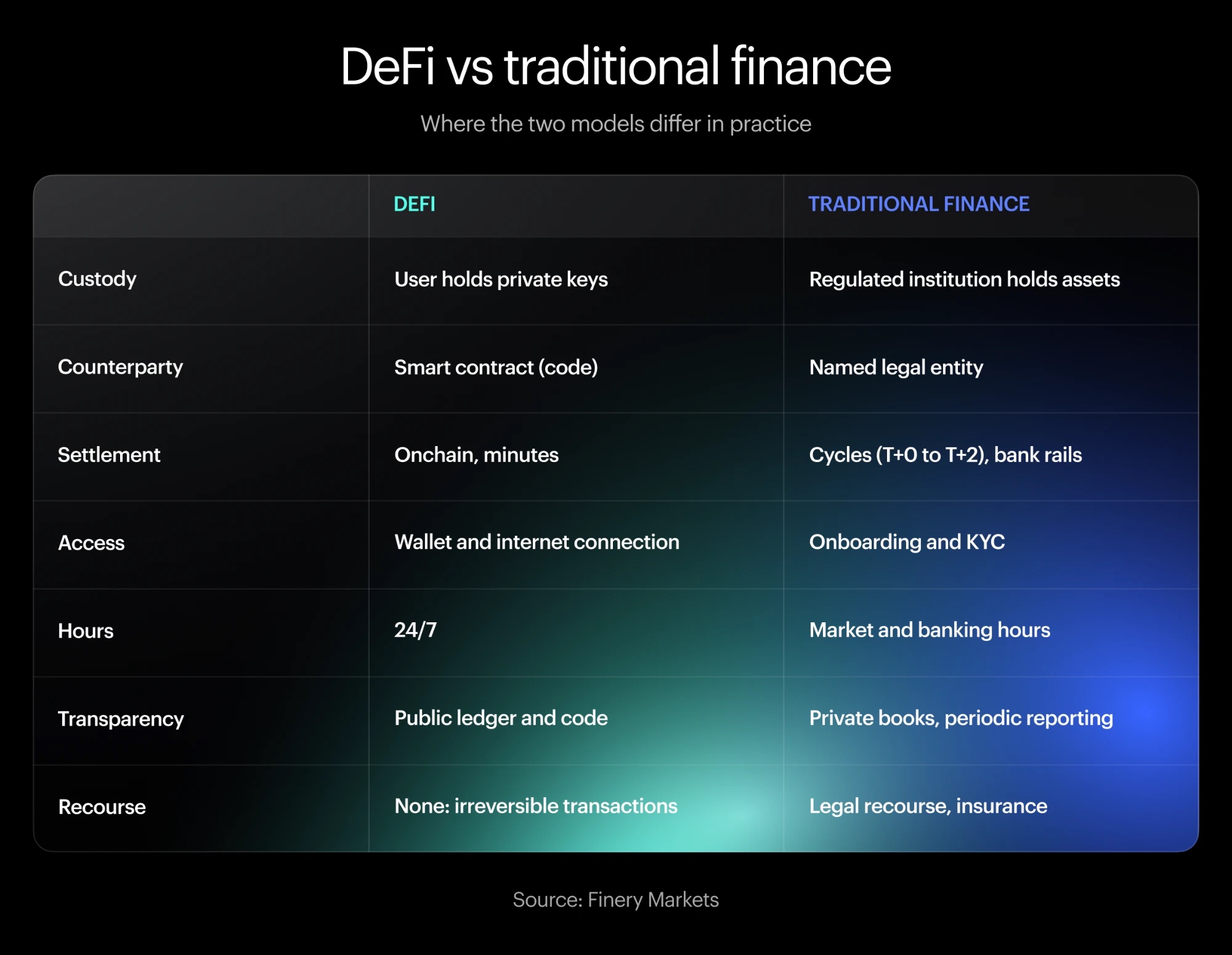
The trade-offs run both ways. DeFi removes counterparty credit risk to an intermediary and replaces it with smart contract risk, oracle risk, and governance risk. It removes onboarding friction and replaces it with the absence of recourse: there is no help desk, no chargeback, and no deposit insurance. Traditional finance offers legal recourse, insurance, and identifiable counterparties, and pays for them with slower settlement, pre-funding, and limited hours.
For an institution, the useful framing is operational. Which functions does the firm need from a venue (firm pricing, credit, settlement in fiat currency, an audit trail, a counterparty that can be named in a contract), and which of those does a given protocol actually provide?
DeFi in 2026: the market in numbers
Total value locked, the standard measure of capital deposited in DeFi protocols, stood at about $88 billion on October 15, 2026. That is below the $98 billion it held before the April exploits, after a year in which security failures, not yields, set the direction.
The pivotal month was April 2026. The Spartan Group counted 28 incidents in 30 days, a record, with $635 million lost. Two exploits accounted for most of it: Drift, a Solana perpetuals venue, lost about $285 million, and on April 18 attackers drained about $290 million of rsETH from KelpDAO's bridge by forging a cross-chain message, then borrowed roughly $236 million of ETH against the stolen tokens on Aave, Euler, and Compound. Aave's TVL fell from $26.1 billion to $15.3 billion, and DeFi lending TVL dropped by $9.6 billion to $43.1 billion, still tens of billions of dollars in permissionless credit.
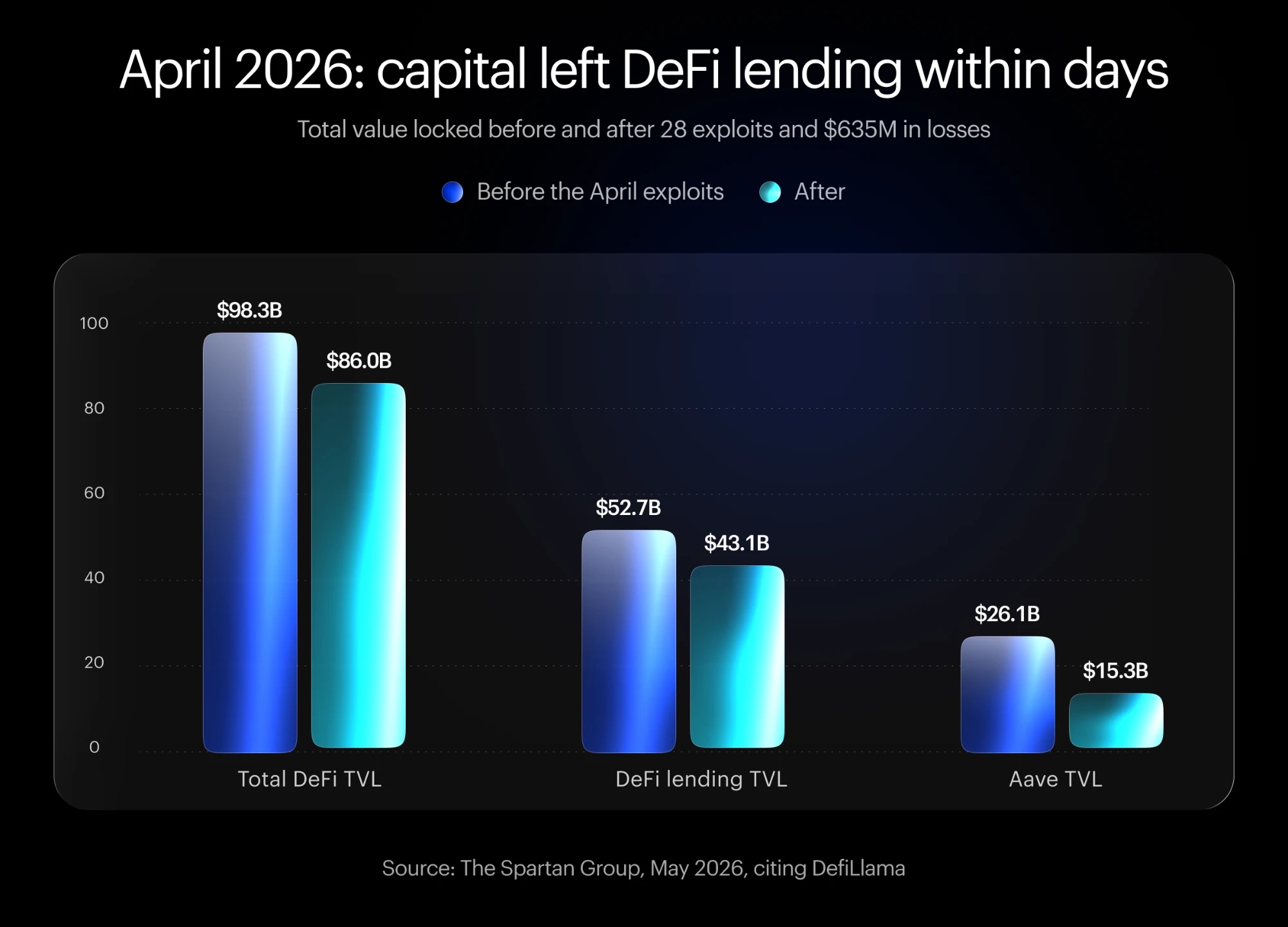
Finery Markets' own market update on the DeFi hacks, published in May 2026, measured the second-order effect: around $13.5 billion of TVL was withdrawn within 48 hours at the peak of the crisis, and Aave lost $17 billion in deposits (38% of its total) and $5.5 billion, or 31%, of its active loans. Month over month, DEX volume fell 22% and CEX volume fell 13%, while OTC volume rose 22%. The DeFi shock did not spread to centralized or OTC venues. Konstantin Shulga, Finery Markets' CEO, described the global crypto liquidity ecosystem as having "proved highly interconnected, yet structurally isolated."
Two longer trends sit behind the monthly data. First, decentralized finance's share of spot trading keeps rising even as absolute volumes swing: the DEX-to-CEX ratio sat below 10% for most of 2024 and reached 24% in July 2026. Second, institutional flow is moving off-screen rather than onchain. Finery Markets' Crypto OTC Trading Report 2026 recorded institutional spot OTC volumes up 109% year over year in 2025, against 9% for the top 20 centralized exchanges, and 40% of surveyed firms named OTC as their first-choice execution venue.
Why is DeFi important for institutions?
For most of its history, DeFi was a retail and crypto-native market, small against the global financial system and separate from the financial markets that institutions trade. That is changing in three places, and each one creates a concrete operational need.
Stablecoin issuers depend on DeFi for distribution. A new stablecoin earns its utility in liquidity pools, lending markets, and DEX pairs, which is where secondary-market liquidity forms before institutional desks will quote it. The GENIUS Act, signed into US law on July 18, 2025, requires 1:1 reserves, monthly reserve disclosure, and prohibits paying yield to holders, which pushes the yield question into DeFi protocols that lend or stake the tokens.
Trading firms, market makers, and crypto-native funds use DeFi apps as a liquidity source and a hedging venue. They provide liquidity to AMMs, borrow stablecoins against crypto assets for cash flow management, and arbitrage between DEX, CEX, and OTC prices. Their constraint is operational: executing size on a DEX means price impact and public order flow, so large trades still route through OTC desks with firm quotes, a split Finery Markets examined in its comparison of CEX, DEX, and crypto ECNs.
Banks and asset managers arrive through tokenization. Permissioned DeFi, where access is restricted to verified institutions but the protocol logic stays onchain, is the bridge. Aave Labs' Horizon, launched on August 27, 2025, runs a permissioned instance of Aave V3 that lets qualified institutions borrow USDC, RLUSD, or GHO against tokenized Treasury funds from Superstate, Circle, VanEck, and Centrifuge, with compliance enforced at the token level by the issuer. The protocol is public; the collateral is gated.
How regulators treat DeFi in 2026
Regulation is the variable that decides how far regulated financial institutions can go. The picture in October 2026 is a patchwork.
The FATF's targeted report on DeFi, published on July 21, 2026, found that 132 of 143 reporting jurisdictions had not yet implemented its standards for qualifying DeFi arrangements, and only 2 of 142 had licensed or registered one. The report sorts DeFi arrangements into three categories: centralized with identifiable controllers, centralized in practice with controllers that are not readily identifiable, and truly decentralized. The anti-money-laundering standards apply to the first two, and the report lists onchain and offchain indicators of control (governance token concentration, administrative keys, upgrade rights, economic benefit) that supervisors should use. Its underlying finding is that "centralised elements frequently persist in practice." Whether the decentralized nature of a protocol is real, in other words, is now the regulatory question.
In the United States, the Securities and Exchange Commission has moved from enforcement toward exemptive relief. In June 2025, SEC Chair Paul Atkins said the agency was working on an "innovation exemption" that would let DeFi platforms bring onchain products to market under conditions, and separated the act of publishing code from regulated financial activity. The GENIUS Act covers payment stablecoins and takes effect at the earlier of 18 months after enactment or 120 days after final rules.
In the European Union, MiCA (Regulation (EU) 2023/1114) has applied to stablecoin issuers since June 30, 2024 and to crypto-asset service providers since December 30, 2024. Fully decentralized protocols with no identifiable issuer or operator sit largely outside its direct scope, but front-end operators and intermediaries serving EU users can be treated as service providers, and any centralized element can bring the full obligations into play.
For a regulated firm, the practical question is whether its own interaction with DeFi (custody of keys, routing of client flow, screening of counterparties, reporting of transactions) meets the obligations the firm already carries.
What an institution needs before using DeFi
A firm that wants exposure to DeFi, whether as a liquidity provider, a borrower, a stablecoin issuer, or a product builder, needs the same operational layers it uses in any other market. The checklist is longer than the protocol's user interface suggests:
- Key management and custody: institutional wallets with policy controls, segregation of client and house assets, and a documented process for signing transactions.
- Protocol due diligence: audit history, governance structure, admin key arrangements, oracle design, and the FATF control indicators above.
- Transaction and counterparty screening: wallet screening against sanctions lists, Travel Rule compliance where a VASP is involved, and monitoring of pool counterparties where possible.
- Execution routing: a rule for which trades go to a DEX, which to a centralized exchange, and which to an OTC desk, based on size, urgency, and information leakage.
- Risk limits: protocol concentration caps, collateral haircuts for volatile tokens, and liquidation monitoring for borrowed positions.
- Accounting and reporting: a trade and position record that reconciles onchain activity with the firm's books and supports tax and regulatory reporting.
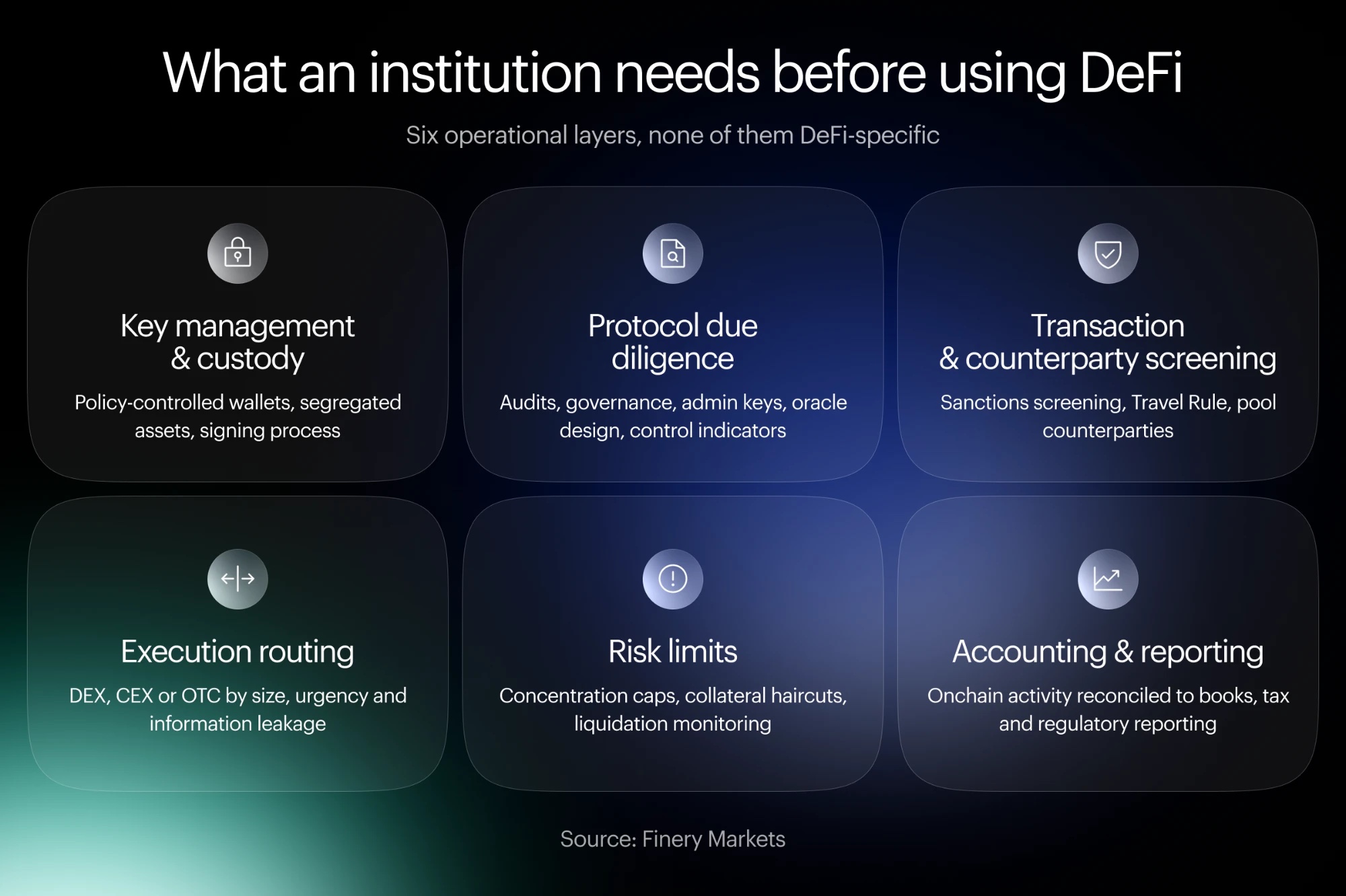
Most of these layers are not DeFi-specific. They are the same functions a firm needs to trade any digital asset, which is why the firms that scale in DeFi are usually the ones that already had institutional trading infrastructure in place.
Where DeFi liquidity ends and institutional execution begins
A DEX gives a trading firm a public price and immediate settlement. It does not give it a firm quote for size, a named counterparty, a credit line, or settlement in fiat currency. For a broker hedging client flow, a payment provider converting stablecoins to euros, or a bank adding trading to custody, those four things are the product.
Finery Markets provides the infrastructure layer where that institutional execution happens. Its non-custodial technology connects liquidity takers (brokers, payment providers, OTC desks, fintechs, banks) with liquidity makers (market makers, OTC desks, prime brokers) across a network of 150+ institutional participants and 200+ crypto and fiat pairs. Three execution methods run on one system: a firm order book with no last look, RFQ for larger or less liquid positions, and quote streams from a chosen provider, accessible through FIX 4.4, WebSocket, and REST APIs or a web interface. Participants trade on bilateral credit lines with reduced or zero pre-funding and settle post-trade across more than 20 blockchain networks, with fiat settlement workflows alongside, which is the opposite of the pre-funded, pool-based model of an AMM.
The April 2026 data shows why the two models coexist. While DEX volume fell 22% in the month of the exploits, OTC volume rose 22%, according to Finery Markets' market update, and the Crypto OTC Trading Report 2026 found 40% of surveyed institutions routing more than half of their trades through OTC rather than on-screen.
Finery Markets does not operate a DeFi protocol, a DEX, or a custodian, and it does not hold, transfer, or sign for client assets. It is a software and ICT provider whose clients execute and settle with one another. For an institution whose DeFi activity generates size that a pool cannot absorb, or whose stablecoin needs secondary-market liquidity with named counterparties, that layer is where the onchain and off-screen markets meet.
Risks and limitations
DeFi's risks are operational and concentrated, which is different from being unmanageable. The main ones are:
- Smart contract and bridge exploits. Chainalysis counted more than $3.4 billion stolen across crypto in 2025, including the $1.5 billion Bybit exchange hack, and April 2026 alone produced $635 million in DeFi losses, most of it through a single bridge.
- Oracle manipulation. A protocol is only as reliable as the price data it consumes; flash loans let an attacker move a thin market and borrow against the distorted price in the same transaction.
- Liquidity runs. Deposits in lending pools can be withdrawn instantly, and in April 2026 Aave lost 38% of its deposits in days. Pools have no lender of last resort.
- Governance concentration. The FATF found that control over upgrades, admin keys, and governance tokens persists in protocols that describe themselves as decentralized, which is both a regulatory and a counterparty risk.
- Market mechanics. Impermanent loss for liquidity providers, front-running and other forms of value extraction by block builders, and price impact on large trades.
- Irreversibility and recourse. DeFi transactions cannot be reversed, there is no deposit insurance, and a user who loses private keys loses the assets.
- Regulatory and tax uncertainty. Treatment varies by jurisdiction, and DeFi income and swaps generally create taxable events that a firm must track without a broker's statement.
None of these is hidden. The data on exploits, withdrawals, and governance is public because the chains are public. The difficulty is that the risks arrive fast and together, as April 2026 showed.
Outlook
Three observable trends shape what DeFi looks like for institutions over the next cycle. Tokenized Treasuries and other real-world assets are becoming accepted collateral in permissioned pools, which brings regulated balance sheets onchain without opening the pools to anonymous counterparties. Stablecoin law in the United States and MiCA in the EU give the settlement asset a legal perimeter, which makes the DeFi protocols that use it easier for compliance teams to assess. And supervisors, led by the FATF, are converging on a control test rather than a technology test, which gives protocol teams a clear target: either remove the centralized components or register them.
The retail story of DeFi was about access, and it was largely delivered. The institutional story is about where liquidity sits and how it moves. The crypto market now runs on three execution layers, DEX, CEX, and OTC, that share the same assets and the same participants but hold liquidity separately. The firms that scale will be the ones that can route between them: onchain where transparency and composability pay, off-screen where size, credit, and settlement control decide the outcome.
FAQ
What is DeFi in simple terms?
DeFi, short for decentralized finance, is a set of financial services and digital assets built as software on public blockchains. Smart contracts handle lending, trading, and stablecoin issuance automatically, so users deal with a protocol rather than a bank or exchange. Users keep custody of their own assets and interact directly from a wallet.
Is DeFi the same as crypto?
No. Crypto refers to blockchain-based assets such as Bitcoin and Ether. DeFi is the set of financial applications built on programmable blockchains that use those assets. Bitcoin itself is digital money without lending or trading protocols on top; DeFi needs smart contract platforms such as Ethereum or Solana.
How does DeFi work?
DeFi works through smart contracts, programs stored on a blockchain that execute when their conditions are met. A lending contract holds collateral and sets interest rates by utilization; an exchange contract quotes prices from a liquidity pool. Users connect a wallet, sign a transaction, and the protocol settles it onchain within minutes.
Is DeFi safe?
Not without controls. DeFi removes intermediary credit risk but adds smart contract, oracle, bridge, and governance risk, and transactions are irreversible. April 2026 saw 28 exploits and $635 million in losses in one month. Institutions manage this with protocol due diligence, custody policy, screening, and position limits, as they would in any market.
How do people make money from DeFi?
Mainly by providing liquidity to exchanges and earning fees, depositing into lending markets to earn interest, staking tokens, and liquidity mining, where protocols pay governance tokens to depositors. Each return carries a corresponding risk: token price, impermanent loss, smart contract failure, or a liquidity run.
What are decentralized exchanges?
Decentralized exchanges (DEXs) are protocols that let users swap tokens directly from their own wallets. Most use automated market makers, where a liquidity pool and a pricing formula replace an order book. In July 2026, DEX spot volume equaled 24% of centralized exchange volume, a record ratio.
What is the difference between DeFi and CeFi?
CeFi, or centralized finance, covers crypto services where a company, acting as a centralized authority, holds client assets and matches trades, such as centralized exchanges and custodial lenders. Decentralized finance runs those financial services in smart contracts with users keeping custody. CeFi offers recourse and support; DeFi offers transparency and self-custody, with no intermediary to call.


 LinkedIn
 Youtube
 Medium
 Twitter