The worst month in DeFi history, marked by almost 30 hacks and $635M in losses (see full list in Appendix 1), revealed structural liquidity isolation across the global crypto ecosystem.
During the defi-crisis peak, withdrawals wiped out ~$13.5 billion in total value locked within just 48 hours. Aave quickly lost $17 billion in deposits, representing 38% of its total, and saw $5.5 billion (31%) of its active loans disappear.
Konstantin Shulga, Finery Markets' CEO and co-founder, commented, “The aftermath surfaced two key observations. First, despite 'institutionalization' being a recurring theme in crypto, TradFi allocators defaulted to familiar trading architecture. Second, the global crypto liquidity ecosystem proved highly interconnected, yet structurally isolated.”
Notably, the worst hack month on record produced no spillovers into CEX or OTC markets. The crypto market absorbed the aftershocks without triggering a significant risk-off reaction, leaving the longer-term dynamics of other segments unaffected.
The 'discommunicating vessels' of crypto liquidity
While CEX, DEX, and OTC operate within the same global crypto liquidity market, their April dynamics revealed a state closer to 'discommunicating vessels' than interconnected pipes. Instead of triggering a broader crypto meltdown, the crisis demonstrated that the DEX "disease" could not easily cross over to the other parts of the liquidity pool.
DEXs are dominated by crypto-native yield farmers, algorithmic traders, and leveraged strategies. CEXs serve a broad blend of retail crowd and standard spot traders. OTC is the niche for institutions, family offices, and HNWIs who need deep liquidity and execution efficiency for large-tickets.
Because of the stark differences in participant profiles, the contagion remained an isolated DeFi phenomenon. Institutional capital held its position in the OTC segment, behaving consistently with its native market conventions.
DeFi short-term hit, while broader trajectory holds
The effect of the exploits was contained within the DeFi niche. The stress test resolved quietly, with no material consequences across the broader crypto market present at the time of writing. Trading data illustrates this clearly.
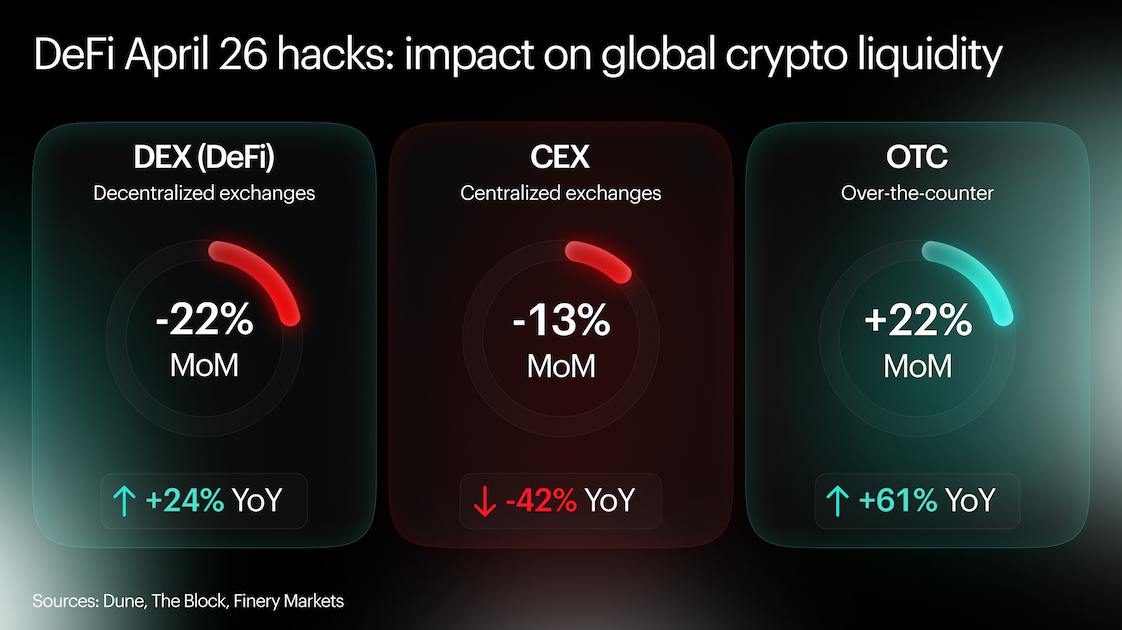
DEX trading volumes declined 22% MoM. CEX volumes decreased 13% MoM. However, in the same period the crypto OTC market posted a 22% MoM increase. As seen during the October '25 market crash, institutions tend to rely on OTC to preserve capital efficiency amid rising volatility.
Stepping back, each segment remained on its established trajectory. DeFi volumes posted a 24% YoY increase, OTC recorded +61%, and CEX continued its decline at 42%. These dynamics are consistent with Q1 2026 trends.
The institutional aftermath may see some active DeFi explorers pull back. But a cooling off is necessary for the industry's maturity. The recent hacks are a pointed reminder of the risks embedded in complex collateral structures.
Capital markets have always evolved through their mistakes to build more robust systems. In our view, the long-term DeFi potential for tokenized RWAs hasn't changed.
The bottom line
The April 2026 hacks resurfaced bridge and collateral vulnerabilities familiar from 2022, with exploits reaching nine-figure losses. Nomad ($190M, 2022) and Multichain ($130M, 2023) stand as comparable cases.
Yet the 'discommunicating vessels' structure contained the damage within DeFi's own niche, serving as a ring-fence against broader market contagion.
In short, April 2026 did not break the crypto market. It stress-tested its internal architecture and revealed something more useful than a crisis — a map of how liquidity actually moves under pressure.







 LinkedIn
 Youtube
 Medium
 Twitter