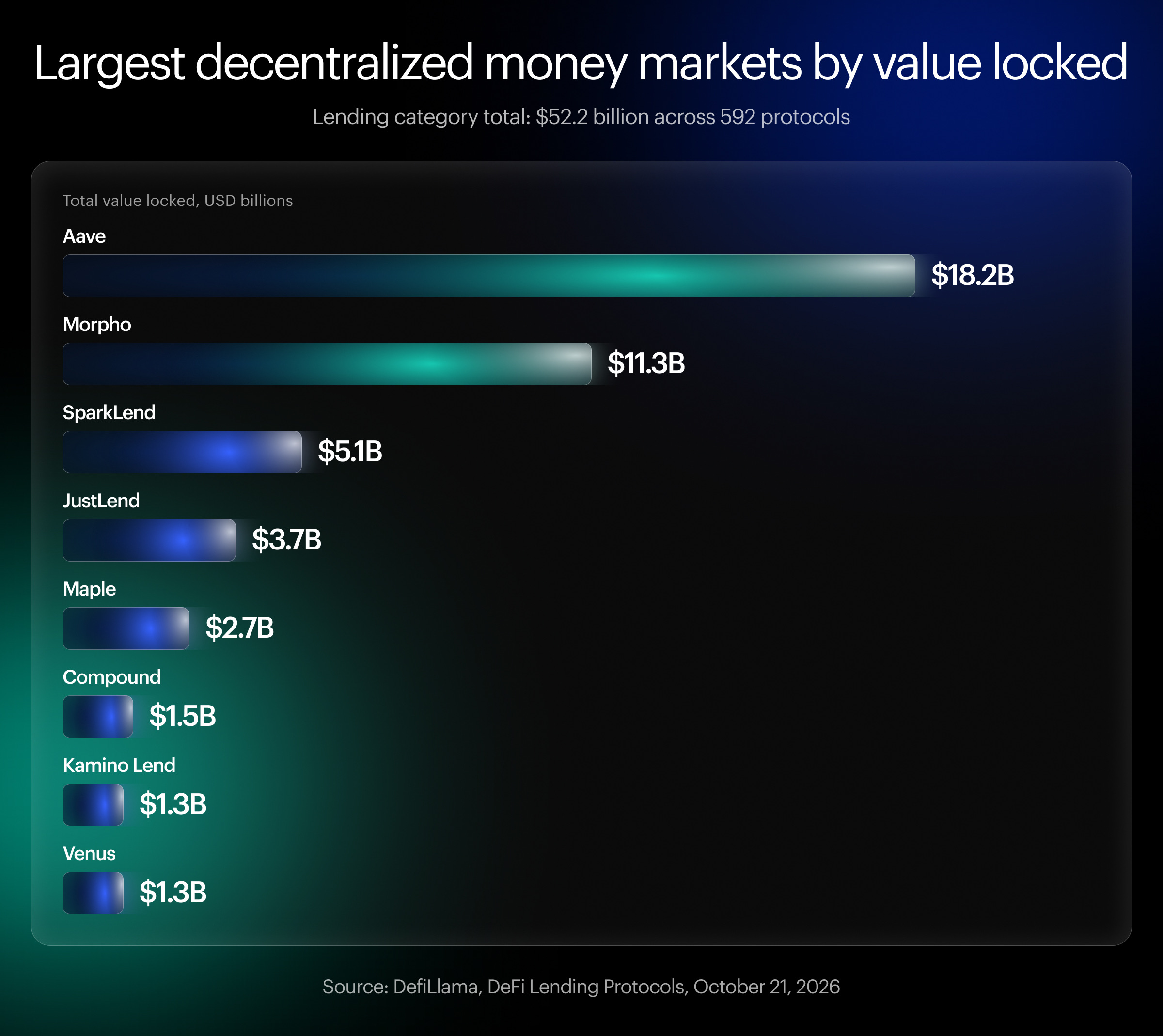
A decentralized money market is a pool of digital assets, run by smart contracts on a public blockchain, where lenders deposit assets to earn interest and borrowers draw loans against collateral they post into the same pool. No bank sits in the middle. The code sets the interest rate, enforces collateral limits, and sells collateral when a loan goes bad. As of October 21, 2026, DefiLlama counts $52.2 billion of value locked in lending protocols, led by Aave at $18.2 billion and Morpho at $11.3 billion.
Institutional use has moved from experiment to product. Galaxy Research puts total crypto-collateralized lending at $56.16 billion at the end of Q2 2026, with onchain lending applications holding 36.37% of it against 40.93% for centralized lenders. Aave Labs launched Aave Horizon on August 26, 2025, a permissioned market where qualified institutions borrow stablecoins against tokenized Treasury funds. Coinbase routes its customer loans through Morpho, an open lending protocol, rather than through its own balance sheet.
The mechanism is simple enough to describe in a paragraph. The operating reality, with its oracles, liquidation thresholds, governance votes, and the trade that has to happen around every loan, is where institutional desks win or lose money. This article explains how a decentralized money market works, how the two main protocol designs differ, where the market stands in 2026, who uses it, what infrastructure sits around it, and where the risks are.
What is a decentralized money market?
A decentralized money market is a lending protocol in which smart contracts pool deposited crypto assets and lend them to borrowers who post more collateral than they borrow. Interest rates are set algorithmically from supply and demand, and undercollateralized positions are liquidated automatically. There is no central counterparty, no credit check, and no fixed term.
The term borrows from traditional finance. In the traditional financial system, money markets are the venues for short-term funding and finance a large share of day-to-day economic activity in the global economy: Treasury bills, commercial paper, repo, and bank deposits. The analogy holds for the function (short-term liquidity between those who hold cash and those who need it) and breaks on the mechanics. Traditional money markets run on credit assessment, legal recourse, and centralized institutions such as banks and dealers. A decentralized money market runs on collateral and code. The result is a non-centralized market structure with no gatekeeper that can refuse a transaction. Digital assets are held by the contract in a non-custodial manner, so no company controls user funds, and any wallet with an internet connection can supply or borrow without a bank account.
What the category includes: pooled lending protocols such as Aave, Compound, and SparkLend; isolated-market protocols such as Morpho; and permissioned variants built on the same contracts, such as Aave Horizon or Maple's institutional pools. What it excludes: decentralized exchanges, which swap assets rather than lend them; centralized lenders that custody user funds; and tokenized money market funds, which are regulated funds holding Treasury bills, even though they increasingly serve as collateral inside decentralized finance (DeFi) protocols.
Decentralized money markets vs traditional money markets
Three differences matter most for a financial institution evaluating the model:
- Collateral replaces credit. Borrowers are pseudonymous wallets, so every loan is overcollateralized. The Bank for International Settlements has described overcollateralization as pervasive in DeFi lending.
- Settlement is continuous. Deposits and withdrawals are financial transactions that update the pool's accounting in the same transaction, with no cut-off time and no settlement cycle.
- Governance replaces management. Risk parameters such as loan-to-value ratios are set by token-holder votes or by designated risk managers, not by a credit committee.
A fourth difference is less obvious. Traditional banks lend deposits in a fractional reserve manner. A lending pool cannot lend more than it holds, so the ceiling on borrowing is the liquidity already deposited.
How decentralized money markets operate
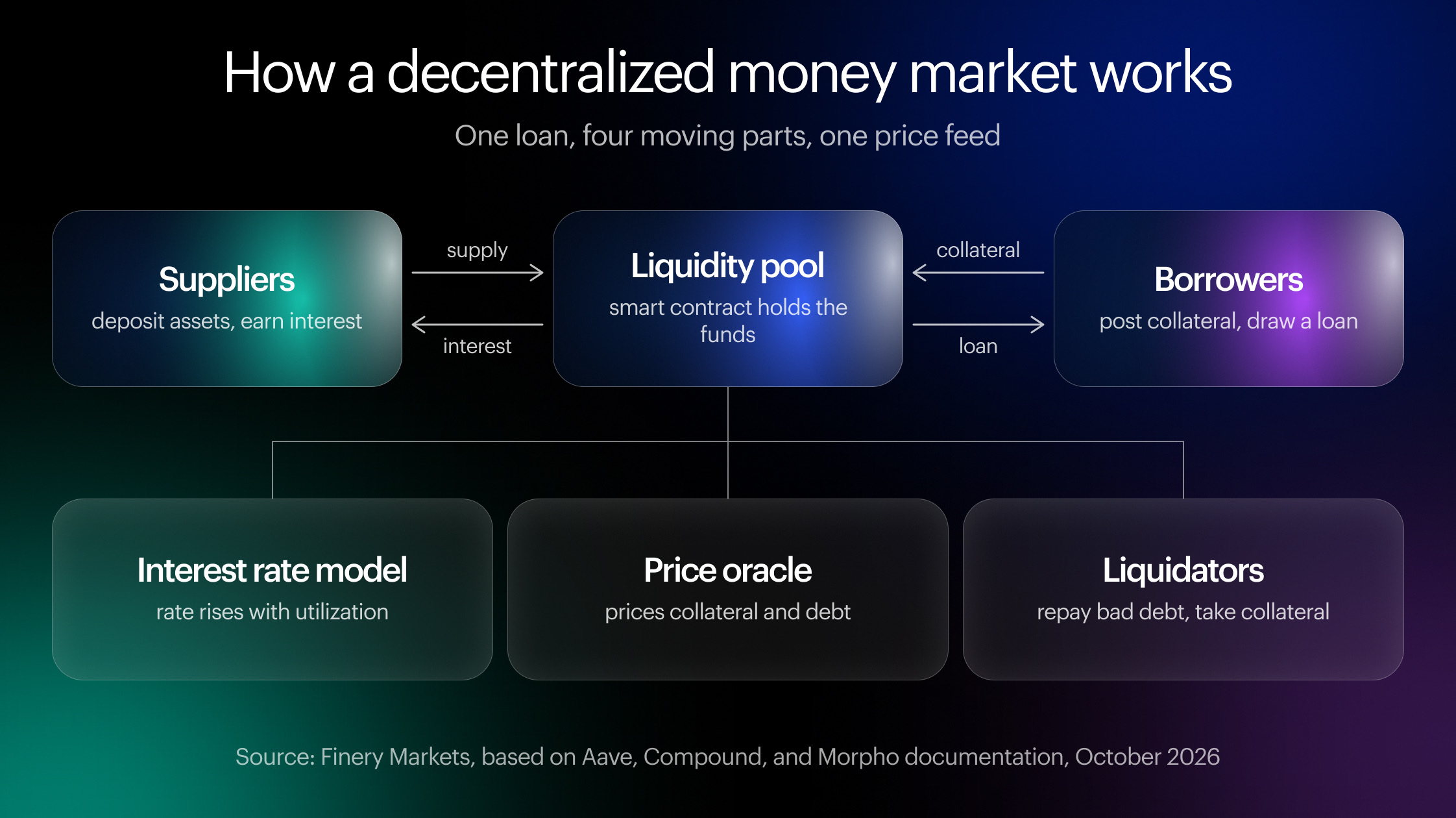
Every decentralized money market has four moving parts: a liquidity pool, a collateral rule, an interest rate model, and a liquidation mechanism, with a price oracle feeding all four. The sections below follow a loan through each of them.
Supplying assets and interest-bearing tokens
A lender who wants to lend assets transfers them, usually a stablecoin or a major crypto asset, into the protocol's smart contract. In return the lender receives a token that represents the deposit plus accrued interest. On Aave these are aTokens, interest-bearing representations of the underlying assets; on Compound v3 the supplied base asset accrues directly to the account balance. Outside permissioned markets, the receipt token can trade freely, which lets deposited funds be used elsewhere in the DeFi ecosystem as collateral or as a yield-bearing instrument. A lender keeps earning on a deposit while the receipt token works elsewhere. This composability is why DeFi protocols are often called money legos.
The deposited funds are not matched to a specific borrower. They sit in a shared liquidity pool, and the pool generates interest from the aggregate borrowing against it. A lender can withdraw at any time as long as the pool holds enough unborrowed liquidity to cover the withdrawal.
Borrowing against collateral: LTV, liquidation threshold, and health factor
A borrower posts collateral and draws a loan in another asset, typically a stablecoin. Three parameters govern the position. Aave's documentation defines the loan-to-value ratio as "the maximum percentage of a collateral asset's value that can be borrowed," so an LTV of 75% means 0.75 ETH can be borrowed against 1 ETH of collateral. The liquidation threshold is "the point at which a loan becomes eligible for liquidation due to insufficient collateral relative to borrowed funds." The health factor compares collateral value to borrowed value, and a reading below 1 makes the position eligible for liquidation.
Compound v3 applies the same logic under different names. Each collateral asset has a borrow collateral factor that sets initial borrowing capacity (the documentation's example is 85% for WBTC) and a higher liquidation collateral factor, so every new position starts with a price buffer before it can be liquidated. Morpho compresses the rule into a single liquidation loan-to-value, or LLTV, fixed per market from a governance-approved list that runs from 38.5% to 98%.
The practical consequence is that a borrower has to monitor the position continuously. A drop in the collateral's price, or a rise in the borrowed asset's price, moves the health factor toward 1 with no margin call and no grace period. Posting more collateral or repaying part of the debt are the only two ways back.
Interest rates set by utilization
Interest rates in a decentralized money market follow predefined logic rather than negotiation. The input is utilization, which Compound defines as total borrows divided by total supply. Both Aave and Compound use a kinked curve: the rate rises gently while utilization sits below an optimal point and steeply above it. Compound's documentation puts it plainly: "above this point the interest rate increases more rapidly." Aave v3 describes the same model as two slopes, one below the optimal usage ratio and one from that point to 100%.
The steep second slope is a liquidity defense. When most of a pool is borrowed, lenders cannot withdraw, so the protocol raises the borrow rate until some borrowers repay or new lenders arrive. Rates therefore move with the pool's own balance sheet, and a desk that has chosen to borrow money from a pool can see its funding cost change within hours. The curve parameters are set by governance, which means they can also change by vote.
Liquidation and the role of price oracles
When a position's health factor falls below 1, any third party can repay part of the debt and receive the collateral at a discount. Aave's glossary calls this discount the liquidation bonus, "the bonus provided to liquidators as an incentive to purchase undercollateralized assets." In Aave v4 the bonus follows a Dutch auction, so lower health factors pay larger bonuses. Compound's absorb function takes the collateral into the protocol and returns its value, minus a penalty, to the user in the base asset.
All of this depends on the protocol knowing the price of the collateral, and smart contracts cannot read market prices on their own. An oracle supplies the price. If the oracle reports a price below the market, solvent borrowers are liquidated by mistake; if it reports a price above the market, borrowers can open positions that are undercollateralized in reality. For an institution, oracle choice and update frequency belong in the credit analysis.
Pooled markets vs isolated markets: two protocol designs
Decentralized money markets have split into two architectures, and the choice between them changes who bears which risk.
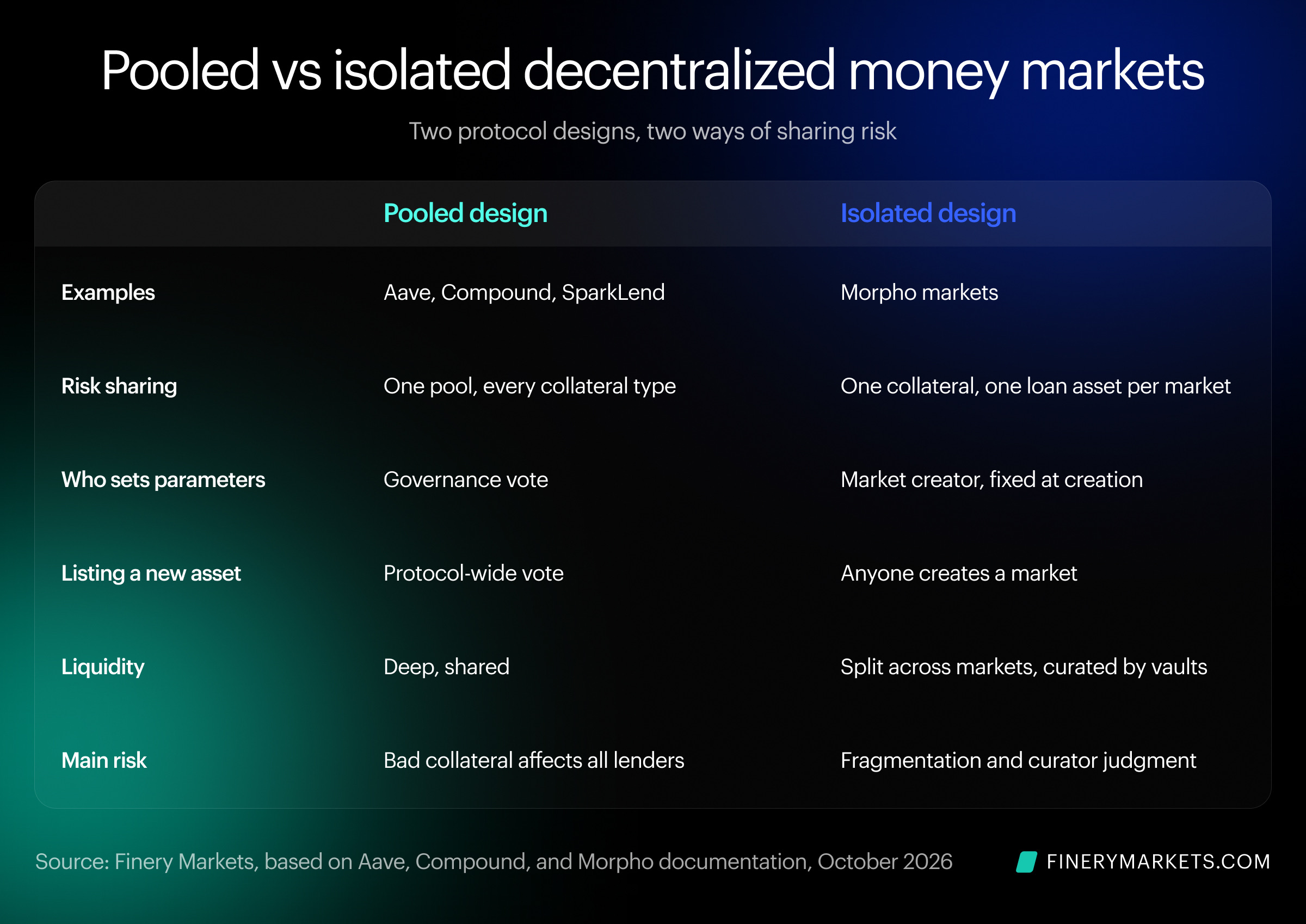
In a pooled design, such as Aave or Compound, all listed assets share one pool and one set of governance-managed parameters. A lender's deposit is exposed to every collateral type the protocol accepts, which is why listing decisions are the most contested votes in these protocols. The benefit is depth: one large pool, one risk framework, and liquidity that a borrower can draw against many collateral types at once.
In an isolated design, such as Morpho, each market pairs one collateral asset with one loan asset and five fixed parameters: the collateral, the loan asset, the LLTV, the oracle, and the interest rate model. Morpho's documentation states that each parameter "persists in perpetuity" once a market is created, and because market creation is permissionless, anyone can create a decentralized money market of their own by choosing those five values. Risk is contained within each pair, so a bad collateral asset cannot drain a pool it was never part of. The cost is fragmentation: liquidity is split across markets, and someone has to decide which markets deserve deposits. That job falls to curators, who run vaults that allocate deposits across markets and set their own risk limits.
Permissioned markets are a third variant layered on either design. Aave Horizon runs on Aave Protocol v3.3 and lets qualified institutions borrow stablecoins against tokenized funds from Superstate and Centrifuge, with each issuer setting its own KYC and whitelisting rules, and with aTokens made non-transferable to respect transfer restrictions. Maple's institutional pools apply a similar permissioned model with professional management and a stated collateral ratio of 159% as of October 2026.
How money markets fit into decentralized finance (DeFi)
A decentralized money market is one component of the wider decentralized finance ecosystem, and it rarely operates alone. Decentralized exchanges supply the swap leg: a borrower who draws USDC against ETH and wants more ETH needs a venue to trade, and liquidators need a venue to sell seized collateral. (Our comparison of CEXs, DEXs and crypto ECNs covers how those venues differ for institutions.) Stablecoins supply the unit of account. Most borrowing in these pools is denominated in USDC, USDT, or DAI, and stablecoins in circulation stood at $301.2 billion on October 21, 2026, according to DefiLlama.
Every layer runs on the same blockchain technology, which is what lets the layers call one another. The money market plays the role for the rest of the DeFi economy that repo plays in traditional finance: it is where idle balances become working capital.
Flash loans, no-loss lotteries, and other composable uses
Because the pool, the exchange, and the borrower's wallet are all on the same chain, one transaction can link them together with minimal friction. Flash loans are the clearest example: a borrower takes an uncollateralized loan, uses it, and repays it inside the same transaction, which reverts entirely if repayment fails. Arbitrageurs and liquidators use flash loans to fund a position they will close seconds later. No-loss lotteries such as PoolTogether deposit pooled user funds into a money market and distribute the interest as a prize while returning principal. Yield aggregators and other DeFi apps route deposits to whichever pool pays most. None of these DeFi applications would work without a money market underneath to generate interest.
The decentralized money market in 2026: size, concentration, and stress
The data on lending protocols in 2026 shows consolidation rather than retreat, and the market is concentrating. DefiLlama's lending category totaled $52.2 billion in value locked on October 21, 2026. Aave held $18.2 billion of that, Morpho $11.3 billion, SparkLend $5.1 billion, JustLend $3.7 billion, Maple $2.7 billion, and Compound $1.5 billion. The top two protocols account for more than half of the category.
Galaxy Research's Q2 2026 leverage report records the first quarter since Q4 2022 in which onchain lending declined across every category. Crypto-collateralized lending fell 16.78% in the quarter to $56.16 billion, 40.13% below its Q3 2025 high of $78.69 billion. DeFi lending applications held $20.43 billion of that, a 36.37% share, with centralized venues at 40.93% and the collateralized portion of CDP stablecoins at 22.7%. The onchain share fell 544 basis points in a quarter, a reminder that decentralized money markets compete with centralized lenders for the same institutional borrowers.
The stress test came in April 2026. Our May 2026 market update at Finery Markets counted almost 30 hacks and $635 million in losses that month, with roughly $13.5 billion of total value locked withdrawn within 48 hours. Aave lost $17 billion in deposits, 38% of its total, and $5.5 billion, or 31%, of its active loans. The same update found no spillover into centralized exchanges or OTC markets: DEX volumes fell 22% month on month while OTC volumes rose 22%. Konstantin Shulga, our CEO and co-founder, described a liquidity ecosystem that "proved highly interconnected, yet structurally isolated."
That isolation cuts both ways. It limited contagion from DeFi into the venues where institutions execute most of their volume. It also means that liquidity inside a decentralized money market cannot be assumed to be available on demand when the rest of the market is under stress.
Who uses decentralized money markets, and for what
The borrowers and lenders in these pools are no longer only crypto-native funds. The use cases now sort by business type.
Trading firms and market makers borrow stablecoins against digital assets held as inventory to fund working capital without selling positions. The appeal is speed and the absence of a credit negotiation; the cost is liquidation risk on volatile collateral.
Brokers and fintechs use DeFi platforms as the lending engine behind their own product. Coinbase's crypto-backed loans are the clearest example: customer bitcoin is converted to cbBTC and posted to a Morpho market, USDC is credited to the customer, and, in Coinbase's own words, "loans are sourced and managed permissionlessly on the Morpho protocol." The broker keeps the client relationship and the interface. The protocol carries the loan.
Asset managers and tokenized fund issuers supply collateral. Aave Horizon's launch collateral came from Superstate's USTB and USCC and Centrifuge's JRTSY and JAAA, with Circle's USYC announced as next. For these issuers, a permissioned money market is a secondary-market function: it gives holders of a tokenized fund a way to borrow against it without redeeming, which addresses part of the RWA liquidity gap.
Treasury teams and stablecoin issuers are the main lenders. Supplying stablecoins to a pool is the simplest way to earn interest onchain, and in a permissioned market such as Horizon the supply side stays open while the borrow side is restricted to qualified institutions. Spark, part of the Sky ecosystem, operates as a capital allocator in this role, directing institutional capital into DeFi markets through its liquidity layer.
OTC desks and payment providers sit at the edge. They rarely borrow in these pools, but they are the venues where borrowed stablecoins get converted into fiat or other assets, and where liquidated collateral eventually reaches the wider market.
What institutions need before using a decentralized money market
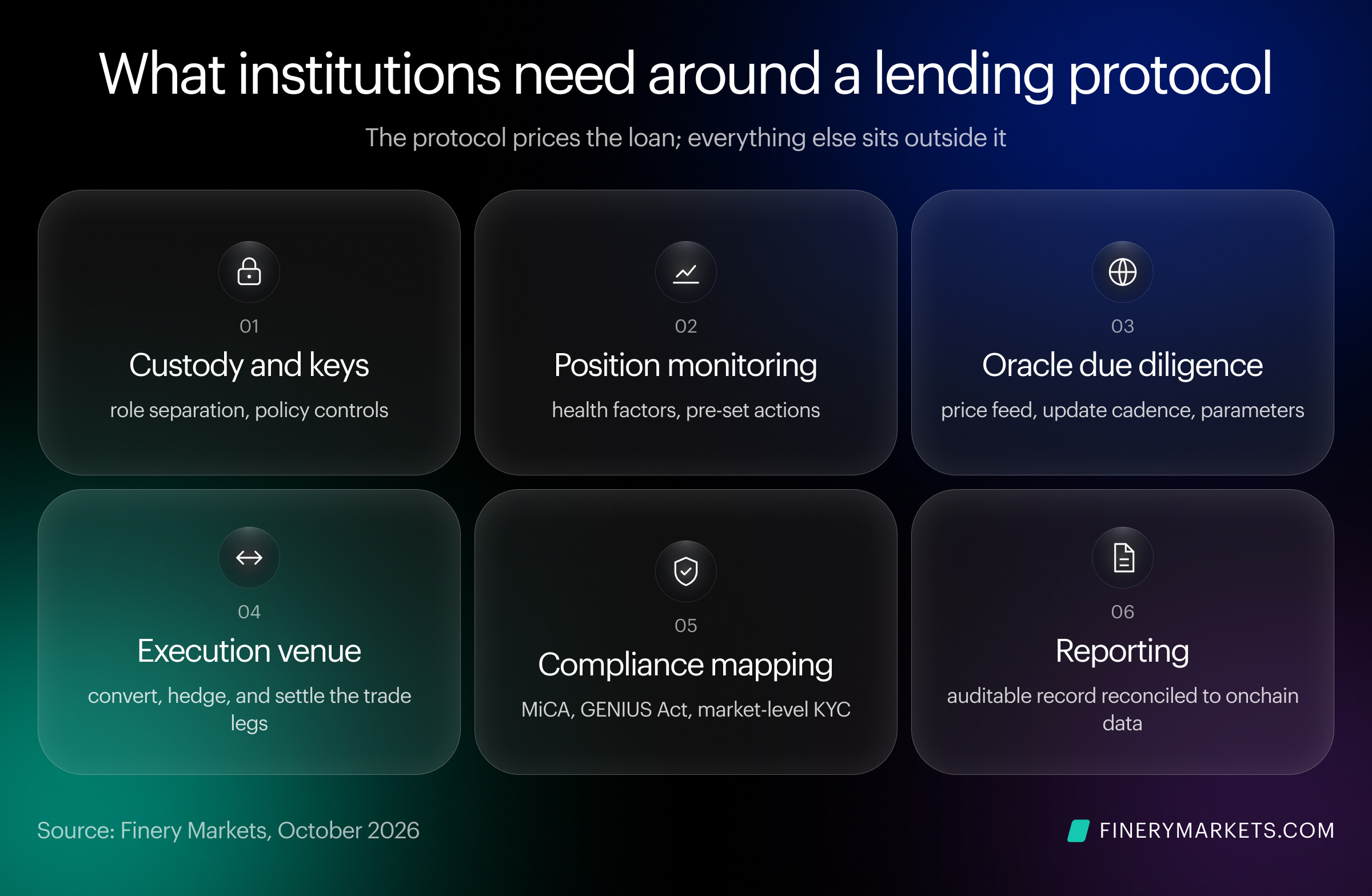
Using a lending protocol at institutional scale requires infrastructure that the protocol itself does not provide. The minimum set covers seven areas:
- Custody and key management: a wallet structure with role separation and policy controls, since the protocol interacts with a private key, not a legal entity. Our guide to institutional crypto custody compares the models.
- Position monitoring: real-time tracking of health factors across every market, with pre-set actions (add collateral, repay) before a threshold is breached.
- Oracle and parameter due diligence: knowledge of which price feed each market uses, how often it updates, and how the LTV and liquidation parameters can change.
- An execution venue for the trade legs: a place to convert borrowed stablecoins, buy collateral, or hedge exposure with firm pricing and settlement the firm controls.
- Compliance mapping: whether the activity falls under MiCA in the EU, under the GENIUS Act's stablecoin regime in the US, or under a permissioned market's own KYC regime.
- Accounting and reporting: a record of every supply, borrow, repayment, liquidation, and the transaction fees paid, that an auditor can reconcile against onchain data.
- Counterparty and legal analysis: who controls the protocol's governance, who can pause it, and what recourse exists if it fails.
The regulatory item deserves a note. MiCA's Recital 22 states that "where crypto-asset services are provided in a fully decentralised manner without any intermediary," they do not fall within the scope of the Regulation, while service providers operating around such assets are covered. The GENIUS Act, signed on July 18, 2025, created the first federal regulatory system for stablecoin issuers in the United States, which bears directly on the assets that dominate these pools. Neither law regulates a lending protocol as such, so an institution's obligations attach to its own role: as a custodian, a broker, an issuer, or a provider of financial services.
Where onchain credit meets offchain execution
A loan from a decentralized money market is rarely the end of the workflow. The borrowed stablecoins have to become something: a hedge, a fiat payment, more inventory, or collateral somewhere else. A liquidation produces collateral that has to be sold. The lending protocol handles none of that, and in April 2026 the venues that did handle it were structurally separate from the pools under stress.
At Finery Markets, we provide the execution layer that institutions use for those legs. Our multi-dealer marketplace connects 150+ institutional counterparties, liquidity takers such as brokers, payment providers, OTC desks, and fintechs on one side and liquidity providers such as market makers and OTC desks on the other, across 200+ crypto and fiat pairs through a single FIX, WebSocket, or REST connection. Participants choose between a firm order book with no last look, request-for-quote for larger or less liquid positions, and direct quote streams from a chosen provider. Trading runs on bilateral credit lines with reduced or zero pre-funding and post-trade settlement, so a desk can execute the trade around a loan without first parking capital on an exchange. Since September 2025, a gateway in our interface built with Yield.xyz has also given clients access to DeFi yields through protocols including Aave, Morpho and Compound, so supplying idle balances to a money market and trading around that position can happen in one environment.
The scale of stablecoin flow through this layer is the relevant proof point. According to our Crypto OTC Trading Report 2026, stablecoins' share of institutional OTC transaction volume rose from 23% in 2023 to 78% in 2025, and institutional spot OTC volumes grew 109% year over year while the top 20 centralized exchanges grew 9%. In the first nine months of 2026, stablecoins accounted for 83% of trades by number across our network. The stablecoin that leaves a lending pool is increasingly the same instrument that settles institutional OTC trades.
We are a non-custodial software provider. We do not run a lending protocol, hold or move client assets, act as a counterparty, or replace the custodian, bank, or regulated intermediary in the workflow. We supply the infrastructure through which our clients price, execute, and settle with one another.
Risks and limitations
The risks involved in a decentralized money market are structural, and regulators have documented them in detail.
Smart contract risk
The pool is code, and code has bugs. The BIS Quarterly Review of December 2021 notes that in October 2021 an update to Compound "introduced an error that incorrectly distributed rewards worth $90 million." Audits reduce this risk without removing it, and April 2026 showed what a month of exploits does to deposits.
Oracle risk
A wrong price liquidates solvent borrowers or lets insolvent ones borrow more funds. Each market's oracle is a dependency with its own failure modes, and in isolated designs the oracle is chosen by whoever created the market.
Liquidation cascades and procyclicality
The Financial Stability Board's February 2023 report on DeFi finds that automatic liquidation "is a primary reason why deleveraging dynamics in DeFi can be especially disruptive," and that the orderly liquidation mechanisms and circuit breakers of traditional markets "are absent in DeFi today." The BIS adds that overcollateralization itself "generates procyclicality": collateral requirements bite when prices fall, which forces selling into a falling market.
Governance concentration
The BIS describes a "decentralisation illusion," since every protocol has centralized components, chiefly the governance token holders, often the developers, who vote on parameters. For an institution this is counterparty risk in a new form: the counterparty is a voting process.
Liquidity mismatch and collateral chains
Lenders can withdraw on demand, borrowers have no term, and the only tool that balances the two is the interest rate. In a stressed pool, withdrawals can be blocked by high utilization at exactly the moment a lender wants out. The FSB also notes that borrowed funds are often reused as collateral for further loans, akin to rehypothecation, which makes true leverage hard to measure from outside.
None of these risks is hidden. A desk that monitors them prices them differently from one that does not.
Outlook: where decentralized money markets go next
Three trends are visible in the 2026 data for decentralized finance lending. Collateral is broadening from crypto assets to tokenized funds and other digital assets, with Aave Horizon, Maple, and Spark all building on real-world assets as the loan's security. Market design is moving toward isolation and curation, with Morpho's vault and curator model turning risk selection into a service. And permissioning is becoming a feature rather than a contradiction: issuers set the rules for who can borrow, while the supply side stays open to lenders worldwide.
The BIS has argued that for DeFi lending to reach the real economy it must tokenize real assets and rely less on collateral, and that the system "is likely to gravitate towards greater centralisation" as a result. Aave Horizon and Maple are early evidence for that forecast: the fastest-growing institutional markets are the ones with a gatekeeper.
What has not changed is the division of labor. A decentralized money market prices and enforces the loan. It does not source the liquidity to trade around it, settle in fiat, or absorb a shock. The April 2026 episode made that division visible: the largest pool lost a third of its active loans in days, and the venues where institutions execute kept running. Onchain credit is a funding tool whose risk lives in parameters, oracles, and votes, and its value to an institution depends on the execution and settlement infrastructure that sits beside it.
FAQ
What is a decentralized money market?
A decentralized money market is a lending pool run by smart contracts on a public blockchain. Lenders deposit digital assets to earn interest, borrowers post collateral worth more than their loan, interest rates adjust to utilization, and positions that fall below a collateral threshold are liquidated automatically, without a bank or central counterparty.
How is a decentralized money market different from a decentralized exchange?
A decentralized exchange swaps one asset for another at a market price. A decentralized money market lends one asset against another as collateral and charges interest over time. The two are complementary: exchanges supply the swap leg for borrowers and liquidators, and money markets supply the credit leg for traders and liquidity providers.
Why are DeFi loans overcollateralized?
Because borrowers are pseudonymous wallets with no credit history or legal recourse, the protocol can only trust collateral it holds. Overcollateralization protects lenders, but the BIS notes it limits credit to borrowers who already hold assets and creates procyclicality when prices fall and collateral requirements bite.
What are the risks of decentralized finance lending?
Smart contract bugs, oracle errors, liquidation cascades in falling markets, governance concentration among token holders, liquidity mismatches between on-demand lenders and open-ended borrowers, and hidden leverage from reused collateral. Regulators including the BIS and the FSB have documented each of these, and the April 2026 hacks demonstrated several at once.
What happens when a loan is liquidated?
When a position's health factor drops below 1, a third-party liquidator repays part of the debt and receives collateral at a discount, the liquidation bonus. The borrower keeps the remaining collateral but loses the discounted portion. There is no margin call or grace period; the process starts as soon as the oracle price crosses the threshold.
Can institutions use a decentralized money market?
Yes, and increasingly through permissioned markets. Aave Horizon lets qualified institutions borrow stablecoins against tokenized Treasury funds under issuer-set KYC rules, Maple runs permissioned pools for professional allocators, and brokers such as Coinbase route customer loans through Morpho. Each requires custody, monitoring, compliance, and execution infrastructure around the protocol.
What is a flash loan?
A flash loan is an uncollateralized loan that is borrowed and repaid within a single blockchain transaction. If repayment fails, the whole transaction reverts and the loan never happened. Arbitrageurs and liquidators use flash loans to fund positions they will close seconds later, which makes them a tool for professionals rather than a form of credit.


 LinkedIn
 Youtube
 Medium
 Twitter