The tokenization of assets is the process of recording ownership of an asset, or a claim on it, as a digital token on a distributed ledger, so the asset can be issued, transferred, and settled on shared infrastructure. The asset itself stays the same: a Treasury bill is still a Treasury bill, with a new record of who owns it and new rails to move on.
The numbers are still small next to global financial markets, but the direction is set. RWA.xyz tracked $38.88 billion of tokenized real-world assets that can move between wallets as of October 8, 2026, and a further $361.62 billion recorded on ledgers without being freely transferable. In July 2026, more than 30 firms completed live trades in tokenized securities held at the Depository Trust Company (DTC), ahead of a service launch scheduled for October. Broadridge's distributed ledger repo platform processed $8.0 trillion in the same month.
Issuing a token has become the easy part. The harder questions sit around it: what the holder legally owns, where the token can be traded, who quotes a price, and how the cash leg settles. This guide explains how asset tokenization works, the models in use, what is being tokenized today, and the infrastructure tokenized assets need before they function as markets.
What is the tokenization of assets?
Tokenization of assets means creating a digital representation of an asset, or of rights to it, on a distributed ledger. The token carries the ownership record and can embed rules for transfer, eligibility, and payments. The underlying asset stays in custody, in a fund, or on an issuer's register, and the token takes its value from it.
The U.S. Securities and Exchange Commission staff gave the term a working definition in its Statement on Tokenized Securities of January 28, 2026. A tokenized security is a financial instrument that meets the legal definition of a security, is formatted as or represented by a crypto asset, and has its record of ownership maintained in whole or in part on one or more crypto networks. The statement added the point that matters most to compliance teams: the format in which a security is issued does not affect how federal securities laws apply.
Three boundaries keep the term precise. First, tokenized assets differ from native digital assets such as bitcoin, which have no underlying reference asset and exist only on their own blockchain network. Second, tokenization differs from digitization. Most financial assets already exist in digital form in a securities depository or a transfer agent's database. With tokenization, the record sits on a shared digital ledger that several parties read and write to under common rules.
Third, a token is only as good as the legal claim behind it. Some digital tokens are the share or bond itself. Others give economic exposure to an asset that a third party holds.
How asset tokenization works
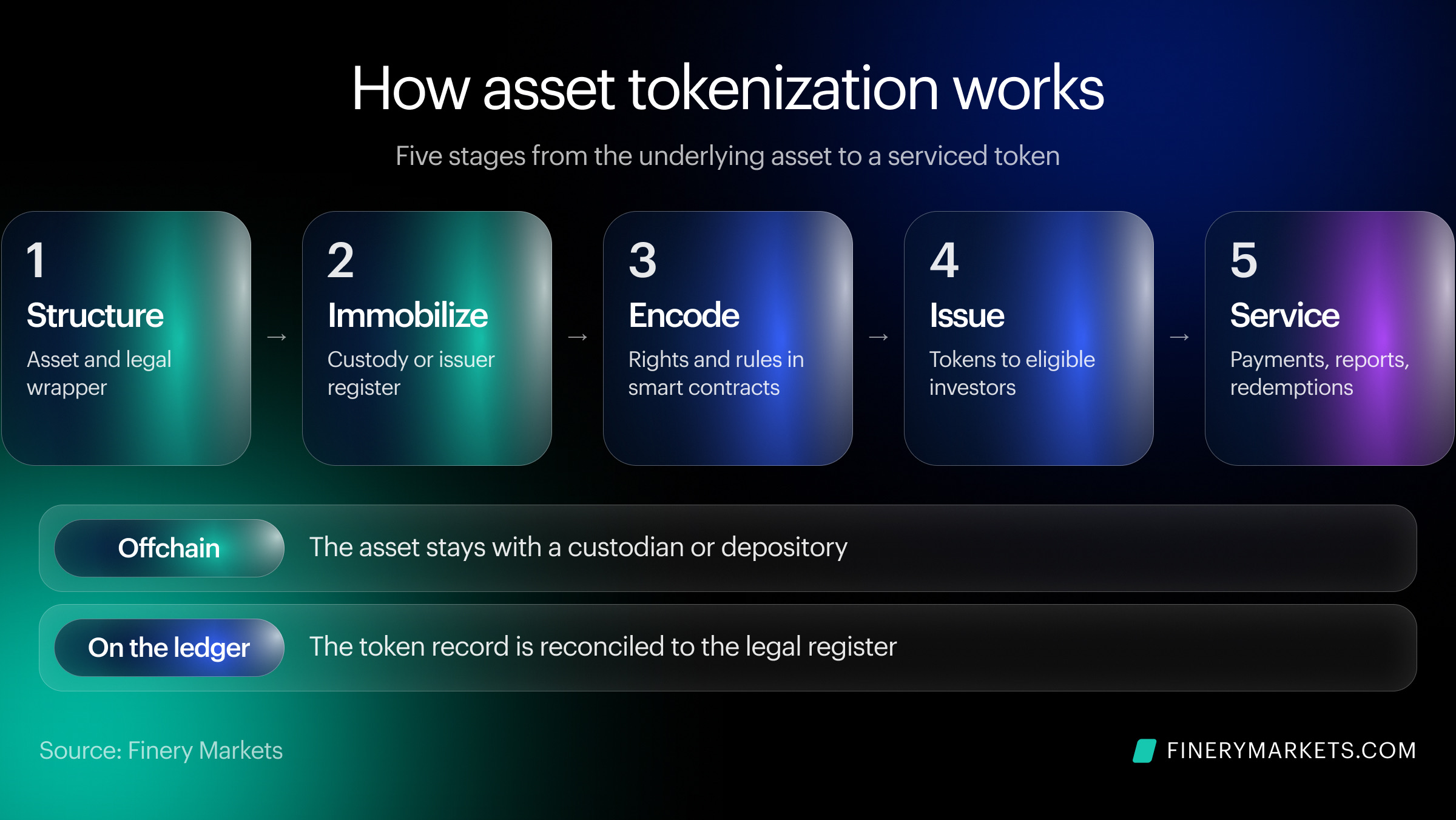
A tokenization project runs through the same stages whatever the asset class. Blockchain technology is one part of the work. The legal structure and the servicing arrangements take longer.
- Select and structure the asset. The issuer decides what is being tokenized (a fund share, a bond, a loan pool, a property held in a special-purpose vehicle) and which legal wrapper connects the token to it.
- Immobilize the underlying asset. The asset is placed with a custodian, trustee, or depository, or recorded on the issuer's register, so it cannot be sold twice while tokens circulate.
- Encode rights and rules. Smart contracts define the token: supply, transfer restrictions, investor eligibility, and events such as coupons, dividends, and redemptions.
- Issue and distribute. Tokens are minted on the chosen network to investors who have passed onboarding checks, usually against payment in fiat, stablecoins, or deposit tokens.
- Service the asset through its life. Corporate actions, reporting, redemptions, and secondary transfers run for as long as the token is outstanding, and the onchain record is reconciled to the legal register.
The distributed ledger and smart contracts
Distributed ledger technology supplies the shared record. Every permitted participant sees the same state, which removes much of the reconciliation that traditional systems perform between separate databases. Smart contracts supply the logic. They can move the asset and the payment in a single step and pay distributions without manual instruction.
Issuers choose between public blockchains, where tokens can interact with other applications, and permissioned networks, where an operator or consortium controls access. DTC's July 2026 production trades used both kinds: a private network run by DTCC and the Canton network. The choice shapes privacy, interoperability, and who can gain access to the asset later.
Tokenization models: who issues the token and what the holder owns
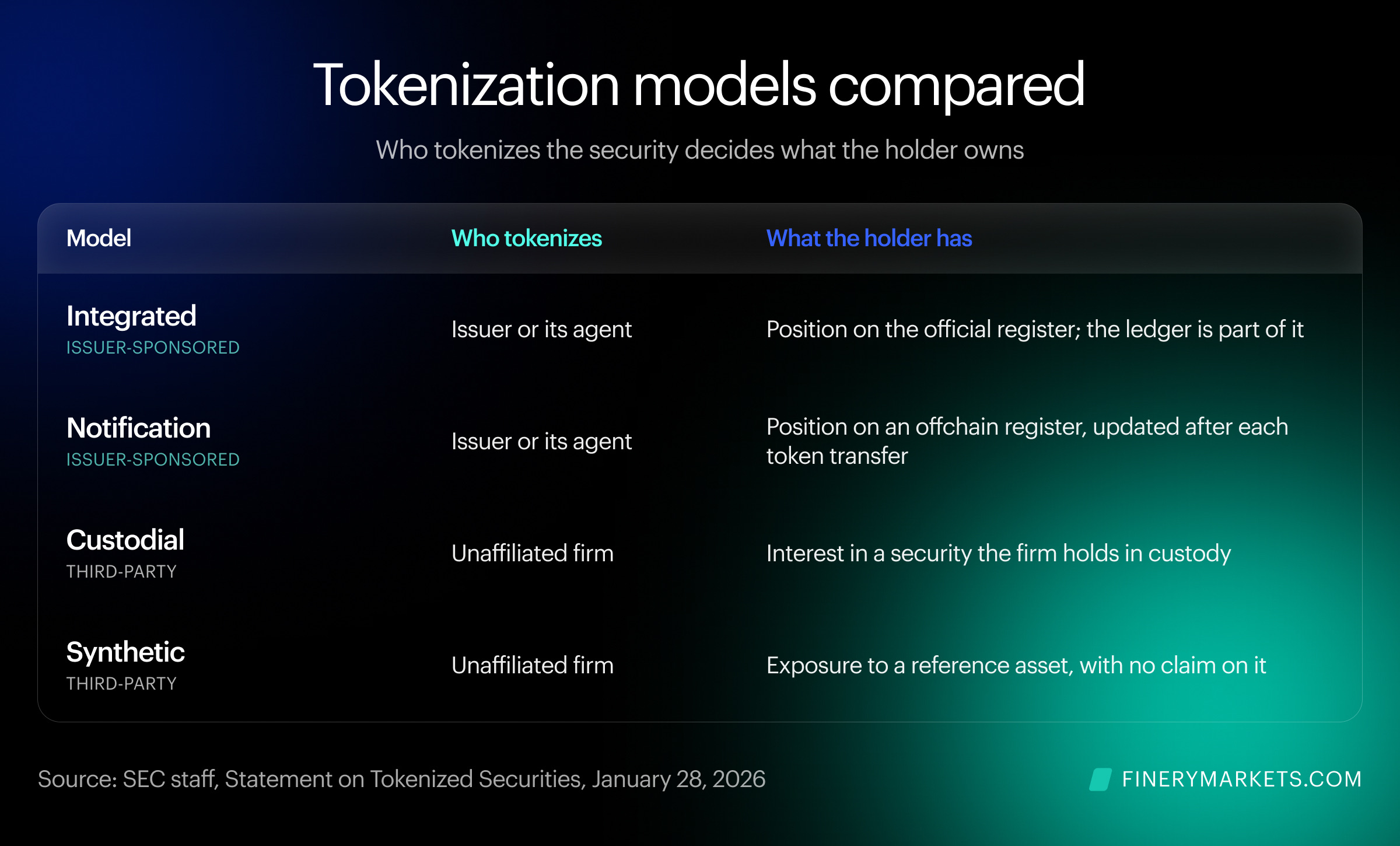
The SEC staff statement sorts tokenized securities by who does the tokenizing. The distinction decides which ownership rights the holder has, and it is a useful way to read any tokenized product, in any jurisdiction.
In issuer-sponsored tokenization, the issuer or its agent puts the security on a ledger. In an integrated model, the distributed ledger is part of the master securityholder file, so an onchain transfer is a transfer on the official record. In a notification model, the ledger sits outside the official register, and each token transfer instructs an offchain system to update it.
In third-party tokenization, a firm unaffiliated with the issuer creates the token. A custodial tokenized security represents an interest in a security that the third party holds in custody, much like a traditional indirect holding. A synthetic tokenized security gives exposure to a reference asset without any claim on it, for example through a linked note or a security-based swap formatted as a crypto asset.
The practical test for any product is short: who is the issuer, where is the legal register, and what happens to the holder if the tokenizing party fails. Asset ownership through an issuer-sponsored token and price exposure through a synthetic one can trade under similar tickers and carry very different risks. The token format also changes nothing about disclosure, suitability, or investment advice obligations toward the end investor.
What can be tokenized? The main categories today
In principle, any asset with a definable owner and a legal structure can be tokenized, and pilots exist in many sectors. In practice, activity concentrates in instruments that are standardized and easy to value. These are the main categories in October 2026, with values from RWA.xyz:
- Cash and cash equivalents. Stablecoins are tokenized claims on fiat reserves and remain the largest category by far, at $295.09 billion. Banks have added deposit tokens: JPMorgan made its U.S. dollar deposit token, JPM Coin, available to institutional clients on the Base network in November 2025.
- Money market funds and Treasuries. Tokenized U.S. Treasury funds held $15.00 billion across 109 products on October 7, 2026. Circle's USYC, Ondo's USDY, and BlackRock's BUIDL each exceed $2.2 billion.
- Bonds and private credit. Loans, corporate bonds, and structured credit are issued or recorded on a ledger to shorten settlement and widen distribution.
- Equities. Tokenized company shares and ETFs are the newest institutional category, and the one that U.S. exchanges and the central depository are now building for.
- Commodities. Gold-backed tokens dominate, led by XAUT at $3.0 billion and PAXG at $1.8 billion.
- Private equity and venture capital funds. Tokenized feeder vehicles lower minimums and automate transfers for alternative investment products.
- Real estate. Property is usually tokenized through a vehicle that owns the building, with tokens representing fractional ownership of that vehicle.
Stablecoins matter for a second reason: they are the cash leg for most other tokenized assets. According to Finery Markets' Crypto OTC Trading Report 2026, stablecoins' share of institutional OTC transaction volume rose from 23% in 2023 to 78% in 2025. In the first nine months of 2026, stablecoins accounted for 83% of trades by number on our network.
Why tokenization matters now: the market in 2026
Tokenized assets excluding stablecoins were worth less than $3 billion in mid-2024. By April 2026 they had crossed $30 billion, according to a16z crypto's analysis of RWA.xyz data. The growth came from investment products that institutional investors already understand, with tokenized money market funds and Treasury products in front.
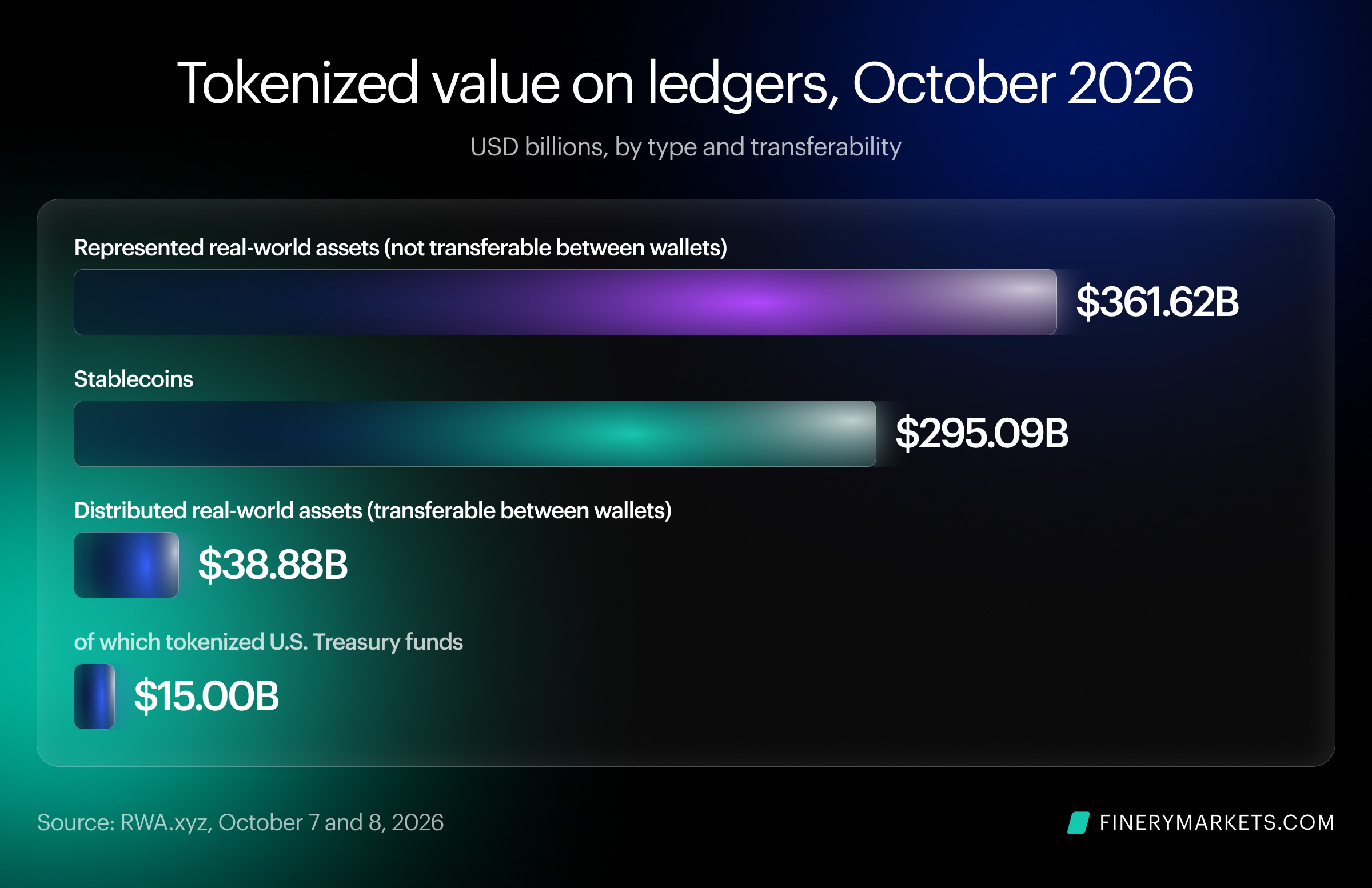
The $38.88 billion headline needs one qualification. RWA.xyz separates distributed assets, which can be moved to wallets outside the issuing platform and transferred between them, from represented assets, which cannot. The represented figure, $361.62 billion, is more than nine times larger. Most tokenization so far has upgraded the record-keeping of traditional assets without making them transferable.
Regulators and market infrastructure in the United States have moved in sequence since mid-2025:
- July 18, 2025: the GENIUS Act became law and set a federal framework for payment stablecoins.
- December 11, 2025: DTC received an SEC no-action letter to tokenize custodied assets on pre-approved blockchains for three years, covering Russell 1000 stocks, ETFs that track major indices, and U.S. Treasury bills, bonds, and notes.
- January 28, 2026: SEC staff published the taxonomy of tokenized securities described above.
- March 18, 2026: the SEC approved a Nasdaq rule change that lets eligible securities trade in tokenized form on the same order book, with the same CUSIP and shareholder rights.
- July 15, 2026: DTCC processed tokenized trades covering collateral, securities lending, repo, and equities with more than 30 firms.
In the European Union, MiCA does not apply to crypto assets that qualify as financial instruments, so tokenized securities stay under existing securities law. The DLT Pilot Regime, in application since March 23, 2023, lets market infrastructures trade and settle them on distributed ledgers within size limits.
Forecasts vary widely because they count different things. McKinsey estimated in June 2024 that tokenized market capitalization could reach around $2 trillion by 2030, excluding cryptocurrencies and stablecoins. Ripple and BCG projected $18.9 trillion by 2033 in April 2025. PwC expects tokenized fund assets under management alone to reach $715 billion globally by 2030. The spread reflects uncertainty about how quickly legal, custody, and trading arrangements will catch up, and it says little about the potential value of any single product.
Benefits of tokenization for issuers and institutional investors
The benefits of tokenization are operational first. They come from putting the asset, the cash, and the rules on one ledger, and they show up as operational efficiencies before they show up as new value for investors.
- Faster settlement. Delivery and payment can complete together within minutes at any hour, which cuts counterparty exposure and frees balance sheet capacity tied up in settlement cycles.
- Collateral mobility. A tokenized fund share can be pledged, moved, and released intraday. This is the use case behind most tokenized Treasury demand and behind repo platforms such as Broadridge's, which averaged $365 billion in daily transactions in July 2026.
- Programmability. Smart contracts automate coupons, cash sweeps, margin calls, and transfer restrictions, which reduces manual error.
- Real-time visibility. Issuers, administrators, and supervisors can see holdings and transactions as they happen instead of waiting for end-of-day files.
- Fractional ownership and access. Lower minimums let wealth managers and smaller institutions reach private equity, credit, and real estate that used to require large tickets, and widen the set of investable assets.
- Yield on idle cash. Under the GENIUS Act, payment stablecoin issuers cannot pay interest to holders. J.P. Morgan Asset Management points to this as one driver of demand for tokenized money market funds.
One benefit is often overstated: increased liquidity. A tokenized fund share can remain an illiquid asset. A token makes an asset easier to transfer, but whether anyone wants to buy it, at what price, and in what size depends on market structure.
Who uses tokenized assets, and for what
Adoption in the financial services industry is led by firms with a specific operational problem to solve. The potential benefits differ by business type:
- Asset managers issue tokenized share classes of money market funds and alternatives to reach new distribution channels. In PwC's November 2025 survey, more than 40% of managers said tokenization will be their most important future product innovation.
- Banks and custodians issue deposit tokens, hold tokenized securities for clients, and use tokenized collateral in repo and margin workflows.
- Corporates and treasurers move cash between entities around the clock and sweep balances into tokenized funds that match their investment objectives.
- Brokers, wealth managers, and fintechs distribute tokenized funds and equities. A 2023 EY-Parthenon survey found that 77% of institutional and 80% of high-net-worth investors wanted to buy tokenized assets through traditional financial institutions.
- Stablecoin issuers and payment providers hold tokenized Treasuries as reserves and use tokenized cash for settlement.
- Trading firms and market makers quote tokenized assets, post them as collateral, and trade the difference between onchain and traditional venues.
What infrastructure do tokenized markets need?
A tokenized asset becomes a market when several layers work together. Issuance is only the first. Tokenization also keeps most traditional intermediaries in place: custodians, transfer agents, administrators, and dealers still have jobs to do, on new rails.
- Legal and issuance: structuring, transfer agency, and the link between token and register.
- Custody and key management: wallets, segregation of client assets, and recovery procedures.
- Regulatory compliance: onboarding, whitelists, transfer restrictions, and sanctions and Travel Rule screening.
- Liquidity: market makers and dealers willing to quote firm two-way prices.
- Execution: order books, request for quote, and streaming quotes suited to institutional size.
- Settlement: a credible cash leg in stablecoins, deposit tokens, or bank money, with delivery versus payment.
- Data and reporting: valuations, audit trails, and regulatory reports.
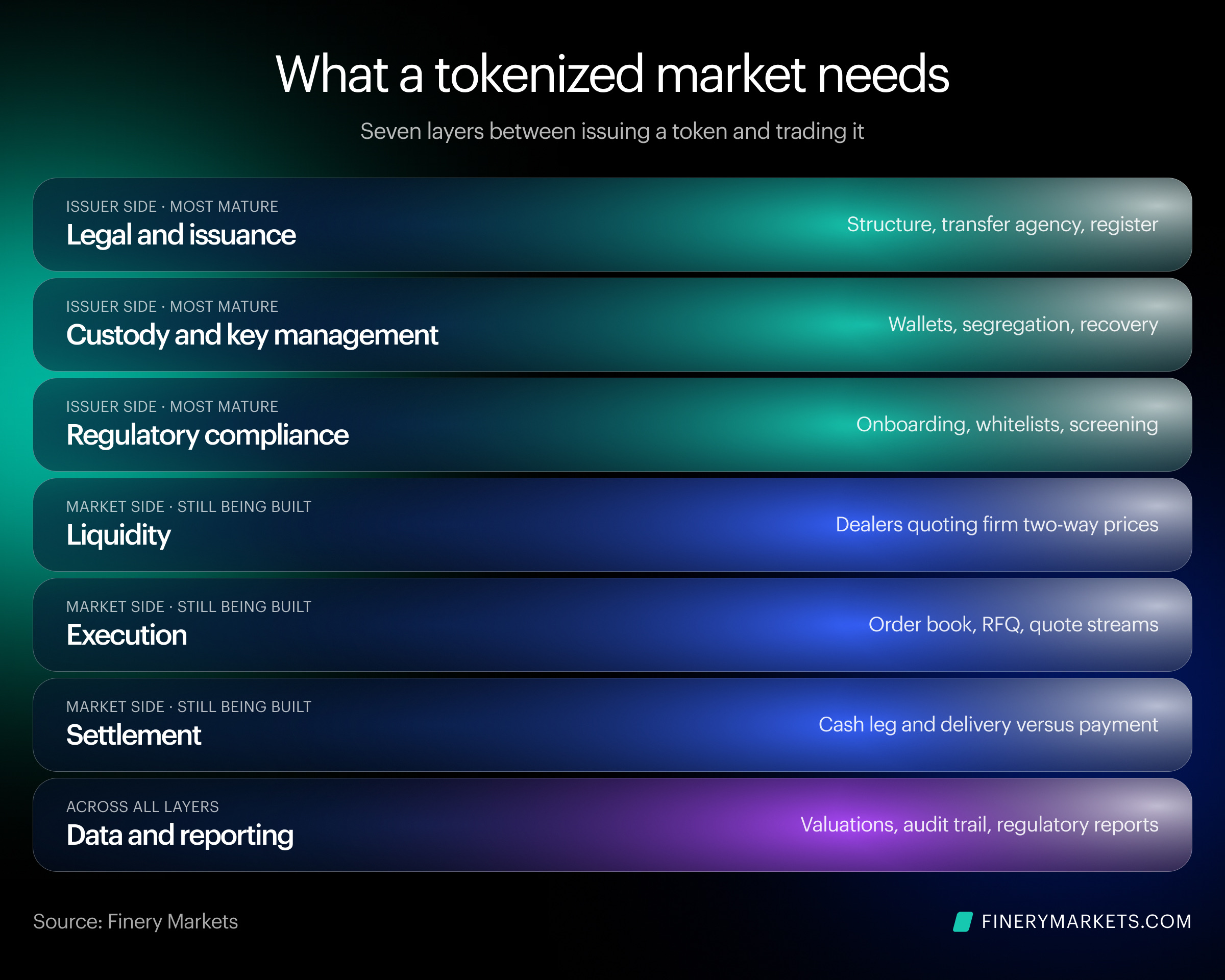
The first three layers have matured fastest, because issuers control them. The trading layers lag. BeInCrypto Intelligence found in July 2026 that 910 of the 1,289 tokenized assets worth more than $100,000, representing $32.9 billion, recorded zero weekly transfers, and that 62 assets held 88% of market value. We examine this gap in our guide to how tokenized assets become tradeable markets.
An institution evaluating a platform for tokenized assets should ask the questions it would ask in traditional finance. Are prices firm or indicative? How much capital must be pre-funded? Which asset settles the cash leg? Who holds the assets while a trade is open, and what reporting supports risk management and audit?
From issuance to execution: the trading layer behind tokenized assets
A token can be minted in minutes. A dealer willing to make a firm price in it, in institutional size, outside banking hours, is harder to arrange. That part of the stack is trading infrastructure, and it has to connect to wherever the asset and the cash are held.
At Finery Markets, we provide infrastructure of this kind for OTC spot digital assets and stablecoins. Our non-custodial technology connects liquidity takers such as brokers, payment providers, banks, and OTC desks with market makers and other liquidity providers through one integration. Participants on our multi-dealer liquidity marketplace trade through a firm order book, request for quote, or quote streams, on credit lines with reduced or zero pre-funding and post-trade settlement, and connect by FIX, WebSocket, or REST API.
More than 150 institutional participants are connected to our network. The relevance to tokenization lies in the cash leg and the operating model. Stablecoins are both the largest tokenized asset and the settlement instrument for most others. The stablecoin FX workflow that prices and settles USDC against euros is the workflow a tokenized fund share needs: several dealers competing, a firm price, bilateral limits, and netted settlement.
We do not tokenize assets, act as a transfer agent, or hold client assets, and tokenized securities remain subject to the licensing rules of each jurisdiction. Our role is the software through which regulated firms source liquidity and manage execution and post-trade workflows.
Risks and limitations
Legal certainty comes first. A holder needs to know whether the token or an offchain register prevails in a dispute, and what happens in the insolvency of the issuer, the custodian, or the tokenizing agent. Regulatory uncertainty persists in many jurisdictions, and a structure that works under one legal system may not be recognized in another.
Global standard setters remain cautious. In its final report on tokenization of November 11, 2025, IOSCO found that commercial interest is rising but adoption is still limited, that many market participants still rely on traditional infrastructure for trading and post-trade processes, and that the lack of credible settlement assets hinders scalability.
Fragmentation is the second constraint. The same asset can exist on several networks, and assets issued on closed bank ledgers cannot easily move to public ones. Until standards for interoperability settle, liquidity for one instrument can be split across venues that do not connect.
Operational risk changes shape without disappearing. Smart contract errors, lost keys, and cyber incidents replace some of the failures of traditional financial systems, and markets that never close require staffing, controls, and funding that most institutions built for business hours. The underlying asset also keeps its own credit, market, and valuation risk.
Outlook: tokenization moves into market plumbing
The next phase will be decided inside existing market infrastructure. With DTC tokenizing custodied securities, Nasdaq cleared to trade them on its main order book, and regulators treating the token as a format, tokenized and traditional assets are converging on the same legal footing. Regulatory clarity will not arrive evenly, and widespread adoption will come one asset class at a time, starting with cash, Treasuries, and collateral.
Financial services companies now have practical choices to make: which assets to hold in tokenized form, which networks to support, and which partners provide custody, liquidity, and settlement. Those choices will need revisiting as products multiply.
As financial markets evolve toward shared ledgers, the scarce resource shifts. Issuance capacity is abundant and getting cheaper. Balance sheet willing to quote, credit lines between counterparties, and reliable settlement between tokenized assets and tokenized cash are limited. In tokenized markets, greater efficiency will go to the parts of the financial ecosystem that supply them.
FAQ
What is tokenization of assets?
Tokenization of assets is the recording of ownership of an asset, or exposure to it, as a digital token on a distributed ledger. The underlying asset stays with a custodian, fund, or issuer, while the token carries the ownership record and transfer rules. It is used for funds, bonds, equities, cash, commodities, and real estate.
How do you tokenize an asset?
An issuer structures the asset in a legal wrapper, places it with a custodian or records it on a register, encodes rights and transfer rules in smart contracts, and issues tokens to eligible investors on a chosen blockchain. The issuer then services the token through payments, redemptions, and reporting for its full life.
What are examples of tokenized assets?
Stablecoins are the largest example, followed by tokenized U.S. Treasury and money market funds such as BUIDL, USYC, and USDY. Other examples include gold tokens, private credit pools, tokenized shares and ETFs, bank deposit tokens, and interests in private equity, venture capital funds, and real estate vehicles.
Can you tokenize a house or other real estate?
Yes, usually indirectly. The property is typically placed in a company or trust, and tokens represent shares in that vehicle, because a token is rarely accepted as title in a land register. The holder owns a fraction of the vehicle and depends on its governance and on local property law.
Which blockchain is best for tokenization?
No single network is best. Issuers choose by investor access, compliance tooling, privacy, cost, and integration with custodians and trading venues. Public and permissioned networks are both used in production, and many products are issued on several. DTC's tokenization service, for example, lists a DTCC-operated chain, Canton, and Stellar as eligible networks.
Is a tokenized asset the same as a crypto asset?
No. A tokenized asset takes its value from an underlying asset such as a bond or fund share and stays subject to the rules for that instrument. A native crypto asset such as bitcoin has no reference asset behind it. Regulators may describe the token's format as a crypto asset, but legal treatment follows the instrument.
Does tokenization make an asset more liquid?
Not automatically. Tokenization makes transfer and settlement easier, but liquidity requires buyers, sellers, and dealers quoting prices. Most tokenized assets by number trade rarely today. Liquidity improves when market makers, execution venues, and a reliable cash leg are connected to the asset.


 LinkedIn
 Youtube
 Medium
 Twitter