Liquid assets can be converted into cash quickly, at or near their quoted price. Illiquid assets cannot: selling them takes time, negotiation, or a discount. The distinction between liquid vs illiquid assets comes down to three things a seller can measure before trading: how long the sale takes, how far the price moves, and how certain the outcome is.
The gap between the two ends is wide. Foreign exchange markets turned over $9.6 trillion per day in April 2025, according to the Bank for International Settlements, and US Treasury securities traded an average of $1.2 trillion a day in the first eight months of 2026. At the other end, private equity firms now hold a typical portfolio company for more than six and a half years. Digital assets span the whole range. Bitcoin trades around the clock in size, while $32.9 billion of tokenized real-world assets recorded zero weekly transfers in a July 2026 analysis of RWA.xyz data.
For brokers, OTC desks, payment providers, and treasury teams, the label matters less than the mechanics behind it. Liquidity decides what a firm can quote to a client, how much capital it must hold idle, and whether a position can be exited when markets turn. This guide defines liquid and illiquid assets, gives examples of each, explains how liquidity is measured, and shows where digital assets sit and what infrastructure makes them tradeable.
What is the difference between liquid and illiquid assets?
The difference between liquid and illiquid assets is how easily each can be converted into cash without a significant loss of value. A liquid asset has many buyers and sellers, a visible price, and fast settlement, so it can be sold in minutes or days at a fair price. An illiquid asset has few buyers, an uncertain price, and a sale process that can run for months.
Regulators attach numbers to the idea. Under the US Securities and Exchange Commission's liquidity rule for open-end funds, a highly liquid investment is one a fund expects to convert to cash in three business days or less without significantly changing its market value. An illiquid investment is one that cannot be sold in seven calendar days or less without significantly changing its market value, and a fund may not hold more than 15% of its net assets in such positions.
Bank regulation uses the same logic. The Basel liquidity coverage ratio requires banks to hold high-quality liquid assets, defined as cash or assets that can be converted into cash quickly with no significant loss of value, sufficient to survive 30 calendar days of stress. Assets below the top tier count only after a haircut, 15% for the Level 2A category, and within caps.
Both frameworks treat liquidity as a test with a time limit and a price tolerance. An asset passes or fails under current market conditions, which means the answer can change.
What are liquid assets?
Liquid assets are holdings that are readily accessible and can be turned into cash quickly at a predictable price. They trade in deep financial markets, on public exchanges or between dealers, where standardized contracts and continuous quotes keep transaction costs low. Firms hold them to meet financial obligations, cover expenses, and absorb unexpected events.
Examples of liquid assets
Common examples of liquid assets, ordered roughly from the most liquid down:
- Cash: physical currency and demand deposits such as checking accounts, savings accounts, and money market accounts, all of which offer immediate access.
- Cash equivalents: Treasury bills, money market funds, and commercial paper.
- Government bonds from major issuers.
- Shares of publicly traded companies listed on a major stock market.
- Exchange-traded funds and mutual funds, which can be sold or redeemed on any business day.
- Major currency pairs in foreign exchange.
- In digital asset markets: bitcoin, ether, and the largest stablecoins.
Cash and cash equivalents
Cash equivalents sit one step below cash. International accounting standards define them as short-term, highly liquid investments that are readily convertible to known amounts of cash and subject to an insignificant risk of changes in value. For a corporate treasurer, these short-term investments are where surplus cash waits: they earn a money market yield while staying available for near-term needs.
Other liquid assets carry more price risk. Stocks and exchange-traded funds can be sold in seconds, but the price they fetch depends on the market that day. Sale and cash are also separated by settlement: most US securities transactions have settled one business day after the trade since May 28, 2024.
What are illiquid assets?
Illiquid assets cannot be sold quickly without a meaningful discount. They trade rarely, often through private negotiation, and each sale needs its own valuation, legal work, and buyer search. An illiquid asset can be valuable and still be unavailable when cash is needed, which is why selling illiquid assets under time pressure usually means accepting a significant loss.
Examples of illiquid and non-liquid assets
Typical illiquid assets include:
- Real estate, from commercial buildings to a family home.
- Private equity and venture capital fund interests, which lock up capital for years.
- Private credit and loans with no secondary market.
- Infrastructure, equipment, and other physical business assets.
- Collectibles such as art.
- A retirement account with withdrawal restrictions.
- Thinly traded securities, including small-company shares and older corporate bonds.
- In digital asset markets: small-cap tokens, locked or vesting allocations, and tokenized assets without active secondary trading.
On a balance sheet, most of these non-liquid assets appear as fixed or long-term assets.
Why investors hold illiquid investments
Investors accept limited liquidity because they expect to be paid for it. Illiquid investments are held for long-term growth, to generate income from rental property or private loans, to diversify beyond public markets, or as an inflation hedge. The extra return investors expect for giving up access to their money is called the illiquidity premium.
The cost is time. McKinsey's Global Private Markets Report 2026 found that more than 16,000 companies worldwide have been held in buyout portfolios for over four years, 52% of buyout-backed inventory and the highest share on record. Distributions fell to 6% of private equity assets under management in the 12 months to June 2025, against an average of 16% from 2015 to 2019. Investors who planned on cash coming back have had to wait for an extended period.
Liquid vs illiquid assets compared
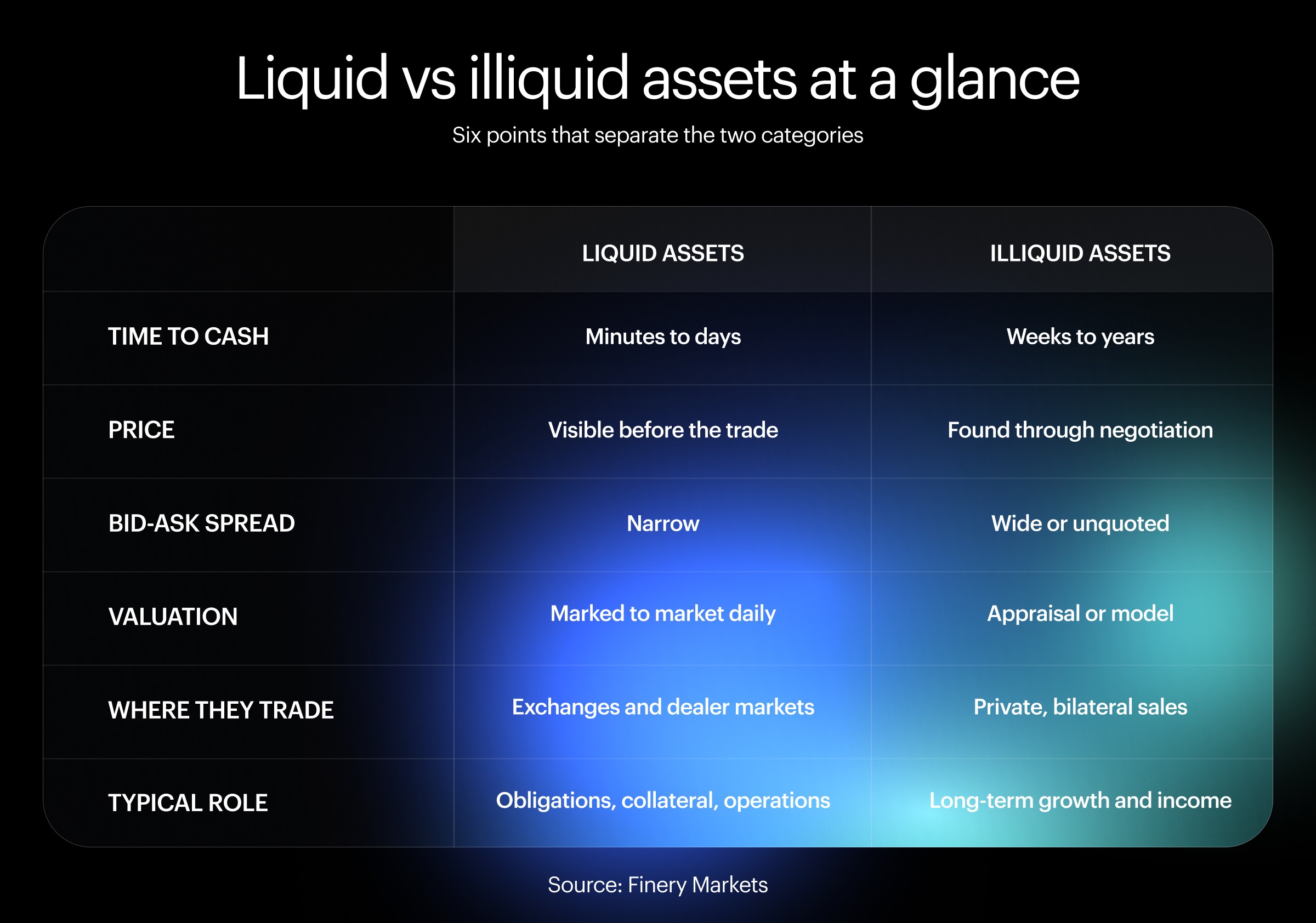
Liquid assets convert to cash in minutes to days, at a price visible before the trade, through exchanges and dealer markets with narrow bid-ask spreads. Their value is marked to market daily. They serve short-term liquidity: paying obligations, posting collateral, and funding operations.
Illiquid assets take weeks to years to sell, at a price discovered through negotiation, with wide or unquoted spreads. Between transactions they are valued by appraisal or model. They serve long-horizon financial goals, where the holder can wait.
The trade-offs run in both directions. Liquid investments give flexibility and usually lower expected returns, and cash sitting idle loses purchasing power to inflation. Less liquid investments may return more but cannot be relied on to meet a payment next week.
Liquidity is a spectrum, and it moves
Few assets are purely one or the other. Most asset classes sit on a spectrum, and their position shifts with trade size, contract terms, and market conditions.
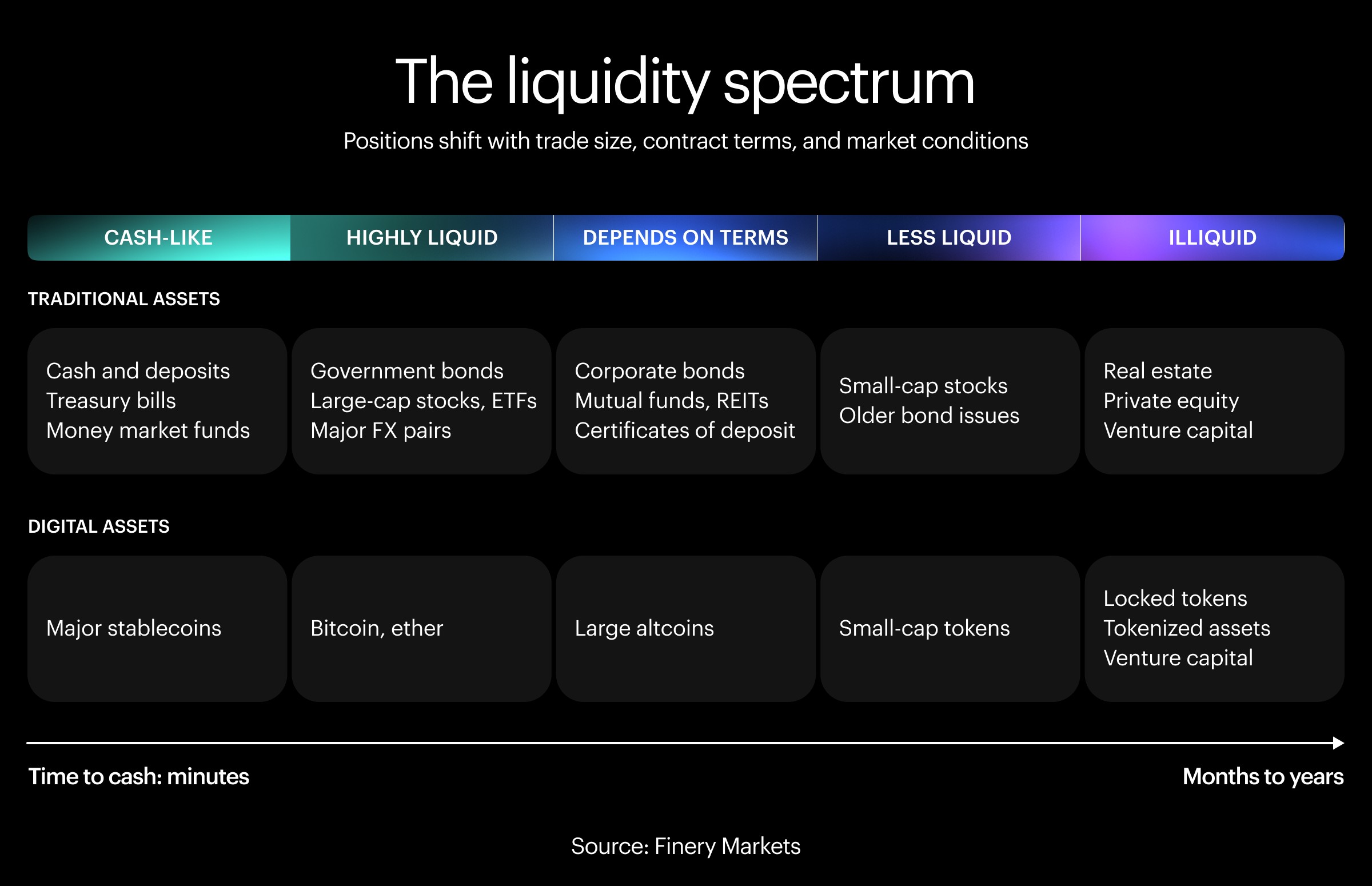
Assets that are liquid depending on terms and size
Some assets are liquid depending on the contract. A certificate of deposit returns cash at maturity, but breaking it early triggers early withdrawal penalties. Mutual funds redeem at the day's closing value, while real estate investment trusts listed on an exchange turn property into a share that trades all day. Corporate bonds range from actively quoted recent issues to older ones that change hands a few times a month.
Size changes the answer as well. A position that is highly liquid at $1 million can be illiquid at $100 million, because the order would exhaust the bids near the quoted price. Liquidity belongs to the trade as much as to the asset.
When liquid assets stop being liquid
Even the deepest markets can seize. In March 2020, heavy sales of US Treasuries by leveraged non-bank investors and foreign holders added to dysfunction in the world's benchmark government bond market. The Financial Stability Board's review of the episode found large and persistent imbalances between the demand for and supply of liquidity, and concluded that the stress would very likely have worsened significantly without central bank intervention.
Crypto markets show the same pattern at higher frequency. Kaiko measured the largest drawdown in order book depth within 2% of the market price during the second quarter of 2025 at 18.05% for bitcoin and up to 31.3% for altcoins. Market volatility and economic downturns thin out buyers at the moment sellers need them, and investors facing withdrawals sell their more liquid assets first. Liquidity should be measured under stress as well as on a calm day.
How liquidity is measured
Five measures describe how liquid an asset is at a given moment:
- Bid-ask spread: the cost of trading immediately. Narrow spreads signal competition among buyers and sellers.
- Market depth: the volume available to trade near the current price.
- Turnover: how much of the asset changes hands each day.
- Price impact: how far a trade of a given size moves the price. In execution this shows up as slippage.
- Settlement time: how long it takes for a completed sale to become usable cash.
Liquid and non-liquid assets on the balance sheet
Accountants sort a balance sheet in order of liquidity. Cash, cash equivalents, and receivables are current assets, while property, equipment, and long-term holdings are non-liquid assets. The split shows whether a business holds enough liquid assets to meet obligations due within a year, or whether its cash flow depends on selling something that cannot be sold in time.
Treasury and financial planning teams build their forecasts on this split, and lenders and trading counterparties read the same numbers when they set credit limits.
Where digital assets sit on the liquidity spectrum
Digital assets do not form one liquidity class. Bitcoin, ether, and the largest stablecoins trade continuously across many venues and behave like liquid assets for most trade sizes. Liquidity falls away quickly beyond them: Kaiko found in July 2025 that the ten largest altcoins accounted for 63% of all altcoin trading volume.
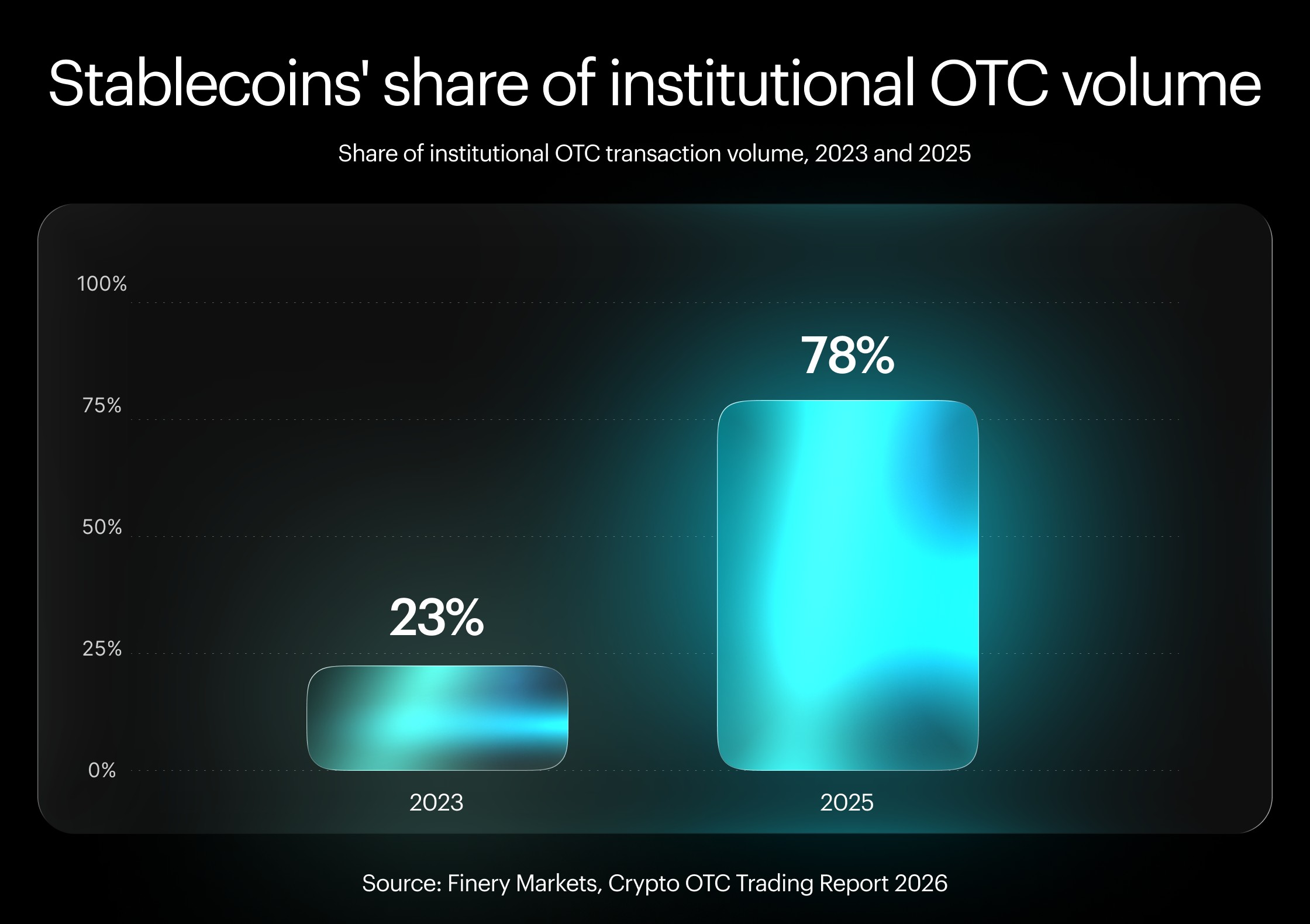
Stablecoins have become the cash equivalents of this market. According to Finery Markets' Crypto OTC Trading Report 2026, stablecoins' share of institutional OTC transaction volume rose from 23% in 2023 to 78% in 2025. They are the liquid leg that other positions are bought and sold against.
At the illiquid end sit tokenized assets with no active market. An analysis of RWA.xyz data published in July 2026 found that $32.9 billion of tokenized real-world assets recorded zero weekly transfers and that 62 assets held 88% of the market's value. Putting an asset onchain makes it transferable. It becomes liquid only when counterparties quote prices for it.
Two features set digital asset liquidity apart from traditional markets. Trading runs 24 hours a day with no central closing price, and liquidity is split across exchanges, OTC desks, and onchain pools that do not share an order book. An asset can be liquid on one venue and thin on another, so a firm's effective liquidity depends on which venues and counterparties it can reach.
What liquidity means for brokers, OTC desks, and payment providers
For a broker, liquidity sets the product shelf. A pair can be offered to clients only if the broker can hedge it at a known price, so thin markets mean wider client spreads or no quote at all.
For an OTC desk, the question is size. Clients come to a desk because their order is too large for the visible market, and the desk needs several liquidity providers competing for the trade before it can return a firm price.
For a payment provider, liquidity is a timing problem. Incoming crypto or stablecoin flows must be converted and paid out on schedule, which requires enough liquidity in the specific currency pair at the moment of conversion and enough cash to settle.
For a treasury team, liquidity is a buffer. A household keeps an emergency fund, and a trading business keeps a reserve sized to cover short-term expenses, margin calls, and unforeseen events. The reserve has a cost, because capital parked in pre-funded accounts across several exchanges earns nothing while it waits.
What infrastructure makes an asset tradeable
Liquidity is produced by market infrastructure. The same token can be liquid for one firm and illiquid for another, depending on the connections each has built. A firm that needs dependable liquidity in digital assets requires:
- Access to multiple liquidity providers, so that no single counterparty sets the price.
- Firm quotes that can be executed at the displayed price.
- A choice of execution methods matched to the asset.
- Credit lines or post-trade settlement, which reduce the capital locked in pre-funded accounts.
- Settlement workflows that move both legs of a trade on a defined schedule.
- Reporting and risk controls, including limits per counterparty and a record of every trade.
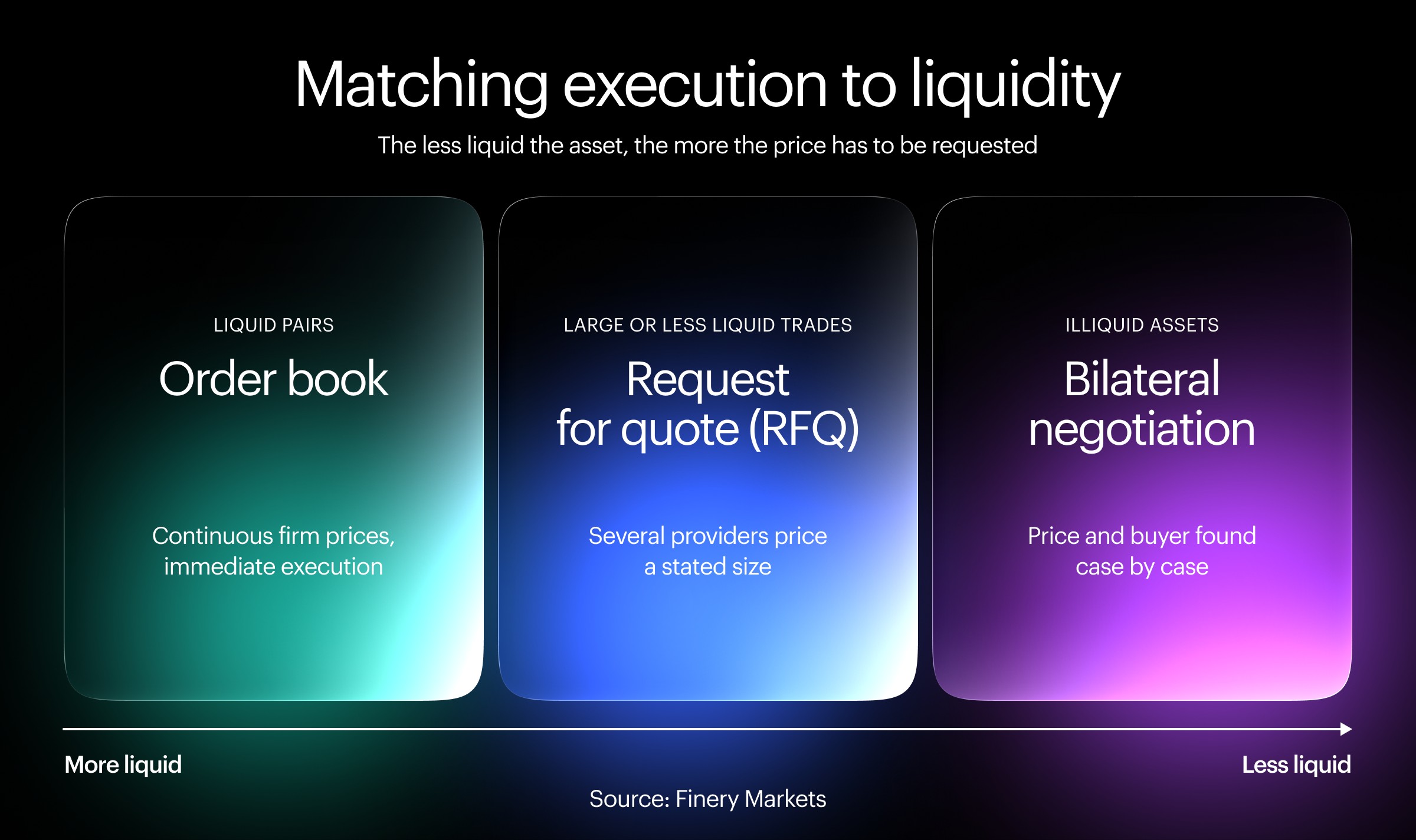
Execution method matters most at the illiquid end. In a liquid pair, an order book gives continuous prices and immediate execution. In a less liquid pair there may be no continuous market, and a request for quote (RFQ) lets a firm ask several providers for a price on a specific size before committing. Slippage, the gap between the expected and the executed price, is the visible cost of using the wrong method.
How Finery Markets supports trading across the liquidity spectrum
An asset is only as liquid as a firm's access to the counterparties that trade it. Building that access one integration at a time is slow, and each new connection adds credit and settlement arrangements to manage.
Finery Markets provides non-custodial trading technology that connects liquidity takers, such as brokers, payment providers, and OTC desks, with institutional liquidity providers. Takers reach liquidity aggregated from OTC providers and centralized exchanges through a single API or GUI connection across 200+ crypto and fiat pairs. Trading runs on bilateral credit lines with reduced or zero pre-funding, so less capital waits in exchange accounts.
The execution methods map to the spectrum described above. Liquid pairs trade in an aggregated order book with firm prices. For large trades and for asset pairs with no continuous market, the RFQ workflow lets a taker request a quote for a specific volume and receive competing responses from several providers. Quote streams allow direct execution with a chosen provider.
The network spans more than 150 institutional participants across 40 countries, and its execution data underpins the company's OTC research. Finery Markets is a software provider. It does not act as a counterparty or hold client assets, and it cannot turn an illiquid asset into a liquid one: prices come from the liquidity providers on the network, and an asset that none of them quotes remains hard to trade.
The risks of misjudging liquidity
The most common error is a mismatch between assets and obligations. A firm that funds short-dated liabilities with assets it cannot sell in time is solvent on paper and unable to pay on the day.
Valuation is a second risk. Illiquid assets are marked by model or appraisal, and the mark can sit well above the price a forced sale would achieve. Positions that look comfortable in a report can lose a large part of their value when they have to be sold.
Stress is a third. Liquidity measured in calm markets overstates what will be available in a sell-off, when spreads widen and depth falls across correlated assets at once. Firms manage risk by setting limits on concentration in any one asset, venue, or counterparty, and by testing how long a position would take to exit at several sizes.
Holding too much liquidity carries its own cost. Idle cash earns little, and inflation erodes it over time. The aim is to hold enough cash and liquid assets for obligations and shocks, and to let other investments work for return.
Outlook: liquidity is being built
Settlement is getting faster. US securities moved to next-day settlement in 2024, and stablecoins settle in minutes at any hour.
Secondary markets are forming for assets that had none. Traded private-market secondaries rose 48% in 2025 to $240 billion, according to McKinsey.
Tokenization is placing funds, credit, and Treasuries on shared ledgers where they could, in principle, trade continuously.
None of this changes the underlying rule. An asset becomes liquid when enough counterparties are willing to quote it, in size, through infrastructure that can execute and settle the trade. Faster rails and new wrappers lower the cost of building that market, and the building still has to be done. For trading businesses, the practical boundary between liquid and illiquid assets is drawn by their own market access: the providers they can reach, the prices those providers will hold, and the speed at which a trade becomes cash.
FAQ
What is the difference between liquid vs illiquid assets?
Liquid assets can be sold for cash quickly at close to their quoted price, while illiquid assets take longer to sell and often require a discount. The difference is measured by time to sale, price impact, and certainty of execution. Cash, Treasury bills, and listed stocks are liquid. Real estate and private equity are illiquid.
What does it mean when an asset is said to be illiquid?
It means the asset cannot be converted into cash quickly without a material loss of value. There are few ready buyers, no continuously quoted price, and the sale may take weeks or months. US fund rules use a concrete test: an investment is illiquid if it cannot be sold within seven calendar days without significantly changing its market value.
What are examples of liquid assets?
Cash, bank deposits, Treasury bills, money market funds, government bonds, shares of large listed companies, and exchange-traded funds are standard examples. In digital asset markets, bitcoin, ether, and major stablecoins are the most liquid. Each can be sold on any trading day at a visible price with low transaction costs.
Is owning a home considered a liquid asset?
No. A home is an illiquid asset. Selling real estate requires finding a buyer, agreeing on a price, and completing a legal transfer, a process that usually takes weeks to months. The owner can sell quickly only by accepting a lower price, which is the defining feature of an illiquid asset.
Is a 401(k) considered a liquid asset?
Generally no. The funds held inside a 401(k) are often liquid, but access to the account is restricted. In the United States, distributions taken before age 59½ are generally subject to a 10% additional tax on top of income tax, with certain exceptions, so the balance is not freely available cash.
Is cryptocurrency a liquid asset?
It depends on the asset and the trade size. Bitcoin, ether, and large stablecoins are liquid for most institutional trades. Smaller tokens are much less so: in mid-2025 the ten largest altcoins accounted for 63% of altcoin trading volume. Liquidity also varies by venue, so access to several providers matters.
Can a liquid asset become illiquid?
Yes. Liquidity depends on market conditions. In March 2020 even US Treasuries became difficult to trade until central banks intervened, and crypto order books thin sharply during sell-offs. Trade size matters too: a position that is liquid at $1 million may not be at $100 million.


 LinkedIn
 Youtube
 Medium
 Twitter