RWA liquidity is the ease with which a tokenized real-world asset can actually be bought and sold, at a fair price, without moving the market against you. It is not the same thing as tokenizing an asset. Putting a bond, a gold bar, or a private credit position onchain proves the asset can be represented. It says nothing about whether anyone can trade it once it is there.
That distinction is now the central question in institutional tokenization. The market for tokenized real-world assets has passed $65 billion, up roughly 44% since the start of the year, and forecasts from McKinsey, Standard Chartered, and others point to trillions by the end of the decade. Yet a large share of that value does almost nothing. Market research built on RWA.xyz data found that around $32.9 billion of tokenized assets recorded zero weekly transfers, and that just 62 assets hold 88% of total market value. The assets exist. The markets around them, for the most part, do not.
This article covers the basics of real-world assets, then explains what RWA liquidity means, why the gap between issuance and active trading has opened up, and what infrastructure institutions need to turn a tokenized asset into something they can trade, settle, and manage at scale.
What are RWAs?
A real-world asset, in a tokenization context, is a traditional financial or physical asset represented as a token on a blockchain. The token is a digital claim on something that exists offchain. Ethereum's overview groups these into tangible assets you can physically hold, such as gold bars or commercial buildings, and digital ones, such as government debt, equity in a company, or intellectual property.
The categories seeing the most institutional activity today are government debt, private credit, and commodities. InvestaX and other tokenization platforms describe the broader universe as spanning real estate, bonds, funds, equities, and fine art. An RWA token has no intrinsic value of its own. It reflects the value of the asset it represents, and it moves as that underlying value moves.
How do RWAs work?
Tokenization converts ownership rights into a digital format that can be issued, divided, and transferred on a blockchain. A tokenized gold product is a clear example. A custodian holds physical gold in a vault, and issues tokens each backed by a defined quantity of that gold, which holders can typically redeem for the underlying metal. The same pattern applies to a tokenized Treasury fund or a tokenized credit position: the asset sits with a regulated custodian or issuer, and the token is the onchain representation of a claim on it.
Two mechanics make this useful. The first is fractionalization. A single high-value asset can be divided into many smaller units, which lowers the barrier to entry and widens the pool of potential owners. The second is programmability. Because tokens run on smart contracts, transfers, and in some cases compliance rules, can be executed fast and automatically rather than through manual clearing. Wallet and infrastructure providers increasingly support these tokens directly, and tokenization infrastructure firms provide the issuance and custody rails underneath them.
What are the benefits of RWAs?
The appeal for institutions is operational rather than speculative. Chainalysis frames the core benefit as superior rails: 24/7 market access, near-instant settlement, and reduced intermediary costs compared with legacy systems. For an asset manager or a bank, faster settlement and simpler collateral movement have a direct effect on capital efficiency.
Beyond efficiency, tokenization broadens access. Fractional ownership lets more participants hold asset classes that were previously restricted to large institutions, and removes some of the geographic barriers to investment. It can also make historically illiquid assets easier to mobilize, at least in principle, by turning a static holding into a transferable unit. The transparency of public ledgers adds a further benefit for institutions, since real-time visibility into asset flows aligns with compliance and risk-management requirements.
What is RWA liquidity?
Liquidity is the layer that sits on top of all of that. As Chainlink defines it, RWA liquidity refers to how easily tokenized assets can change hands onchain without distorting their price. Deep liquidity means many buyers and sellers, tight spreads, and the ability to execute size without waiting days for a counterparty. Thin liquidity means the opposite: an asset that is technically transferable but practically stuck.
The important point for institutions is that tokenization and liquidity are separate problems with separate solutions. Fractionalizing a building into tokens lowers the barrier to entry, but more potential buyers is not the same as an active market. A token still needs pricing, counterparties, execution venues, and settlement before liquidity exists in any meaningful sense.
The market has proven representation, not liquidity
The growth numbers are real, and worth taking seriously. Excluding stablecoins, a16z crypto put the tokenized asset market above $30 billion, roughly 10x larger than it was in mid-2024. US Treasury debt has driven most of that expansion, with major asset managers building multibillion-dollar tokenized money-market products. Chainalysis data shows institutional categories such as asset-backed credit reaching $1 billion in value in about six months, far faster than retail-oriented categories, a sign that large allocators deploy capital once the infrastructure allows.
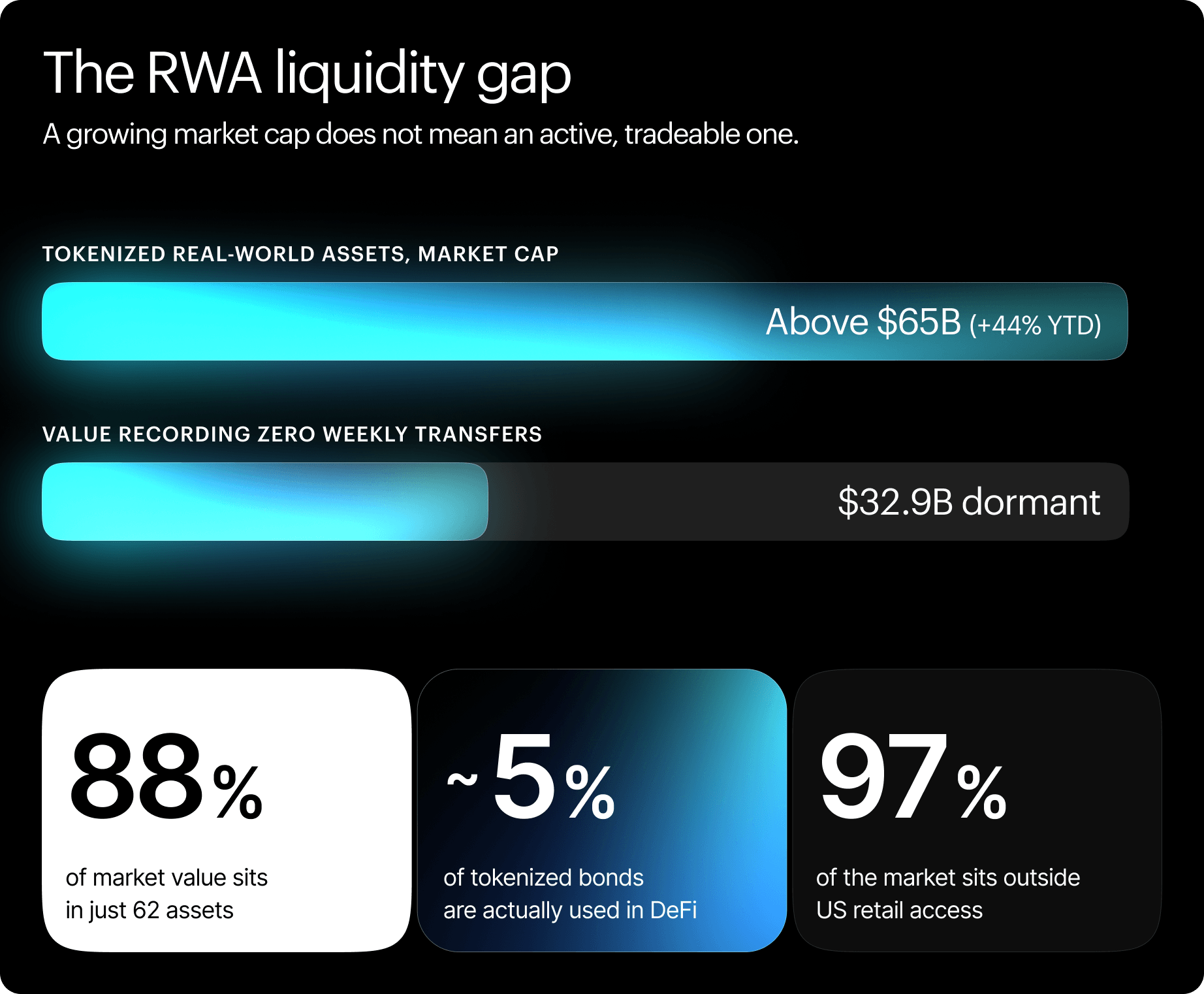
But scale in market cap has not translated into activity. The a16z analysis is direct about it: bonds are the largest tokenized category at more than $15 billion, yet only about 5% of that supply is deployed inside DeFi. Most tokenized Treasurys and gold are held, not used. The report draws a line between assets that are natively onchain and assets that function as little more than digital receipts for holdings still managed through offchain ledgers, and concludes that much of what gets called tokenization today is closer to digitization.
The concentration compounds the problem. When 62 assets account for 88% of value and a handful of products make up roughly half the market, liquidity pools in a few instruments while thousands of others sit idle. Academic research on tokenized asset markets reaches a similar conclusion: secondary-market depth, not issuance, is the binding constraint on whether tokenized assets behave like functioning markets.
Why the liquidity gap exists
Several structural forces keep tokenized assets from trading, and they reinforce one another.
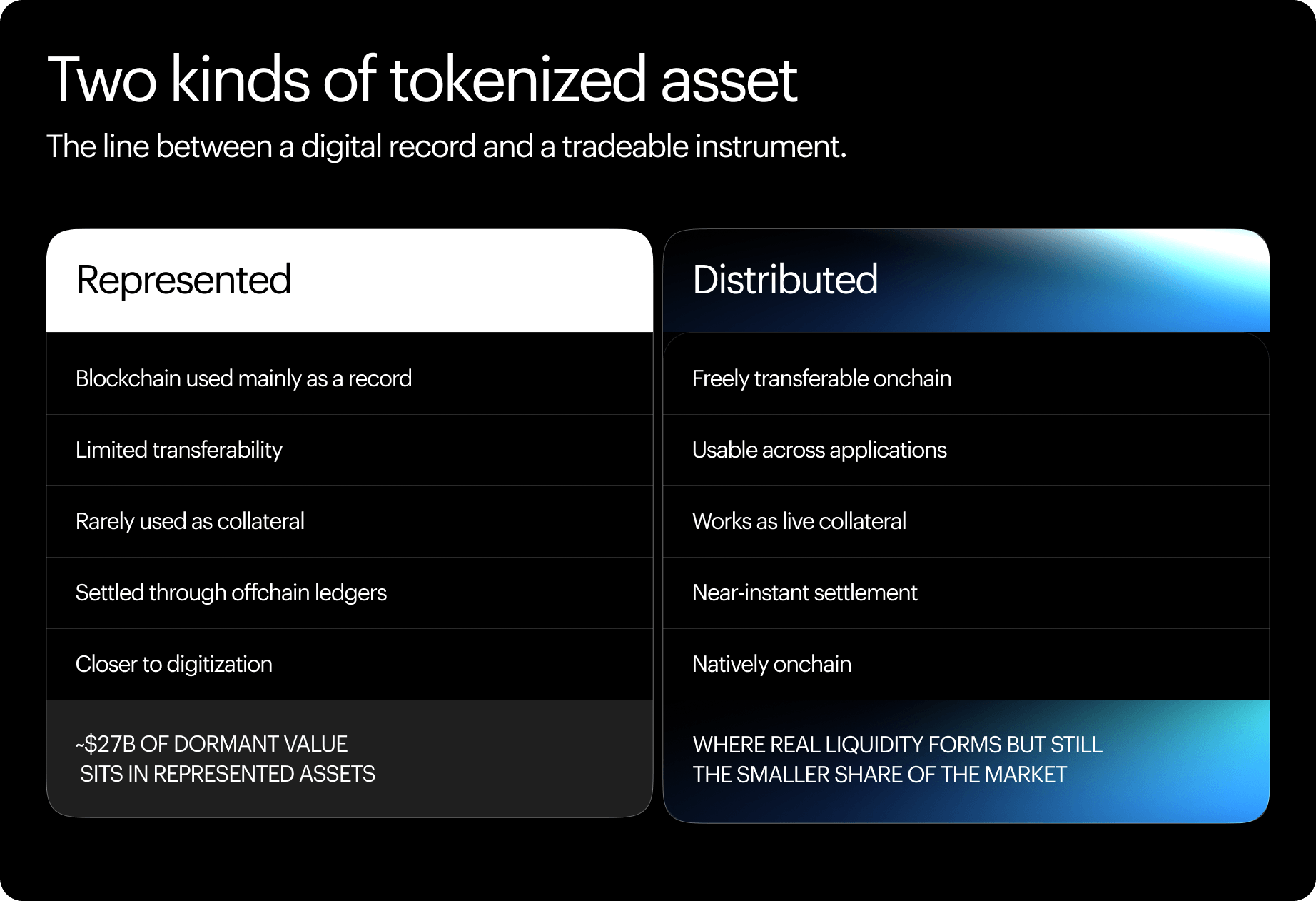
The first is the split between represented and distributed assets. Analysts at RWA.xyz and a16z separate tokens that move freely across public rails from tokens that use the blockchain mainly as a record. Around $27 billion of the dormant value sits in represented assets, many designed for institutional recordkeeping and settlement rather than open trading. These were never built to change hands on a secondary market, so their inactivity is a design outcome, not a failure.
The second is fragmentation across chains. CoinMarketCap reports that Ethereum leads with about a third of the market, Provenance holds roughly a quarter, and BNB Chain, XRP Ledger, and Solana each hold single-digit shares. No single venue dominates, so liquidity spread thin across many chains is hard to access from any one of them.
The third is regulatory segmentation. The same research found that EU-regulated products account for only about $3.3 billion, or 6% of the core market, and that 97% of the market sits outside US retail access. When each jurisdiction develops its own rules, the market risks hardening into isolated regional pools rather than a connected whole.
The fourth is simply that issuing a token does nothing to create the counterparties around it. A token with no participants quoting prices against it is not a market. It is a listing. The gap between tokenized existence and tokenized activity is, at its core, a gap in market infrastructure.
How RWA liquidity actually gets built
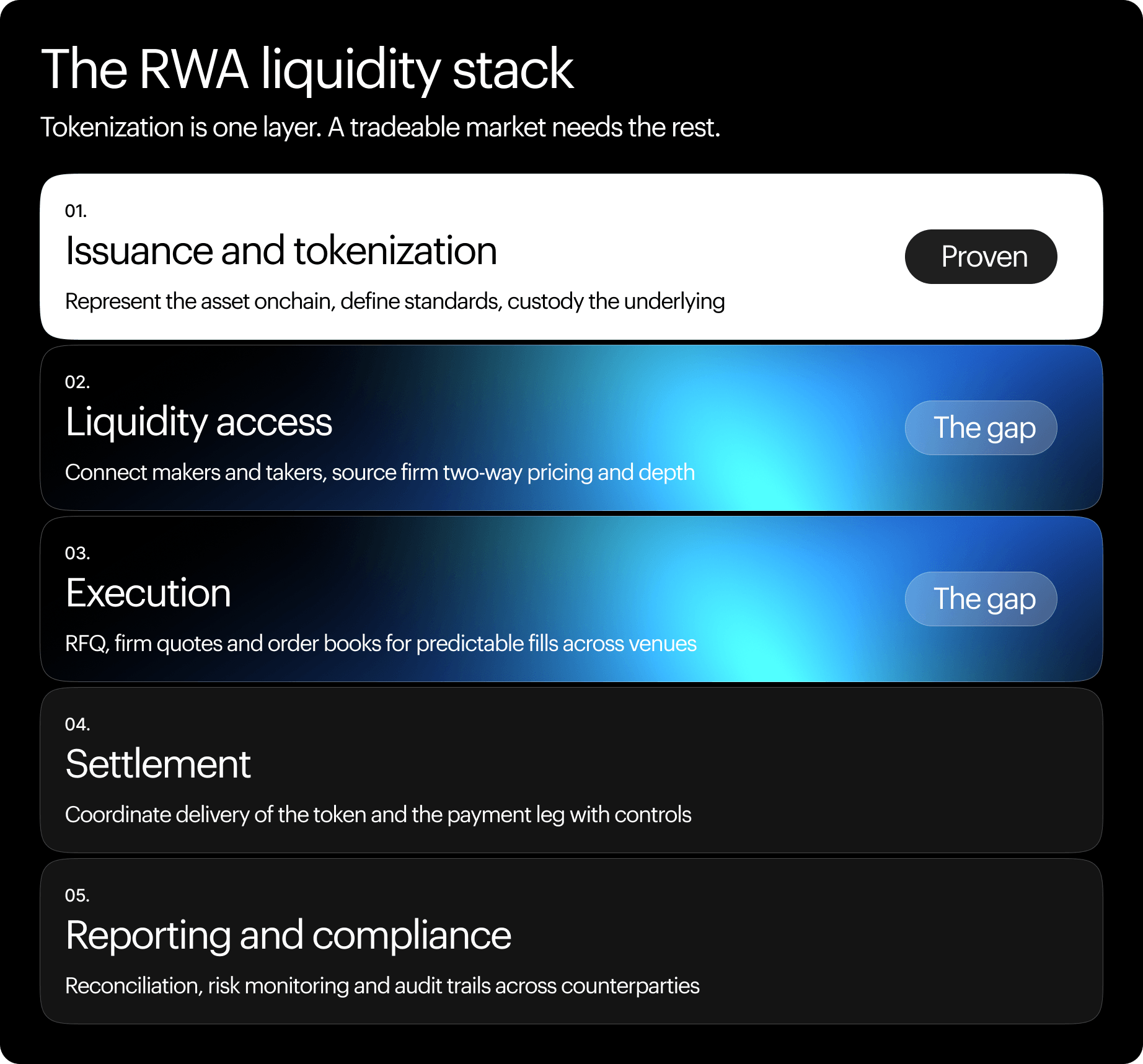
Liquidity is manufactured, not assumed. Turning a tokenized asset into a tradeable one means assembling several operational layers that traditional markets take for granted.
It starts with pricing and counterparties. A market needs participants willing to quote both sides, which for institutional-size trades usually means firm quotes rather than indicative ones, so a desk knows the price it will actually receive before committing. This is where execution models matter. Request-for-quote workflows are useful when a participant needs a firm price on a larger or less liquid position before trading, while order books suit more standardized, higher-frequency flow. Many tokenized assets, especially those outside the most liquid Treasury and gold products, are better served by quote-driven execution precisely because continuous two-sided depth does not yet exist for them.
Cross-venue connectivity is the next layer. Because liquidity is fragmented across chains and issuers, sourcing a competitive price often means reaching multiple providers rather than a single pool. Settlement then has to coordinate two legs, the delivery of the token and the payment against it, with controls that reduce counterparty and operational risk. Reporting, reconciliation, and compliance sit across the whole workflow, because an institution cannot hold a position it cannot monitor, book, and audit.
There are early signs this layer is starting to form. Chainalysis found that the trading-volume correlation between tokenized gold and traditional gold markets, historically near zero, moved into strong positive territory through 2025 and stayed there into 2026. In plain terms, onchain gold is beginning to trade in step with the underlying market rather than on its own isolated crypto cycle. That is what maturing liquidity looks like, and it is still the exception rather than the rule.
Who needs institutional RWA liquidity
The liquidity layer matters to different participants for different reasons, and framing it by business type makes the need concrete.
Tokenized-asset issuers need secondary-market liquidity so their products are more than a primary issuance that then goes quiet. An issuer whose token cannot be traded after launch struggles to attract the next allocator. Asset managers holding tokenized treasuries or credit need to enter and exit positions at predictable prices, particularly if they intend to use those positions as collateral. Brokers and fintechs that want to offer clients access to tokenized assets need execution they can rely on rather than a patchwork of manual connections to individual venues.
Banks, EMIs, and payment firms exploring tokenized settlement need the trading and settlement legs to connect cleanly to fiat and stablecoin rails. Treasury teams evaluating tokenized money-market products care less about the blockchain transfer itself and more about whether they can move in and out on demand. Across all of them, the underlying requirement is the same: liquidity is not a market feature they can take for granted. For an institutional business, it is a product requirement.
The infrastructure requirements
Operationalizing RWA liquidity means having the pieces of a functioning trading venue, whether a firm builds them or connects to them. That includes a network of liquidity providers willing to make prices, execution models that fit both liquid and less-liquid assets through RFQ, order book, and quote-stream workflows, and APIs that let the whole thing integrate into existing systems rather than sit beside them.
It also means settlement workflows that coordinate token and payment legs, custody arrangements suited to the institution's risk posture, and compliance, reporting, and reconciliation tools that satisfy internal and regulatory requirements. Analysis of institutional RWA adoption consistently returns to the same theme, that the constraint is rarely the token standard and almost always the surrounding market and operational infrastructure.
How Finery Markets supports RWA liquidity
To support this workflow at institutional scale, businesses need infrastructure that connects liquidity, execution, and settlement into one controlled process rather than a set of disconnected steps. This is where Finery Markets provides a core technology layer.
Finery Markets operates an institutional liquidity network that connects liquidity takers, such as brokers, payment providers, banks, and issuers, with liquidity makers, such as market makers, OTC desks, and institutional trading firms. The same architecture that supports OTC spot digital asset and stablecoin trading is the architecture a tokenized asset needs to become tradeable.
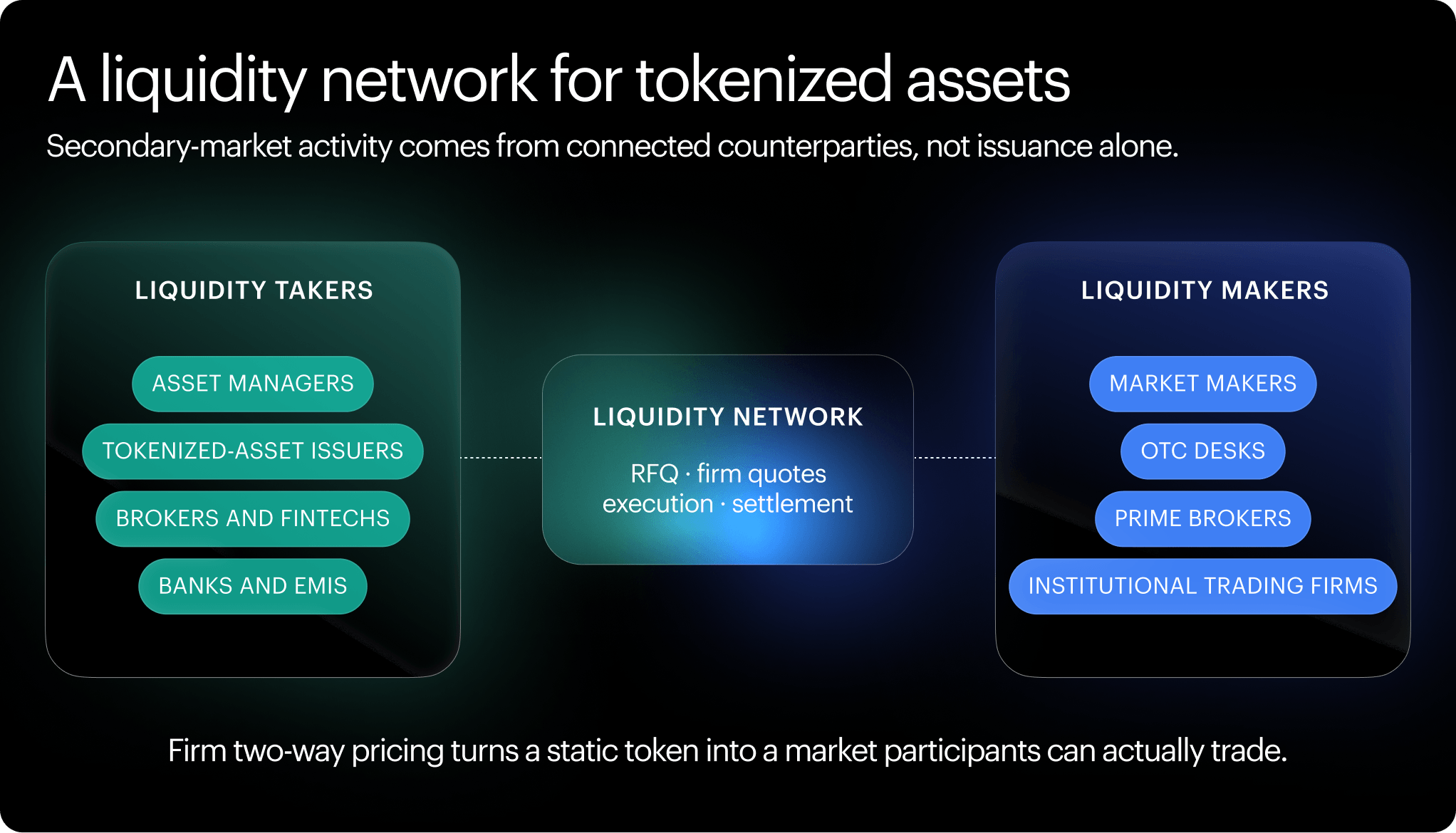
In practice, that support works across several layers of the liquidity stack. Firm two-way pricing turns a static token into an instrument a desk can transact against with execution certainty, rather than an indicative quote that may not hold at size. RFQ, order-book, and quote-stream execution give participants a model that fits both liquid and less-liquid assets, which matters when depth is uneven across categories. A network of connected makers and takers concentrates counterparties in one place, addressing the core problem that issuance alone does not create a market. Integrated settlement and reporting coordinate the token and payment legs and keep positions auditable. Because the technology is API-first and non-custodial, institutions can connect it into existing operations instead of rebuilding a trading stack from scratch.
What are the limitations of RWAs?
RWAs carry real constraints that institutions should weigh honestly, and they fall into two groups.
The first group concerns the asset itself. As Ethereum's overview notes, a token's value depends on the enforceability of the claim behind it, and whether courts recognize token ownership still varies by jurisdiction. Proof of reserves matters for the same reason, since a token is only as sound as the verifiable backing it represents. Custody of the underlying asset, and the legal standing of the entity holding it, remain central questions rather than solved ones.
The second group concerns the market. Thin secondary depth is the practical risk: for most tokenized assets outside the largest categories, liquidity is shallow, spreads can be wide, and executing size can move the price. Fragmentation across chains and jurisdictions makes sourcing that liquidity harder. Counterparty and settlement risk persist wherever trades are not properly coordinated. And there is a maturity risk worth naming plainly, since a market where a large share of value never moves is still early, and early markets can reprice quickly as the mix of participants changes.
A decision framework
The useful question is not whether tokenized assets are better in the abstract. It is where a liquidity layer changes the economics, control, or scalability of a specific workflow.
Consider how often the position actually needs to trade rather than simply be held. Consider whether the asset needs to function as collateral, which requires reliable pricing and exit. Consider the size and frequency of expected flow, since larger and less liquid trades favor firm-quote execution. Consider whether clients are asking for access, whether internal teams can support the operational load, and what the current cost of manual or fragmented access already is. Where those point toward frequent trading, larger size, collateral use, or client demand, a dedicated liquidity and execution layer is likely to matter. Where an asset is genuinely buy-and-hold, it may not.
The outlook
Forecasts for tokenization are large and directionally aligned. As a16z summarizes, McKinsey's base case sees $2 to $4 trillion by 2030, BCG and Ripple estimate $9.4 trillion, and Standard Chartered projects north of $30 trillion by the mid-2030s. The disagreement is about scope and definitions, not direction, and broader coverage of institutional adoption points the same way.
But every one of those forecasts quietly assumes something the market has not yet delivered: that tokenized assets will trade, not just exist. CoinMarketCap notes that RWA liquidity, once established on a given chain, is among the stickiest in crypto because issuers face high switching costs. That cuts both ways. It rewards whoever builds the liquidity layer first, and it means the assets that remain dormant today will stay dormant until that layer reaches them.
RWA liquidity is becoming more important because the market has run out of road on issuance alone. The real question is no longer whether an asset can be represented onchain. It is whether the full workflow around it can be priced, executed, settled, monitored, and reconciled to institutional standards. As the market matures, the advantage will likely accrue to the firms that treat liquidity as infrastructure rather than a byproduct of tokenization.
FAQ
What is RWA liquidity?
RWA liquidity is how easily a tokenized real-world asset can be bought and sold onchain without materially affecting its price. It depends on having active buyers and sellers, firm pricing, and execution and settlement infrastructure, not just on the asset being tokenized.
Why do tokenized assets have a liquidity problem?
Because tokenization creates a digital representation but not a market. Research using RWA.xyz data found roughly $32.9 billion of tokenized assets with zero weekly transfers, driven by assets built for recordkeeping rather than trading, fragmentation across chains and jurisdictions, and a lack of connected counterparties quoting prices.
Is RWA liquidity the same as tokenization?
No. Tokenization is representing an asset onchain. Liquidity is the ability to trade it afterward. An asset can be fully tokenized and still be effectively illiquid if no infrastructure exists to price, execute, and settle trades in it.
Which tokenized assets are the most liquid today?
US Treasury debt and gold dominate by market cap and see the most activity, though even large categories are lightly used. Tokenized bonds, for example, have only a small share of supply actively deployed. Most other categories remain thin.
What infrastructure is needed to make tokenized assets tradeable?
A liquidity network of makers and takers, execution models such as RFQ, firm quotes, and order books, cross-venue connectivity, coordinated settlement of token and payment legs, and reporting, reconciliation, and compliance tooling across the workflow.







 LinkedIn
 Youtube
 Medium
 Twitter