Three years ago, "crypto bank" meant a handful of Swiss boutiques and a few US lenders that did not survive 2023. In 2026 it describes JPMorgan, Citi, BNY, Standard Chartered and a growing list of institutions that never set out to be crypto companies at all.
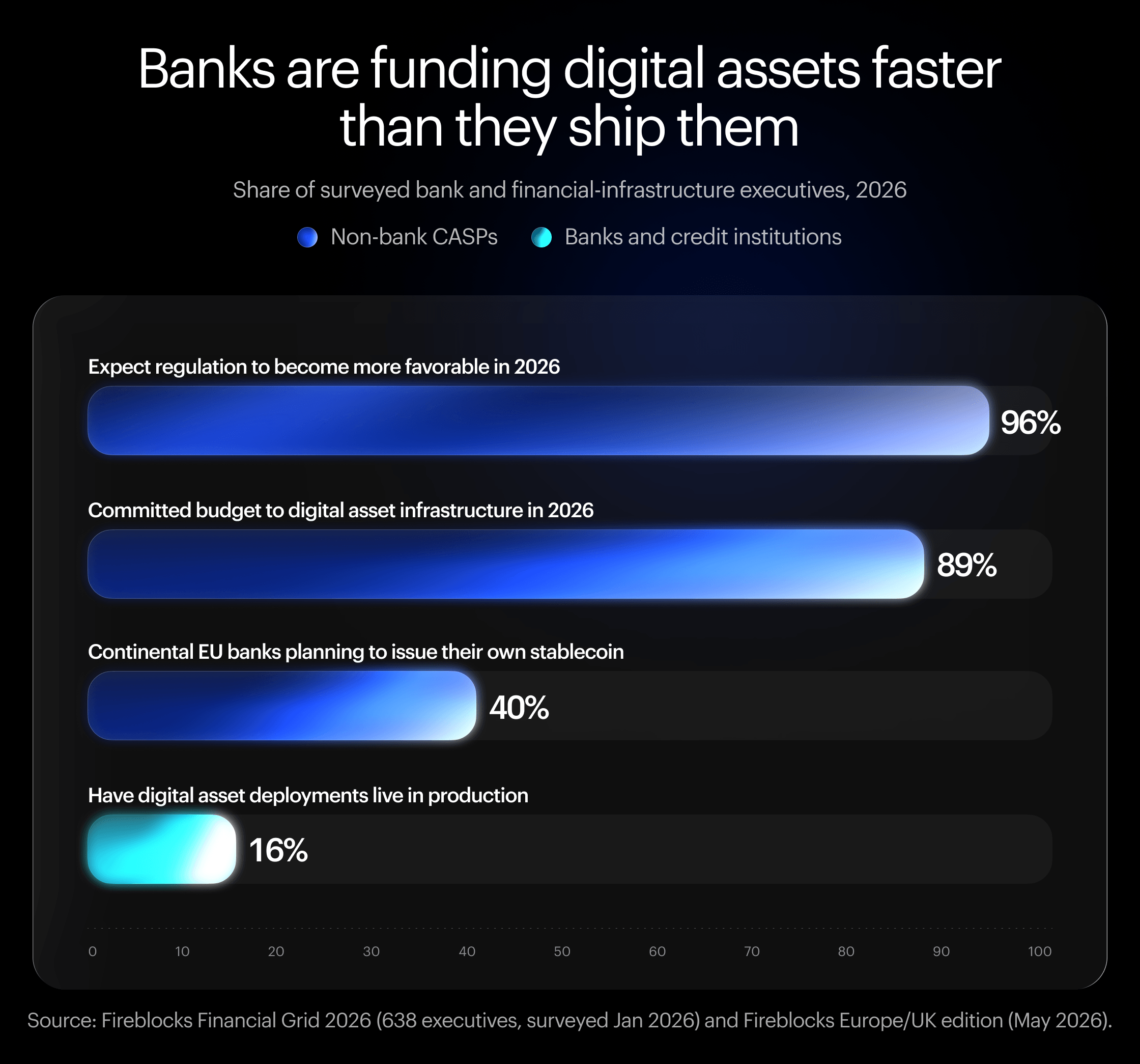
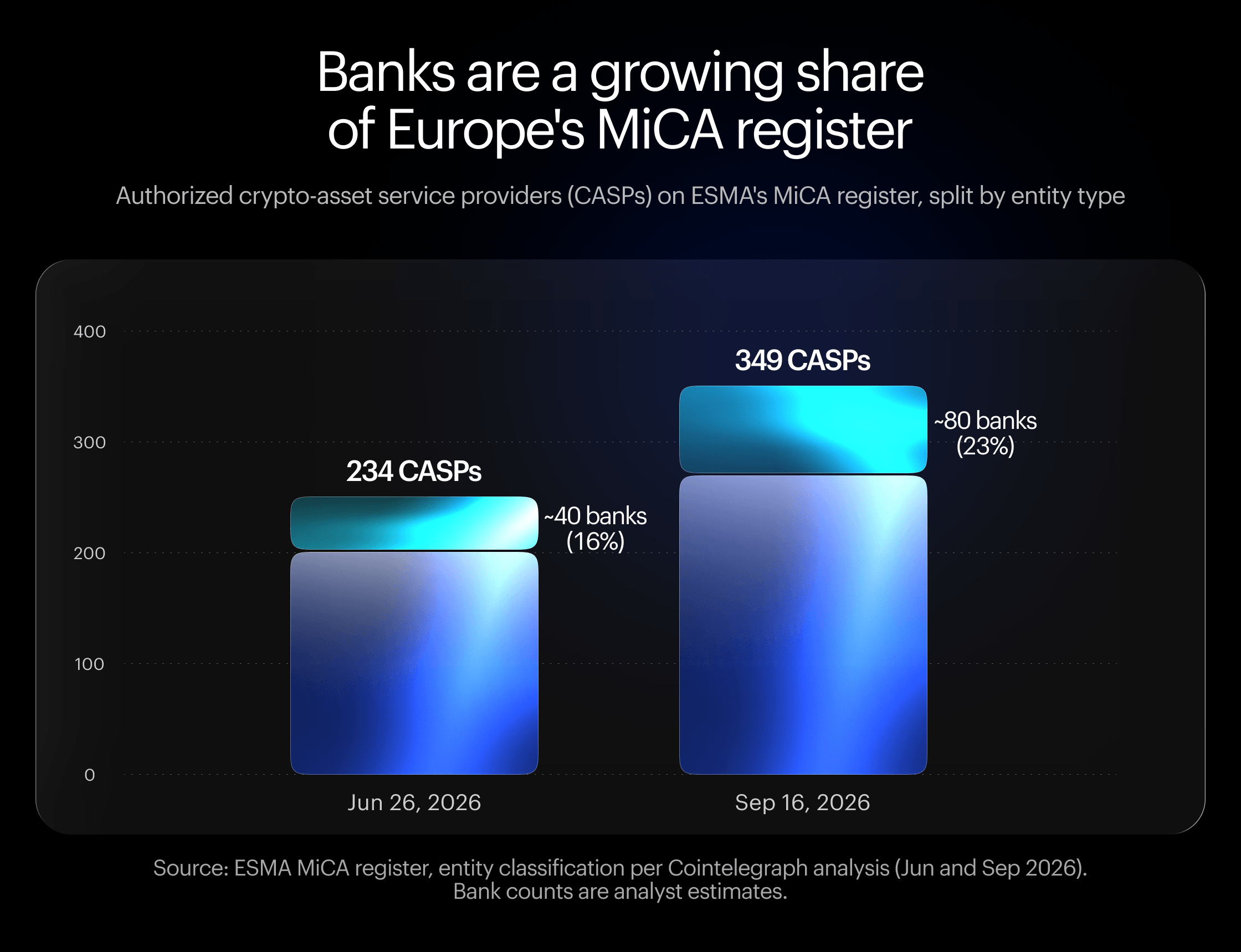
The shift is measurable. Stablecoin supply sits above $300 billion. The OCC has granted 16 conditional national trust bank charters to digital asset firms since December 2025. ESMA's MiCA register lists 349 authorized crypto-asset service providers, and roughly a fifth of them are banks. Yet when Fireblocks surveyed 638 bank and market-infrastructure executives in January, 89% had committed budget to digital asset infrastructure and only 16% had anything in production.
That gap between budget and production is the story of crypto banking in 2026. This report covers what the term now means, what the largest traditional banks in the United States and Europe have actually shipped, how the rulebook changed, and where the next phase is heading.
What are crypto banks?
A crypto bank is a licensed, deposit-taking institution that offers digital asset services under its own regulatory perimeter. The services fall on a ladder: custody, trading and execution, crypto-linked funds and advisory access, collateralized lending, stablecoin issuance or distribution, tokenized deposits, and on-chain settlement. Very few institutions cover the whole ladder. Coincub's 2025 review of 250 institutions found more than 100 offering custody and about 90 offering trading, but fewer than 5% offering five or more services.
Three types of institution use the label:
- Crypto-native banks such as Sygnum, AMINA and Anchorage were licensed specifically to serve digital asset clients. They are outside the scope of this report.
- Crypto-friendly fintechs and neobanks such as Revolut built retail crypto trading into a broader consumer banking product and are now adding stablecoins and licenses.
- Traditional banks expanding into crypto are the focus here. They arrive with existing custody mandates and wealth platforms and add digital assets one service at a time, usually starting with custody or ETF access.
One distinction matters more in 2026 than it did before. A stablecoin is a bearer token issued against segregated reserves and transferable to anyone. A tokenized deposit is a bank liability on a ledger, usable only by that bank's onboarded clients. Most large banks have chosen the second route first, and the regulatory sections below explain why.
Crypto banking in 2026: the context
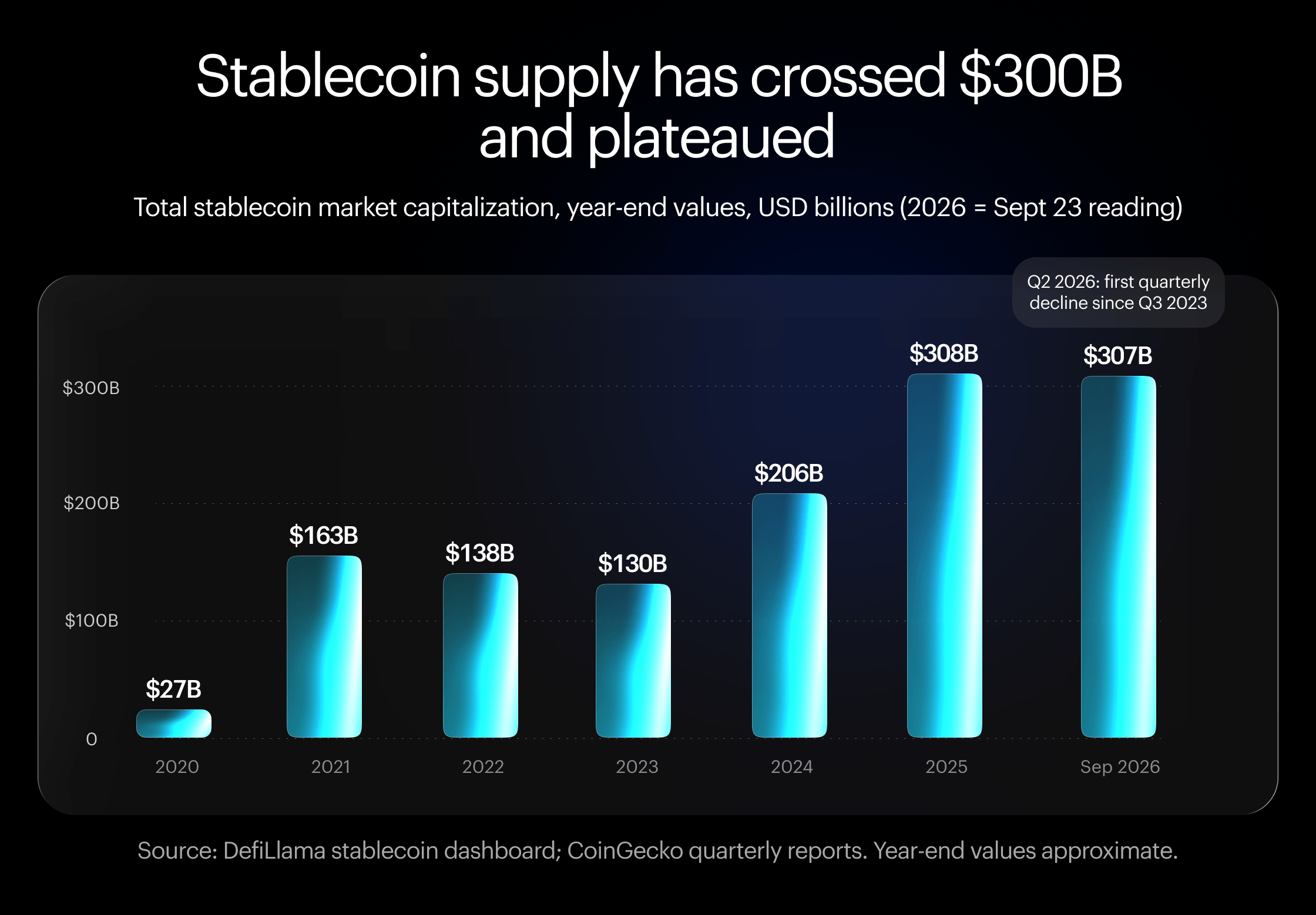
Stablecoins set the agenda. Supply crossed $300 billion in late 2025 and stood at $307 billion on September 23, 2026, with Tether and Circle holding about 85% between them. Transfer volume reached $33 trillion in 2025, up 72% year on year according to Artemis data. Growth then stalled: CoinGecko recorded the first quarterly supply decline since 2023 in Q2 2026.
For banks, this is both a threat and a product. Bank of America's CEO told investors in January that up to $6 trillion in deposits could migrate if stablecoins were allowed to pay interest. The response came in two forms. Individually, banks built tokenized deposit rails: JPMorgan's Kinexys, Citi Token Services, BNY's mirrored deposits and, since July, Swift's shared ledger with 17 banks. Collectively, they formed consortia: Qivalis, the euro stablecoin venture that has grown to 37 European banks, and a 21-bank US dollar stablecoin venture announced on September 1 with Bank of America, Citi, Goldman Sachs, Wells Fargo, UBS, Santander and Deutsche Bank among the members.
Wealth demand is mainstream: US spot bitcoin ETFs have absorbed $57 billion in net inflows since January 2024, and Morgan Stanley and Bank of America now let advisors recommend a crypto allocation. In the EY-Parthenon and Coinbase 2026 survey of 351 institutions, 73% planned to increase allocations and 86% were using or exploring stablecoins.
The production gap has a structural cause. Almost every bank launch in the past twelve months runs on someone else's rails: Coinbase powers PNC's bitcoin service and, through Stablecore, now reaches 3,000 US banks and credit unions; Zerohash sits behind Morgan Stanley's E*TRADE; Bitpanda powers Deutsche Bank's custody and Raiffeisen's rollout; Taurus and Ripple supply custody technology to Deutsche Bank, State Street, BBVA and Société Générale. Build-versus-buy has largely been settled in favor of buy, which shifts the competitive question from access to execution quality.
Top Crypto Banks in 2026: Are Banks Racing Into Crypto?
JPMorgan
JPMorgan runs the largest bank-operated blockchain settlement network. Kinexys has processed more than $4 trillion cumulatively, at over $7 billion per day, with blockchain deposit accounts now in eight currencies. Its USD deposit token, JPMD, went live on Coinbase's Base network for institutional clients in November 2025, and a second issuance on the Canton Network was announced in January. The bank accepts crypto ETFs as loan collateral and has said it will accept bitcoin and ether directly through third-party custodians. What JPMorgan has not done is custody crypto itself or open a spot trading desk; Bloomberg reported in December that institutional trading remains under evaluation. Notably, it is absent from the 21-bank stablecoin consortium, preferring its own rails.
Citi
Citi is the clearest example of the custody-first path. In October 2025 it said it would launch crypto custody in 2026; in August 2026 it unveiled Custody+, a single framework combining traditional and digital asset custody, with bitcoin first. Citi Token Services, its tokenized deposit product, is live in the US, UK, Singapore, Hong Kong and Ireland and handles close to $1 billion a day, with a Japan launch targeted for late 2026. On September 5, Citi and DBS executed the first weekend USD payment on Swift's blockchain ledger, settling in minutes. A Citi-branded stablecoin remains under evaluation.
BNY
The world's largest custodian went live with tokenized deposits in January 2026, with ICE, Citadel Securities, Circle, Anchorage and Zerohash among the first participants. BNY has positioned itself as the stablecoin industry's back office rather than an issuer: it custodies Circle's USDC reserves and Ripple's RLUSD reserves, launched a GENIUS Act-aligned reserves fund in November 2025, and in June added USDC minting, redemption and custody for institutional clients. It also serves as custodian for Morgan Stanley's bitcoin ETF and announced crypto custody in Abu Dhabi in May.
Morgan Stanley
Morgan Stanley moved fastest on the retail and wealth side. In October 2025 it removed restrictions that had limited crypto funds to high-net-worth clients, allowing its 16,000 advisors to recommend a 2% to 4% allocation in any account type. In April 2026 it launched its own bitcoin ETF, MSBT, at a 0.14% fee, and a money market fund for stablecoin reserves. In July, E*TRADE completed its rollout of spot trading in bitcoin, ether and solana, executed and held through Zerohash. The bank has also applied for an OCC trust charter for Morgan Stanley Digital Trust.
Bank of America
Bank of America is the largest US bank still without a live crypto product, and 2026 is the year it stopped saying no. From January 5, Merrill and Private Bank advisors can recommend up to 4% in crypto through four spot bitcoin ETFs. In July it appointed leadership for a global digital assets platform covering tokenized deposits, stablecoins, collateral mobility and custody. It is a member of The Clearing House's tokenized deposit network planned for the first half of 2027 and of the 21-bank stablecoin venture. The pattern is defensive: protect deposits, then build.
Standard Chartered
Standard Chartered is the only global systemically important bank running spot crypto trading for institutions on its own balance sheet. The service launched in London in July 2025 through its existing FX platforms and expanded to the UAE in September 2026, with settlement into the bank's own custody. In May it moved to acquire the rest of Zodia Custody, folding it into the bank. Its Luxembourg entity was added to the MiCA register in June. In Hong Kong, its Anchorpoint joint venture holds one of the first two stablecoin issuer licenses, and the bank executed the first live tokenized deposit transaction on Swift's ledger with HSBC in August.
Société Générale
Through SG-FORGE, Société Générale is the only major European bank with live stablecoins in two currencies. EURCV, its euro stablecoin, is the second-largest euro stablecoin and now runs on Ethereum, Solana, Stellar and the XRP Ledger. USDCV, its dollar stablecoin, launched in 2025 with BNY as reserve custodian. Both were deployed on Uniswap and Morpho, making SocGen the first G-SIB to put bank-issued money into DeFi. In June, Euroclear said it was exploring USDCV settlement for tokenized commercial paper. The bank also serves 15 crypto-native firms as banking clients, a business most peers still avoid.
Deutsche Bank
Deutsche Bank's institutional crypto custody service, first reported in mid-2025, is nearing launch for the end of 2026, pending MiCA notification with BaFin. It will cover bitcoin, ether, USDC and EURC for asset managers, hedge funds and corporates, with Taurus and Bitpanda providing wallet and key management technology. Its asset management arm DWS co-founded AllUnity, whose EURAU euro stablecoin has been live under a BaFin e-money license since July 2025. Deutsche Bank is also a member of the 21-bank stablecoin venture.
BBVA
BBVA is the reference case for a traditional bank offering retail crypto under MiCA. Since July 2025, all retail customers in Spain can trade and custody bitcoin and ether inside the banking app, with Ripple Custody as the underlying technology. The bank has served private banking clients in Switzerland since 2021 and runs Garanti BBVA Kripto in Turkey. In February 2026 it joined Qivalis, the euro stablecoin consortium, and in September it was named among the members of the US dollar consortium as well.
Revolut
Revolut is not a traditional bank, but at 68 million retail customers and $6 billion in 2025 revenue it is the largest crypto distributor holding a banking license in Europe. Its MiCA license from CySEC, granted in October 2025, passports crypto services to 30 EEA states. In August 2026 it launched EURR, a euro stablecoin issued through Stripe's Bridge, in Denmark, Poland and Portugal, while delisting USDT for EEA users. Revolut is one of four firms in the FCA's stablecoin sandbox and has applied for a US national bank charter.
Also moving…
Santander's Openbank offers seven cryptocurrencies to retail clients in Spain and Germany. PNC became the first major US bank to offer direct bitcoin access inside investment accounts, on Coinbase infrastructure. UBS is exploring crypto access for wealthy Swiss clients and is running a Swiss franc stablecoin sandbox with five other banks.
From custody to trading: the infrastructure question
If you were reading the list above carefully, you might have noticed a pattern. Citi, BNY, Deutsche Bank and Standard Chartered all started with custody. It answers the first client question, which is about safekeeping, and it fits inside a regulatory perimeter banks already understand.
The second client question is predictable: clients who custody digital assets with a bank ask to trade them, without moving assets to an exchange or broker the bank does not control. Custody is a cost center with a fee attached. Trading is where the client relationship monetizes.
Building trading in-house raises three recurring problems:
- Counterparty risk: sourcing liquidity means separate bilateral relationships, each with its own credit line, legal agreement and exposure to manage.
- Fragmented liquidity: without an aggregation layer, execution quality is capped by how many venues a desk can realistically maintain, which puts best execution at risk.
- Post-trade complexity: settling across multiple counterparties multiplies operational risk and ties up capital, and building that infrastructure is a multi-quarter commitment before the first trade.
Finery Markets addresses this layer for banks that already custody digital assets. It sits between the bank's custody infrastructure and institutional digital asset liquidity as a non-custodial execution and settlement layer. Clients trade within the bank's platform, under the bank's brand, through the bank's existing onboarding and compliance controls. Assets stay in the bank's custody at all times.
What the bank adds is the trading mechanics: order routing, access to a network of more than 150 institutional participants, streaming firm, executable quotes, automated netting and settlement on a schedule the bank sets, and a full audit trail on every order, through a single integration rather than a portfolio of bilateral relationships.
Deployment decides the regulatory track. Under a white-label master account, the bank is the regulated counterparty facing its clients and Finery Markets is the infrastructure behind it. Under a full white-label network, each client opens its own account and trades bilaterally with other participants, so the bank is not intermediating and typically does not need a trading license. The first suits banks that already hold or intend to hold that license; the second suits institutions offering market access without taking on a broker-dealer role.
Regulation for crypto banking in 2026
United States: from deterrence to rulebook
The supervisory reset that began in early 2025 is now complete. The SEC's SAB 122 removed the balance-sheet penalty on custodied crypto. The OCC's interpretive letters 1183, 1184 and 1186 confirmed that national banks may custody crypto, hold stablecoin reserves, use sub-custodians and hold tokens as principal for permitted activities. The FDIC dropped its pre-notification requirement, the Fed withdrew its 2022 and 2023 guidance, and a rule banning "reputation risk" as a supervisory basis took effect in June 2026.
The GENIUS Act, signed in July 2025, gives insured banks a direct route to issue payment stablecoins through subsidiaries, with 1:1 reserves and no yield to holders. Regulators missed the July 2026 deadline for final rules; the OCC, FDIC, Treasury and FinCEN proposals are out, Treasury's comment period closes October 19, and the act takes effect on January 18, 2027. Market structure legislation fared worse: the CLARITY Act failed a Senate cloture vote on September 15, which likely ends the effort for 2026.
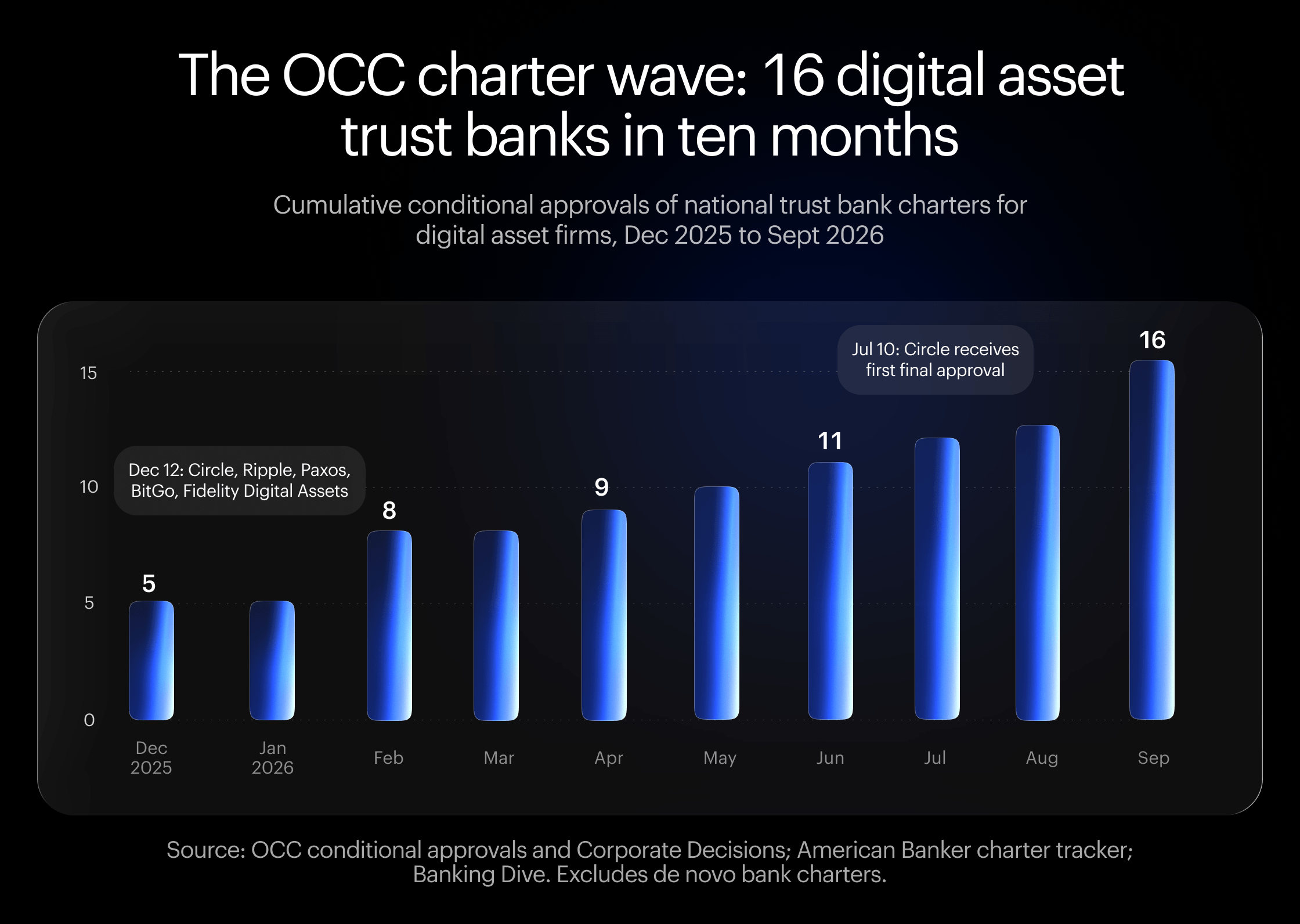
The charter route is open. Since December 2025 the OCC has conditionally approved 16 national trust bank charters for digital asset firms, including Circle, Ripple, Paxos, Coinbase, Stripe's Bridge and Morgan Stanley Digital Trust, and Circle received the first final approval in July. Kraken became the first crypto firm with a Fed account in March, and the Fed's proposed "payment account" would formalize limited access with a $1 billion balance cap. For incumbents, the effect is competitive: their new rivals are becoming banks too.
European Union: MiCA is now the baseline
The transitional period ended on July 1, 2026 with no extensions. Banks can offer crypto services under a notification rather than a full CASP license, and analyst counts put roughly 80 banks and credit institutions on the register by mid-September, about 23% of the total. Euro stablecoins remain small: the ECB counted about €450 million in January against $300 billion in dollar coins, which is the gap Qivalis and SG-FORGE are competing to close. The digital euro cleared the Parliament's economic committee in June, with a pilot planned from 2027.
United Kingdom: rules final, go-live 2027
The FCA published final cryptoasset rules on June 30; the authorization gateway opens on September 30, 2026, and the regime goes live on October 25, 2027. The Bank of England dropped the proposed holding caps on systemic stablecoins in favor of a temporary £40 billion issuance guardrail per coin.
The future of crypto banking
The calendar for the next 18 months is unusually specific. Qivalis targets a euro stablecoin launch in the second half of 2026. GENIUS takes effect in January 2027. The Clearing House's tokenized deposit network and the 21-bank dollar stablecoin are both scheduled for the first half of 2027. The UK regime goes live in October 2027. By the end of 2027, bank-issued money on public and shared ledgers will be an operating reality rather than a pilot.
Tokenized deposits and stablecoins will coexist, and banks will run both
The BIS made the case for tokenized deposits in its June 2026 annual report, and the volumes back it: Kinexys at $7 billion a day and Citi Token Services at $1 billion a day already dwarf every bank-issued stablecoin. But consortium stablecoins exist because clients want bearer instruments that move across institutions. Expect the same bank to offer a deposit token for its own clients and a consortium stablecoin for everyone else.
Custody commoditizes; execution and settlement differentiate
With 16 new trust charters and every major custodian live, safekeeping is becoming table stakes and fee pressure will follow. The banks that earn a return on their digital asset investment will be the ones that turn custody into trading, and trading into a controlled workflow across liquidity, execution and settlement. The Fireblocks gap between 89% budget and 16% production closes in that layer.
Regulatory arbitrage narrows, and the capital rule decides scale
With MiCA, GENIUS, the UK regime and Hong Kong's ordinance all in force by 2027, the question is no longer whether a bank may offer crypto but how much balance sheet it can commit. Basel's review is the single decision that most determines whether banks remain agents and custodians or become principals and market makers.
In 2024, the question for a bank was whether to touch digital assets. In 2026, it is which services to offer and on whose infrastructure. By 2027, it will be how well they execute.







 LinkedIn
 Youtube
 Medium
 Twitter