An institutional trading platform is the software through which banks, brokers, OTC desks, payment providers and funds source liquidity, execute orders, control risk and settle trades with their counterparties. Unlike a retail app, it is judged on execution quality, credit management and auditability, because every order it sends carries the firm's capital and regulatory exposure.
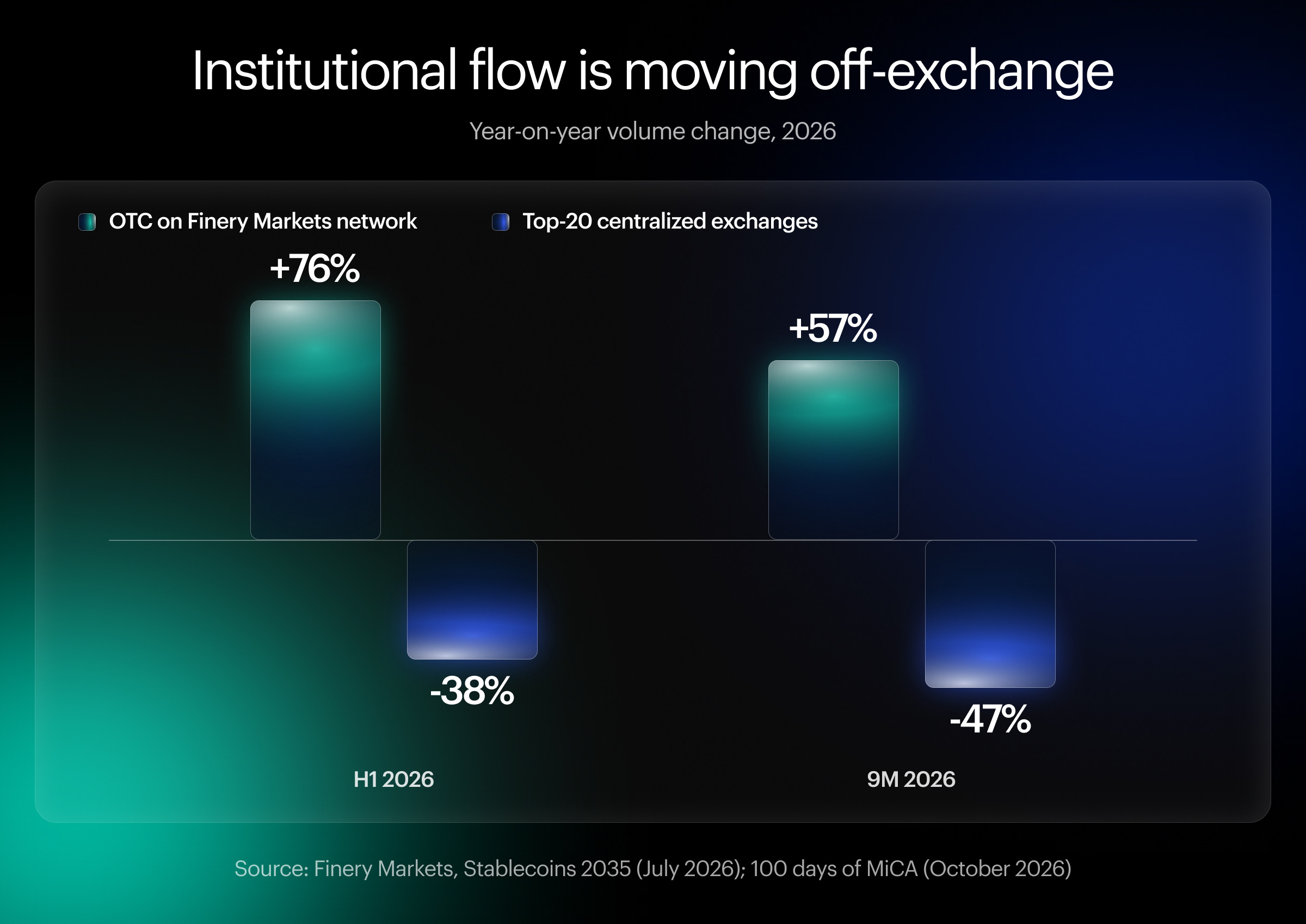
The choice of platform now decides where institutional flow goes. In the first nine months of 2026, institutional OTC volume on our network grew 57% year on year while volume on the top 20 centralized exchanges fell 47%, according to our analysis of 16 million institutional trades. In the survey behind the Crypto OTC Trading Report 2026, 40% of firms named OTC as their first-choice execution venue. MiCA's transitional period ended on July 1, 2026, and only 280 firms appeared on ESMA's first post-deadline list, against 2,747 national registrations in 2024.
Firms that want to serve this flow face a practical question: which features a platform needs before it can carry institutional orders, and whether to build it, license it or connect to an existing network. The sections below go through the architecture, the features institutional clients test for, how these platforms differ from retail ones, a launch sequence and the risks.
What is an institutional trading platform?
An institutional trading platform is a trading system built for professional counterparties. It connects a firm to several liquidity sources, executes orders under firm pricing and pre-trade risk limits, records every action for audit, and settles positions through the firm's own custody and banking relationships. Clients reach it through a web interface (GUI) or through APIs such as FIX, REST and WebSocket.
The term covers several kinds of software. A multi-dealer electronic communication network (ECN) aggregates prices from many market makers into one order book. An order and execution management system (OMS or EMS) routes a buy-side firm's orders to brokers and venues. A white-label platform lets a broker or bank run a branded trading venue for its own clients. What they share is the institutional workflow: credit relationships between named counterparties, negotiated settlement terms and controls that a regulator can inspect.
What the term does not cover: a retail exchange account with an "institutional" pricing tier, or a single market maker's dealing screen. Both give access to one source of liquidity on one set of terms, which is the problem an institutional platform exists to solve.
Which institutional investors and firms use these platforms?
The users fall into two groups. The first is the buy side, the institutional investors who trade their own or their clients' capital: hedge funds, asset managers, mutual funds, pension funds, sovereign wealth funds, family offices, commodity trading advisors and proprietary trading firms. Their portfolio managers make the investment decision, and the trading desk turns it into orders that the platform works across venues with the least market impact.
The second group is the intermediaries that serve those investors and their own institutional clients: broker dealers, prime brokers, banks, OTC desks, payment providers and market makers. For them the platform is both a source of liquidity and a product they offer, so account structure, markups and client reporting matter as much as execution.
In traditional markets, investment firms and asset management houses trade multiple asset classes (equities, fixed income, FX, derivatives) through separate systems. In digital assets the same firms often start with spot crypto and stablecoin pairs and add other financial instruments later, which makes a platform's coverage of asset classes and settlement currencies part of the selection.
How an institutional trading platform works
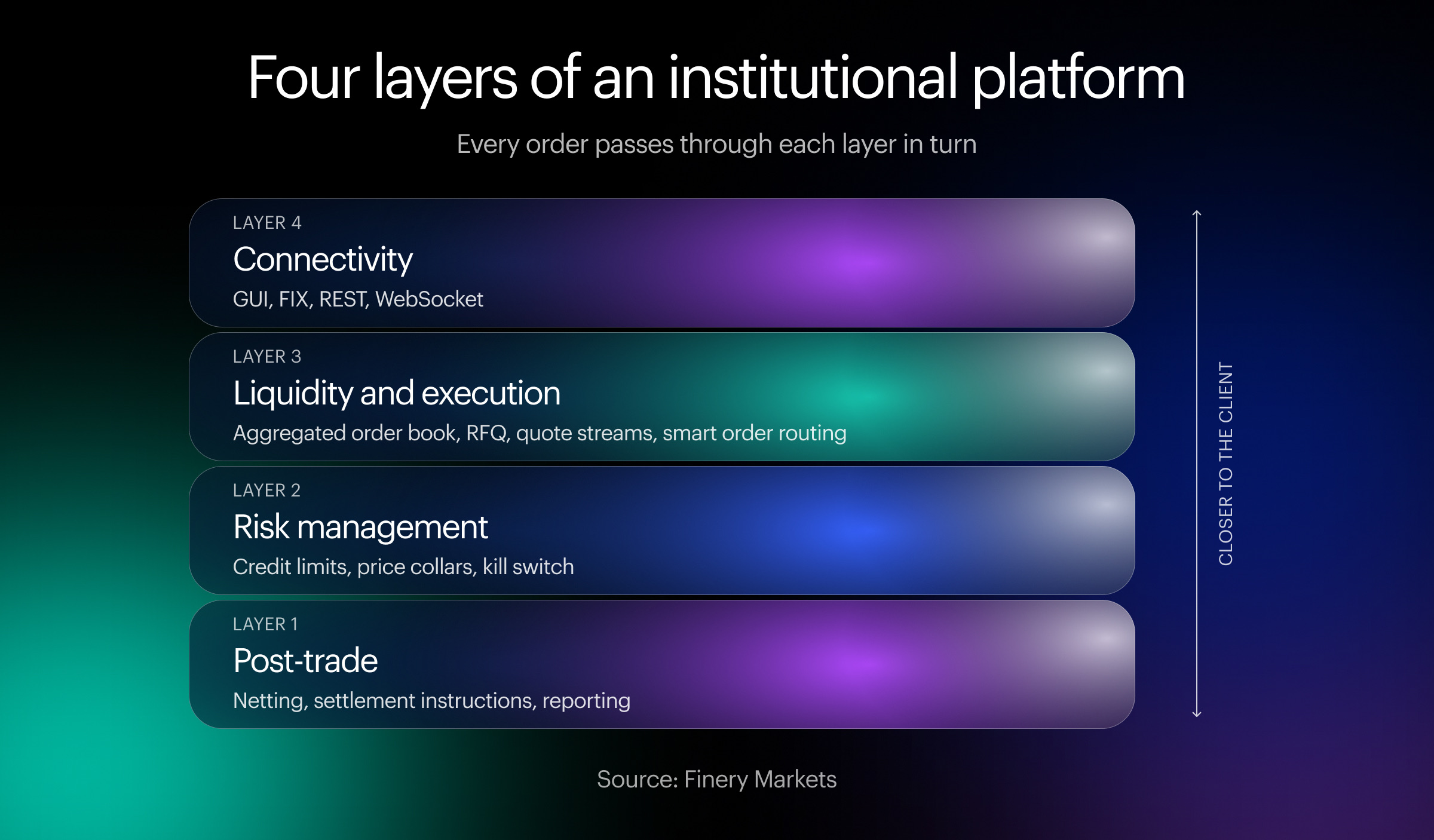
Most platforms can be described as four layers that a trade passes through in order. Each layer can be built in-house, licensed or supplied by a partner, and the boundaries between them decide who carries which risk.
Connectivity and client access
The top layer is how institutions connect to the platform and how its trading technology reaches outward to liquidity providers and trading venues. Discretionary traders use the GUI, while algorithmic desks and payment flows connect through APIs. FIX remains the standard for institutional order flow. The FIX Trading Community has published recommended practices for trading digital assets over FIX, and FIX now accepts ISO 24165 digital token identifiers next to ISO 4217 currency codes. REST and WebSocket APIs carry market data, account management and lighter integrations.
Liquidity and execution
Trade execution happens in the next layer, which holds the matching engine, the aggregated order book and the routing logic. A platform worth the name offers more than one execution method, because a $50,000 stablecoin conversion and a $20 million block of bitcoin need different handling. The common methods are a central limit order book with firm prices, request for quote (RFQ) for larger or less liquid trades, and streaming quotes from a chosen liquidity provider, often combined with a smart order router.
Risk management
Pre-trade controls check every order before it reaches a counterparty: credit limits per counterparty, position and asset limits, price collars, maximum order size and message rates. Post-trade, the risk engines track open positions, margin and exposure in real time, so that a sudden move in market conditions shows up as a limit breach before it becomes a loss. In regulated securities markets these controls are among the regulatory requirements for brokers that give clients market access.
Post-trade and settlement
After execution, the platform records the trade, nets positions per counterparty, generates settlement instructions for crypto and fiat legs, and handles post trade reporting to clients, auditors and regulators. Regulatory reporting requirements differ across multiple jurisdictions, so the report formats need to be configurable. In crypto markets this layer also decides how much capital is locked up, because settlement terms set how much pre-funding each counterparty must post.
Essential features of an institutional trading platform
Requests for proposal from banks and brokers tend to ask about the same capabilities. These are the features that separate a platform built for institutional flow from one adapted to it.
Aggregated multi-dealer liquidity
One connection should reach many liquidity providers, with their prices merged into a single order book. Aggregation narrows spreads, adds depth and removes dependence on one market maker. The platform should let the operator add or remove a provider without a new integration, and show where each fill came from.
Firm pricing and execution methods
Firm prices mean that what the taker sees in the book is what it receives. Many single-dealer and aggregator setups still rely on last look, a window in which the liquidity provider can reject or requote an order after the taker has committed. Rejections cost the taker time and price, and they are hard to measure. An institutional platform should state, for each execution method, whether prices are firm or indicative and what rejection rate clients see.
- Central limit order book: firm, price-time priority, suited to continuous flow in liquid pairs.
- RFQ: several providers quote a stated size and the taker accepts within a short window, suited to block trades and thin pairs.
- Quote streams: direct execution against one provider's streamed prices.
- Smart order routing: splits or routes an order across venues for the best available price for the full amount.
- Algorithmic orders that work a large order over time.
Algorithmic execution, block trades and dark pools
Fund managers and institutional traders rarely send a large order to the market in one piece. An algorithm splits the parent order into child orders and releases them according to a benchmark: time weighted average price (TWAP) spreads them evenly over a period, volume weighted average price (VWAP) follows the market's volume curve, and implementation shortfall strategies trade faster when the price moves away from the decision price. The platform has to handle partial fills, cancel and replace child orders as market conditions change, and report the result against the benchmark.
The alternative for size is to trade away from the visible book. In equities, dark pools match large orders without displaying them before execution. In crypto, the equivalent is RFQ and private OTC liquidity, where a block is priced by several providers without showing the order to the market. During the October 10 to 12, 2025 liquidation, when $20 billion of crypto positions were liquidated over 48 hours, BTC/USDT and ETH/USDT volume in OTC private rooms on our network rose 107% week on week against 48% on exchanges.
Direct market access and exposure controls
Direct market access (DMA) lets a client send orders straight to a venue through its broker's infrastructure, without a trader re-keying them. It gives speed and control, and it is the reason regulators require pre-trade checks at the broker. In the US, the SEC's market access rule (Rule 15c3-5), adopted in 2010, requires broker dealers that provide market access to block orders that exceed pre-set credit or capital thresholds or appear erroneous, and it effectively ended unfiltered "naked" sponsored access. An institutional platform that offers direct access to its own clients needs the same exposure controls: per-client limits, position limits and compliance checks that run before the order leaves.
Pre-trade risk controls and a kill switch
Every order should pass credit, size, price and position checks before it leaves the platform, and the operator should be able to cancel all open orders at once. The cost of skipping this is on record. On August 1, 2012, a faulty router at Knight Capital sent more than 4 million orders in 45 minutes while trying to fill 212 customer orders, and the firm lost more than $460 million. The SEC fined Knight $12 million in its first enforcement action under the market access rule.
Credit lines in place of full pre-funding
On a centralized exchange, every dollar of trading capacity has to be deposited first. Institutional platforms let counterparties trade on bilateral credit lines and settle after the trade, either at fixed times or when the client chooses. Our Marketplace counterparties typically agree pre-funding of 0% to 20%, which frees working capital that would otherwise sit idle on exchange accounts and lowers the loss if a venue fails.
Account hierarchy and client management
Brokers, prime brokers and banks need a master account with sub-accounts for their own clients. Each sub-account keeps its own balance, positions, limits and trade history, while the master account sets markups, risk limits and access rights. This structure lets an operator resell liquidity, internalize offsetting client flow or run a proprietary liquidity pool on the same platform. It is also how prime brokerage works on a trading platform: the prime broker extends credit to its clients through their sub-accounts and faces the liquidity providers itself.
Market data and transaction cost analysis
Clients and compliance teams need to prove best execution. The platform should stream real time market data from every connected venue, keep tick-level history and fills, show spreads across venues, and support transaction cost analysis (TCA): slippage against arrival price, fill ratios, rejection rates and markups paid. Without this record, a desk cannot show its clients or its regulator that routing decisions were sound.
Security, resilience and audit trail
Institutional clients audit their vendors. Expect questions on SOC 2 Type 1 and Type 2 reports, ISO 27001 certification, penetration testing, uptime history, disaster recovery and role-based access control. In the EU, the Digital Operational Resilience Act (DORA) has applied since January 17, 2025, and it covers MiCA-authorized crypto-asset service providers and their contracts with ICT providers. Every order, amendment, cancellation and settlement instruction should carry a timestamp and a user ID.
Institutional vs retail trading platforms
The two categories differ in who carries risk and how trades settle. A retail trading app built for retail traders holds customer assets, matches anonymous users against each other or against the house, and settles instantly on its own books. An institutional platform connects named counterparties that have signed agreements with each other, trades on credit and settles bilaterally after the trade.
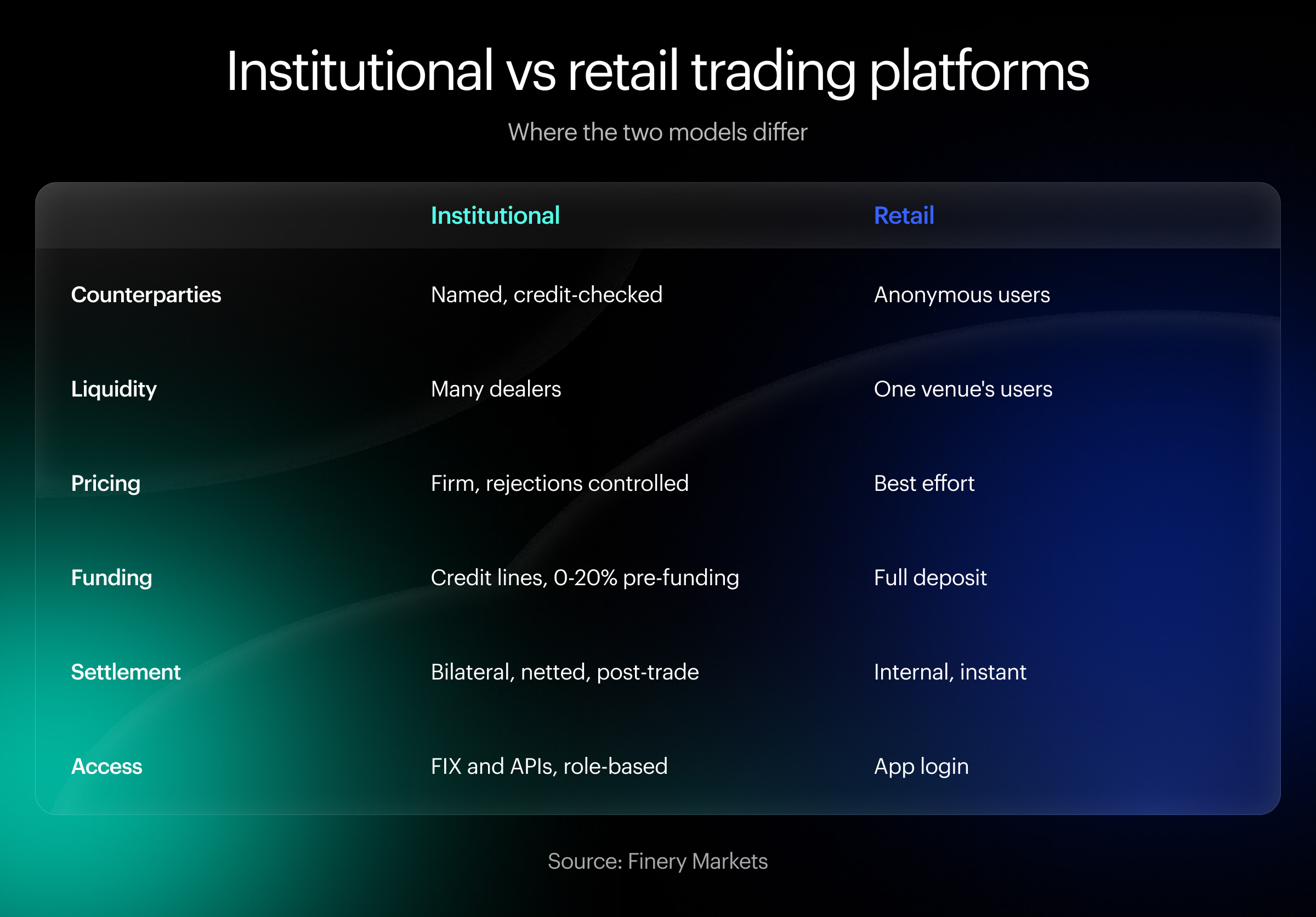
In practice the differences show up in six places. On an institutional platform, counterparties are known and credit-checked, and liquidity comes from many dealers instead of one venue's users. Prices are firm, with rejection rates that clients can measure. Funding runs on credit lines with partial or zero pre-funding, where retail trading requires a full deposit before the first order. Settlement is bilateral and netted after the trade. Access runs through FIX and other APIs with role-based permissions, while retail traders log in to an app.
Why institutional capital is moving to dedicated infrastructure
The market structure for digital assets is shifting from exchange screens to off-exchange execution. Our network data shows the split widening each quarter: OTC volume grew 76% in the first half of 2026 while centralized exchange volume fell 38%, and the gap reached 57% growth against a 47% decline over nine months. Stablecoins accounted for 83% of trades by number on our network in the same period.
Large banks are the next wave. In 2026, 89% of banks reported budget for digital assets but only 16% had anything in production, according to our State of Crypto Banking 2026 report. Most of what large banks have shipped is custody and tokenized deposits. Trading, the part that turns custody into revenue, requires the execution, credit and settlement layers described above.
Regulation pushes in the same direction. MiCA requires crypto-asset service providers in the EU to be authorized, and we expect it to bring the kind of consolidation that followed MiFID II in 2018, when niche brokers were squeezed out of equities and fixed income. Firms that missed the July 1, 2026 deadline have mostly partnered with a licensed provider, which now needs platform infrastructure that can pass a bank-level audit.
How to launch an institutional trading platform
A launch has more legal and operational work than software work. The sequence below reflects how brokers, desks and banks typically bring a platform to market.
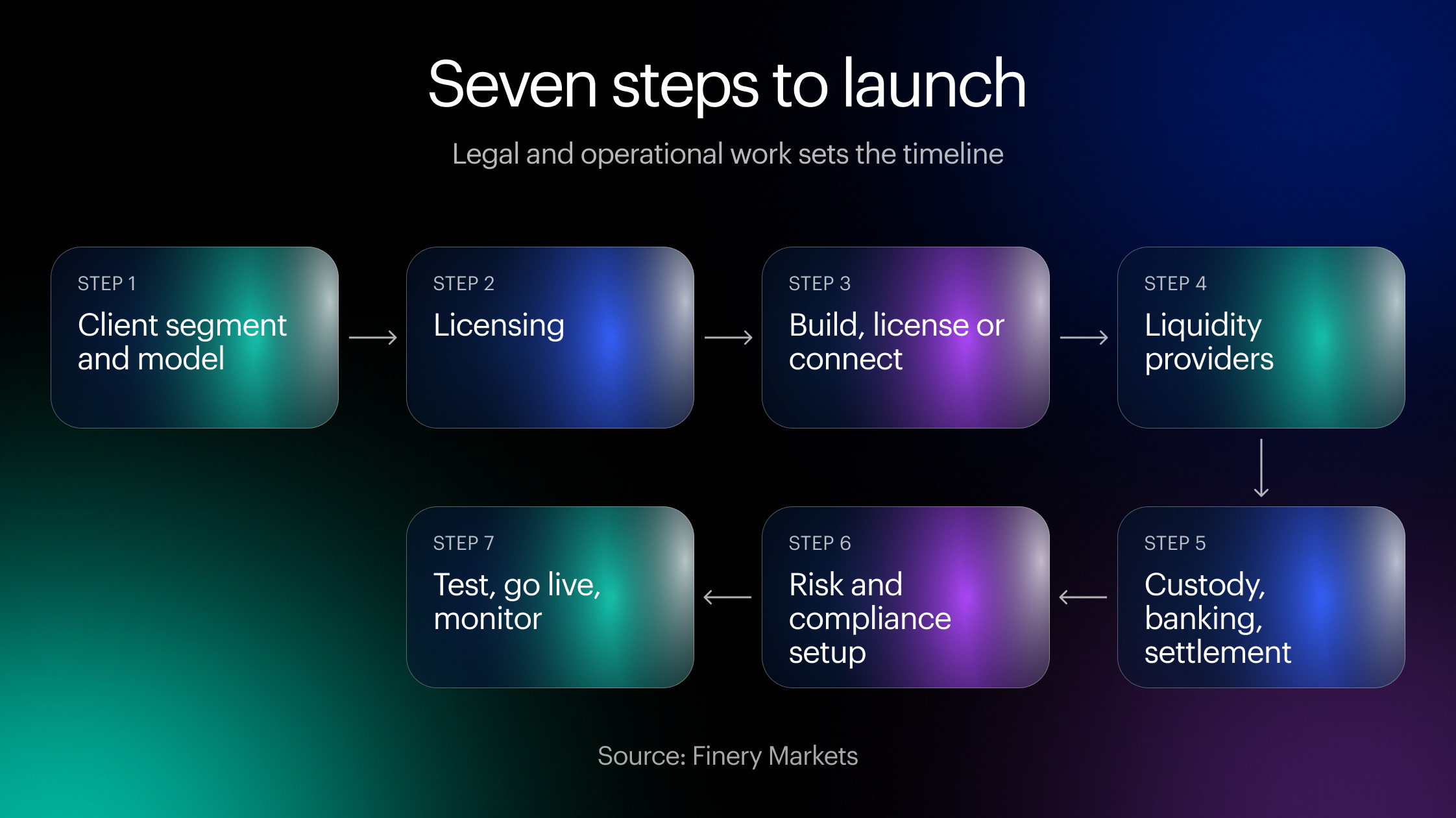
- Define the client segment and the business model. Agency brokerage, principal trading, liquidity resale and payment conversion need different account structures, risk limits and revenue tools.
- Settle the licensing question. In the EU that means MiCA authorization as a crypto-asset service provider, or a partnership with one. In the US it depends on the asset, the activity and the state.
- Choose to build, license or connect. Building gives full control and takes years. Licensing a white-label platform brings the launch time down to weeks. Connecting to an existing network gives liquidity immediately but limits branding.
- Line up liquidity providers. Sign agreements, run mutual KYC, agree credit limits and pre-funding levels, and test each provider's pricing in a test environment.
- Set up custody, banking and settlement. Decide where client assets sit, which banks carry the fiat legs, and how often positions settle.
- Configure risk and compliance. Set pre-trade limits, markups, Travel Rule and KYC procedures, reporting and the kill switch, then document them for the regulator.
- Test, go live and monitor. Run the full trade cycle in the test environment, start with a few clients, and track fill ratios, rejections, uptime and settlement breaks from the first day.
Build or buy
Building in-house suits firms whose institutional trading technology is their product and who can fund a multi-year engineering team. Everyone else is better served by a white-label or software-as-a-service platform and spending the saved time on clients and liquidity relationships. The questions to ask a vendor are concrete: matching engine latency and throughput, uptime history, which execution methods are firm, how settlement works, whether the vendor ever holds client assets, and what the contract allows if the firm wants to leave. Our guide to white label crypto exchanges covers costs and vendor evaluation in more detail.
The infrastructure layer behind institutional crypto trading
A broker or bank that wants to offer crypto trading rarely struggles with the user interface. The hard parts are the liquidity relationships, the credit lines and the post-trade work, each of which takes months to set up provider by provider.
Finery Markets provides that layer as software. Through FM Marketplace, our multi-dealer ECN, liquidity takers reach institutional market makers and exchanges with one connection, and trade on an aggregated order book with firm prices and no last look, as well as through RFQ and quote streams. Counterparties trade on credit lines with post-trade settlement. Through FM White Label, a broker, OTC desk or bank runs the same infrastructure under its own brand, with master and sub-accounts, markups by client and by pair, and APIs on its own domain. We publish a sub-1 millisecond matching engine, capacity for more than 2 million orders per minute and 99.99% uptime, and a fully branded platform can launch in under a week.
Our software is non-custodial. We do not hold client assets, and we are not a party to the trades or settlements between counterparties, which stay bilateral between the firms that agree them.
Risks and limitations
A platform does not create liquidity by itself. If the liquidity providers behind it are few or poorly capitalized, aggregation adds little to the available liquidity, and spreads widen exactly when clients need to trade. Check how many providers are live on the pairs that matter and how prices held up during stress, such as the October 2025 liquidation.
Credit-based trading moves risk rather than removing it. Trading on credit lines exposes each counterparty to the others until settlement, so limits, netting and settlement discipline replace pre-funding as the main protection. Vendor dependence is the other risk: a white-label operator relies on the vendor's uptime and roadmap, and DORA makes those contracts a supervisory matter in the EU. Finally, a platform does not replace a license. The operator remains responsible for KYC, Travel Rule compliance and client protection in every jurisdiction it serves.
Outlook for institutional trading infrastructure
Three developments will shape platforms over the next two years. Banks will move from custody to trading as their digital asset budgets reach production. Stablecoin and euro pairs will take a larger share of volume as MiCA-compliant issuers grow, which favors platforms with fiat settlement corridors in several currencies. And post-trade will gain weight, with cleared settlement networks and netting reducing the credit exposure that limits trading today.
The competitive line between platforms is moving from the screen to the plumbing. Interfaces have become easy to copy, while credit networks, firm liquidity and settlement relationships take years to assemble. Firms that choose infrastructure on those terms will carry institutional flow, and those that choose on features alone will discover the gap at their first volatile market.
FAQ
What is an institutional trading platform?
An institutional trading platform is trading software built for professional counterparties such as banks, brokers, funds and OTC desks. It aggregates liquidity from several providers, executes orders with pre-trade risk controls, supports credit-based trading and produces the audit trail and reports that regulators and clients expect.
How is an institutional trading platform different from a retail one?
The main difference is who carries risk. Retail platforms hold client funds, require full deposits and settle internally. Institutional platforms connect named counterparties that trade on credit lines, settle bilaterally after the trade and connect through FIX or other APIs with role-based permissions.
What features should an institutional crypto trading platform have?
The core list is aggregated multi-dealer liquidity, firm pricing across order book, RFQ and quote streams, pre-trade risk controls with a kill switch, credit-based trading, master and sub-accounts, transaction cost analysis, and security certifications such as SOC 2 and ISO 27001 with a full audit trail.
How long does it take to launch an institutional trading platform?
It depends on the route. Building in-house usually takes several years. A white-label platform can be configured in about a week, but licensing, liquidity agreements, banking and compliance setup typically take several months, so the legal work sets the real timeline.
Do I need a license to run an institutional trading platform?
Usually, yes. In the EU, offering crypto trading to clients requires MiCA authorization as a crypto-asset service provider or a partnership with one. Other jurisdictions have their own regimes. The software vendor's certifications do not replace the operator's license.
How do institutional traders trade large orders?
Institutions trade large orders in pieces. An algorithm such as TWAP or VWAP releases child orders over time, or the trader requests quotes from several liquidity providers for the full block through RFQ. Both approaches limit market impact compared with sending one large order to a visible order book.
Can individual traders use an institutional trading platform?
Usually not directly. Institutional platforms onboard legal entities that pass KYC, sign agreements with their counterparties and meet minimum size or regulatory status. Individual investors reach institutional liquidity indirectly, through a broker or app that connects to such a platform behind the scenes.
What is a kill switch in trading?
A kill switch is a control that cancels all of a firm's open orders on one or all venues at once. Regulators in the EU require it for algorithmic trading firms, and it limits losses when an algorithm, router or connection malfunctions.


 LinkedIn
 Youtube
 Medium
 Twitter