To become a liquidity provider in institutional crypto markets, a firm needs four things before it can quote: balance sheet to hold inventory, a legal entity with the right registrations, a pricing and hedging stack, and counterparties willing to extend credit and route flow to it. How to become a liquidity provider is mostly a question of building and connecting those four pieces in the right order.
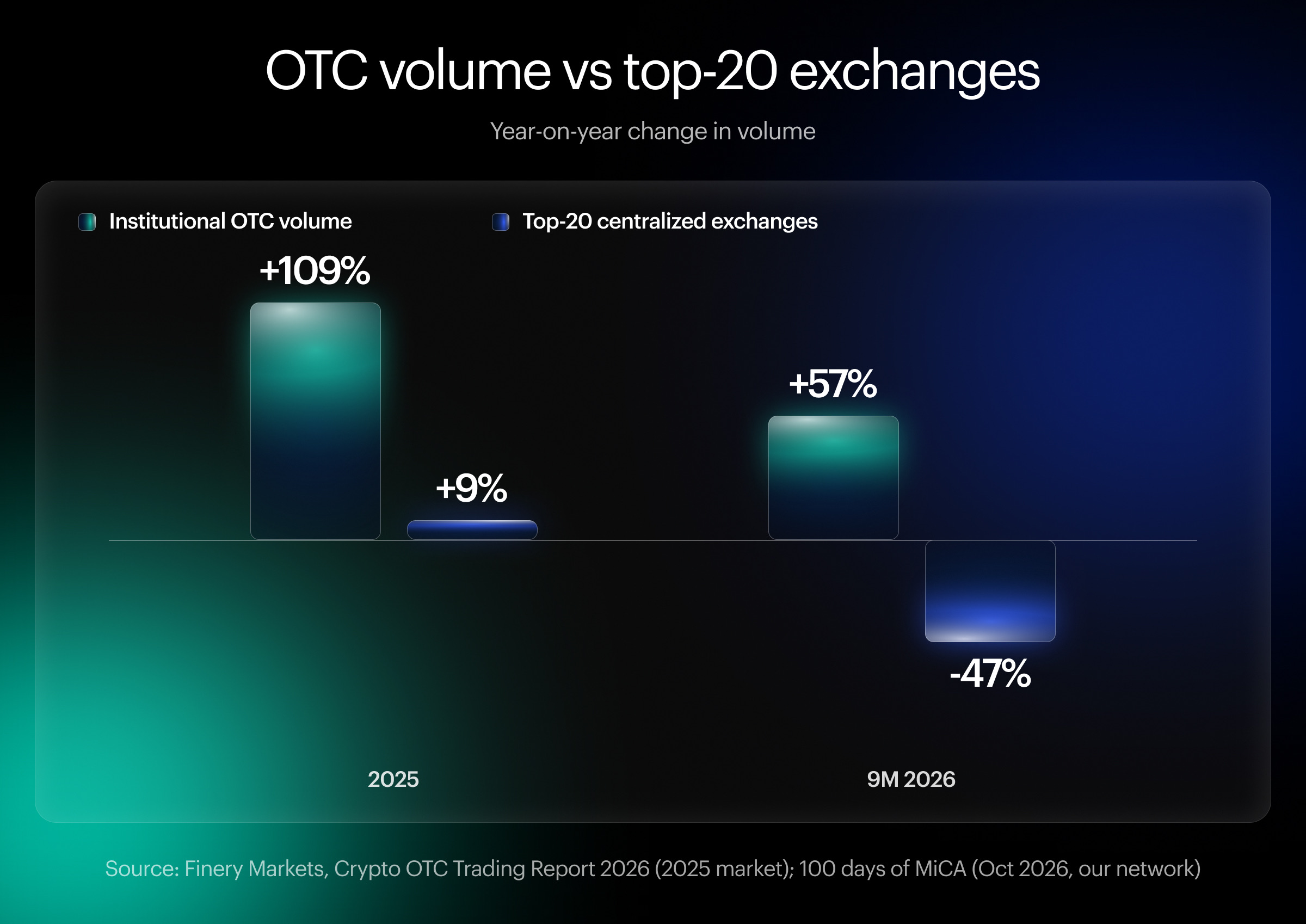
Demand for that capacity is moving off-screen. In the first nine months of 2026, institutional OTC volume across our network grew 57% year on year, while top-20 centralized exchange volume fell 47%, according to our 100 days of MiCA review. In the Crypto OTC Trading Report 2026, 40% of surveyed institutions named OTC as their first-choice execution venue, routing more than half of their trades away from public order books.
The economics are getting harder at the same time. 75% of liquidity providers surveyed for that report saw spread capture decline in 2025 compared with 2024. New entrants therefore compete on credit and distribution more than on price alone. The sections below explain the role, the revenue model and the requirements, then set out an eight-step launch plan and the risks that decide whether the business survives its first volatile month.
What is a liquidity provider?
A liquidity provider is a financial institution or trading firm that stands ready to buy and sell an asset at quoted prices, so that brokers, exchanges, OTC desks and payment companies can facilitate trades for their clients without holding inventory themselves. Firms that provide liquidity in crypto stream two-way prices through APIs, usually to known counterparties, and settle trades off-exchange.
The role covers market makers, proprietary trading firms and OTC desks that run their own book. What unites them is the willingness to take the other side of a trade and manage the resulting position. A broker that only passes orders to someone else is a liquidity taker, even if it shows prices to its own clients.
The model comes from traditional markets. In FX, major banks and non-bank market makers quote currencies and other financial instruments to forex brokers and other intermediaries, and CFD liquidity providers connect to a retail brokerage's trading platform through a liquidity bridge. Firms that already make markets in those asset classes often add crypto assets as an extension of the same stack.
Liquidity providers and market makers overlap, and the terms are often used interchangeably. The usual distinction is that a market maker quotes continuously on a venue, sometimes under formal obligations on spread and size, while a liquidity provider may quote only to selected counterparties or only on request. The difference between the two sides of a trade is covered in more depth in our market maker vs market taker guide.
Institutional LPs vs DeFi liquidity pools
The phrase "liquidity provider" has a second meaning that dominates retail search results. On a decentralized exchange, a user who deposits two tokens into an automated market maker pool is also called a liquidity provider. Smart contracts quote against the pool's balances with a pricing formula, and depositors earn rewards from the trading fees. Retail guides present this as passive income or a form of yield farming, and the returns come with impermanent loss and smart contract risk.
The two roles share a name and little else. A DeFi pool depositor needs a wallet and capital. An institutional LP needs credit relationships, compliance controls, risk systems and connectivity, because it is quoting firm or near-firm prices to regulated businesses at size. This guide is about the institutional role. The DeFi mechanics are explained in our DeFi guide.
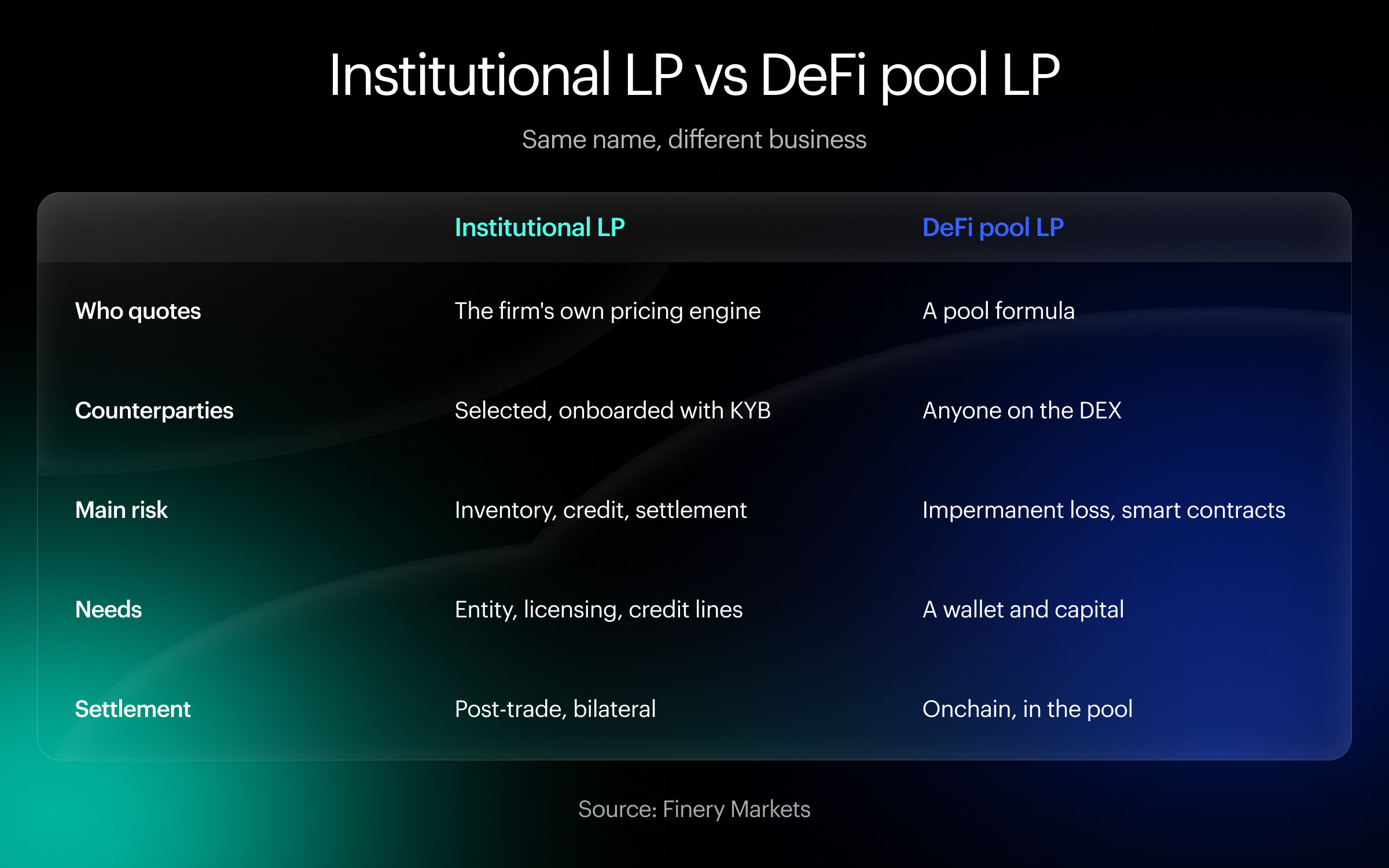
In short: a DeFi LP supplies capital to a smart contract and accepts the curve's pricing and impermanent loss. An institutional LP sets its own prices, chooses its counterparties, hedges its position on other venues and carries counterparty and settlement risk that it manages through credit limits.
How do liquidity providers make money?
The core revenue is the bid-ask spread: buying slightly below and selling slightly above the reference price, many times a day. A provider quoting BTC/USDT to a payment company earns the price difference between its quote and the price at which it hedges the resulting position elsewhere, minus fees and slippage on the hedge.
Spread revenue depends heavily on the quality of the flow. Flow from payment companies, brokers serving retail clients and corporate treasuries tends to be uninformed about short-term price moves, so the provider keeps most of the spread. Flow from fast arbitrage traders and some hedge funds is informed, and the provider loses money on it even when every trade looks profitable on paper. This is adverse selection, often called toxic flow.
Several other revenue lines sit next to spread income:
- Financing: lending coins or stablecoins to counterparties and charging borrowing rates.
- Rebates and fee tiers on exchanges where the provider hedges or quotes.
- Larger RFQ tickets, where the provider prices a block trade for a single counterparty and charges for the risk of holding it.
- Distribution fees or markups when the provider resells its liquidity to its own clients through sub-accounts.
The 75% of liquidity providers reporting lower spread capture in 2025 explains why these other lines matter. A new entrant that relies only on tight quotes in the most liquid pairs is competing with the largest firms on their own ground.
Requirements for crypto liquidity providers
Before the first quote goes out, six building blocks have to be in place. Most failed launches skip one of them, usually credit or risk controls, because the trading model looked complete without it.
Capital and inventory
A liquidity provider needs capital for three uses: inventory in the assets it quotes, margin and pre-funding on the venues where it hedges, and a buffer for losses during volatile periods. The amount depends on the pairs, the ticket sizes, how quickly positions can be hedged and the firm's risk tolerance. Quoting EUR stablecoin pairs to payment companies needs a different balance sheet from quoting altcoins to arbitrage desks.
Pre-funding is where much of the capital goes. A centralized exchange typically requires 100% of a trade's value to sit on the exchange before execution. Bilateral credit lines change that: on our network, pre-funding is typically 0 to 20% of agreed trading limits, set bilaterally with each counterparty. Capital tied up on venues is capital that cannot back new quotes, so credit terms shape how much business a given balance sheet can support.
Legal entity, licensing and compliance
The regulatory perimeter depends on where the firm is based, where its counterparties are and what exactly it does. Dealing on its own account with professional counterparties is treated differently from executing orders for clients or holding their assets, and the answer changes by jurisdiction. Most new liquidity providers take specialist legal advice before choosing an entity.
In the European Union, the Markets in Crypto-Assets Regulation (MiCA) lists the exchange of crypto-assets for funds or for other crypto-assets among the services that need authorization as a crypto-asset service provider (CASP). Minimum own funds start at €125,000 to €150,000 depending on the services, alongside fit-and-proper management, governance, IT security and segregation of client assets, as our MiCA explainer sets out. The transitional period for firms operating under national regimes ended on 1 July 2026 at the latest. Of 2,747 crypto registrations under national regimes in 2024, only 280 firms appeared on ESMA's first post-deadline list.
In the United Kingdom, firms that exchange cryptoassets for money, or one cryptoasset for another, by way of business must register with the FCA under the Money Laundering Regulations before starting. A new authorization regime under the Financial Services and Markets Act 2000 is expected to come into force on 25 October 2027.
Whatever the jurisdiction, counterparties will run their own know-your-business (KYB) checks on the provider. A liquidity provider should expect to supply corporate documents, ownership structure, financial statements, AML policies and evidence of sanctions screening before any institution extends a trading limit. Newer firms without a track record should expect smaller limits at first.
Pricing engine and hedging venues
A pricing engine turns market data into quotes. It takes prices from exchanges and other sources, builds a reference price, then adds a spread that reflects volatility, the provider's current inventory, the size requested and the counterparty. Inventory skew is the important part: a provider that is already long BTC lowers both bid and offer slightly to attract sellers less and buyers more.
Every quote needs a hedge plan, and hedging strategies differ by pair and size. Most liquidity providers offset positions on centralized exchanges or with other OTC providers, and net opposite client flows internally where they can. The hedging venues set the floor on spreads, because the provider cannot quote tighter than the cost of laying off the risk.
Execution quality: depth, fills and lower slippage
Takers judge execution quality on more than the headline price. They look at liquidity depth at the sizes they trade, fill and rejection rates, and whether a provider keeps competitive spreads through high volatility and news events. Liquidity quality on those measures is what earns a provider a larger share of a taker's flow over time.
The comparison is constant. A taker that gets reliable execution from a provider routes it more volume, and a taker that finds better execution elsewhere can shift flow quickly, because most institutional takers connect to several providers at once.
Connectivity and trading APIs
Institutional counterparties connect through standard protocols. FIX 4.4 remains the default for order and quote messages between institutions, WebSocket is common for streaming prices, and REST APIs handle account, balance and reporting calls. Latency matters most for providers quoting in an order book, where a stale price is hit before it can be updated. The tradeoffs are covered in our low latency trading guide.
Risk management
Risk controls decide whether a liquidity provider survives a volatile week. The minimum set covers:
- Position limits per asset and in total, with automatic quote withdrawal when they are hit.
- Credit limits per counterparty, tied to the provider's view of that counterparty's creditworthiness.
- Price checks that stop quoting when reference prices diverge across sources.
- Toxic flow monitoring by counterparty, measuring how prices move after each fill.
- A kill switch that pulls all quotes at once.
Last look is a related decision. Some providers quote indicative prices that they confirm or reject at the moment of execution, which protects them from stale fills but costs them flow from takers who need certainty. Firm quotes win more business and require tighter risk controls. Our last look guide explains how takers judge each model.
Settlement and custody
OTC trades between institutions usually settle after execution, on a schedule both counterparties agree. The provider needs custody for its own assets, wallets on the networks it settles on, fiat banking for the currencies it quotes, and an operations team that reconciles every trade against transfers. Settlement failures and late transfers are a credit event in practice, so the provider needs a policy for them before the first one happens.
How to become a liquidity provider in 8 steps
The order below reflects the dependencies between the building blocks. Credit and distribution come before technology spend, because a pricing engine with no counterparties produces no revenue.
- Define the model: which pairs, which ticket sizes, which client types and which regions.
- Size the balance sheet for inventory, hedging venues and a loss buffer under stressed conditions.
- Set up the legal entity and obtain the registrations or authorizations the activity requires.
- Build compliance: AML and sanctions policies, KYB on counterparties, Travel Rule processes for transfers.
- Choose distribution: bilateral connections, exchange programs, multi-dealer networks, or a mix.
- Build or license the pricing engine, hedging connectivity and risk controls, and test them in simulation.
- Agree credit lines, limits and settlement terms with each counterparty, and complete mutual onboarding.
- Start quoting in a few pairs with conservative limits, measure flow quality, then widen pairs and sizes.
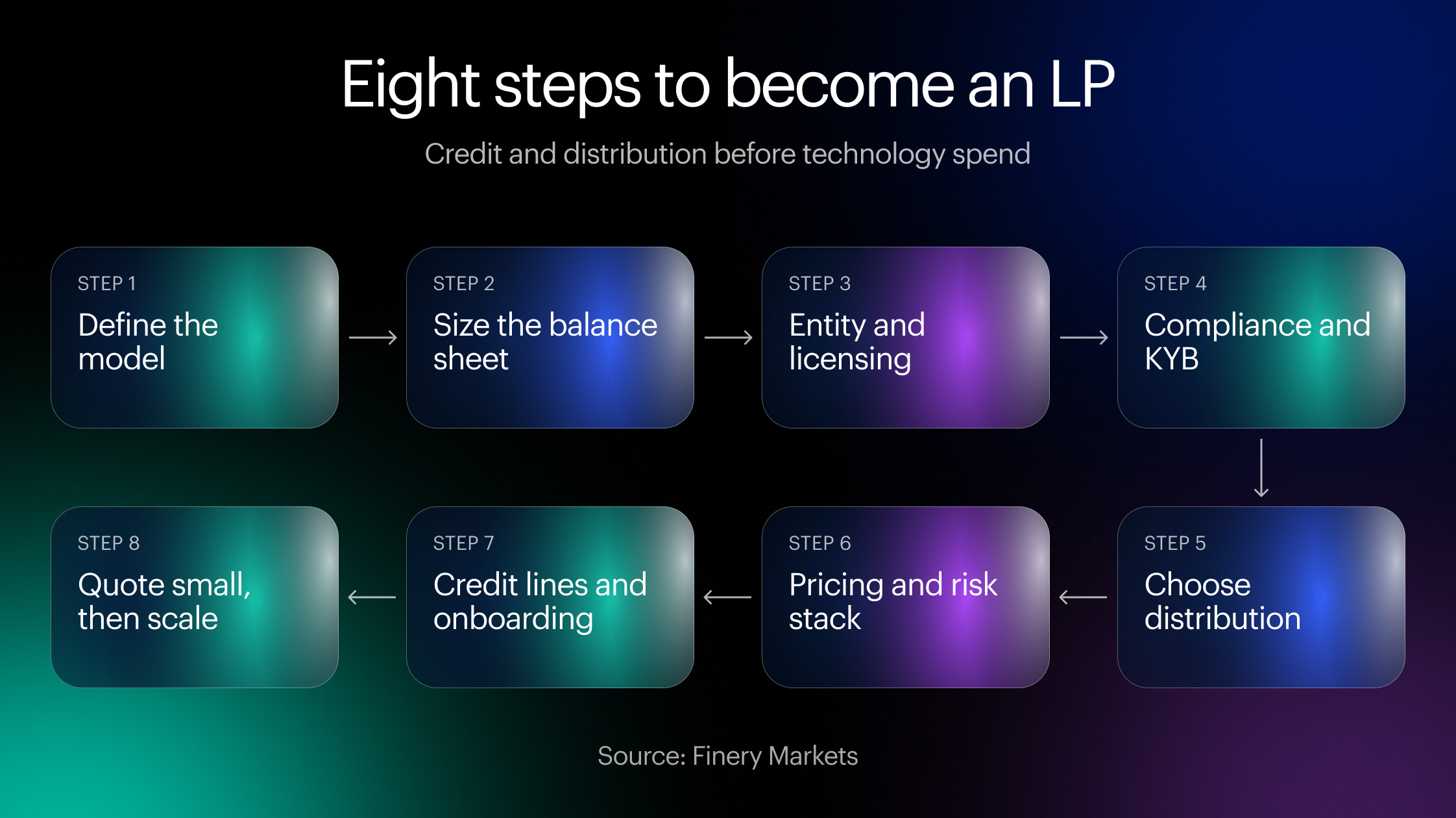
The first months are a measurement exercise. A provider learns which counterparties send profitable flow and which pairs hedge cleanly. Spreads and limits per counterparty are adjusted from that data.
How liquidity providers work with takers: three channels
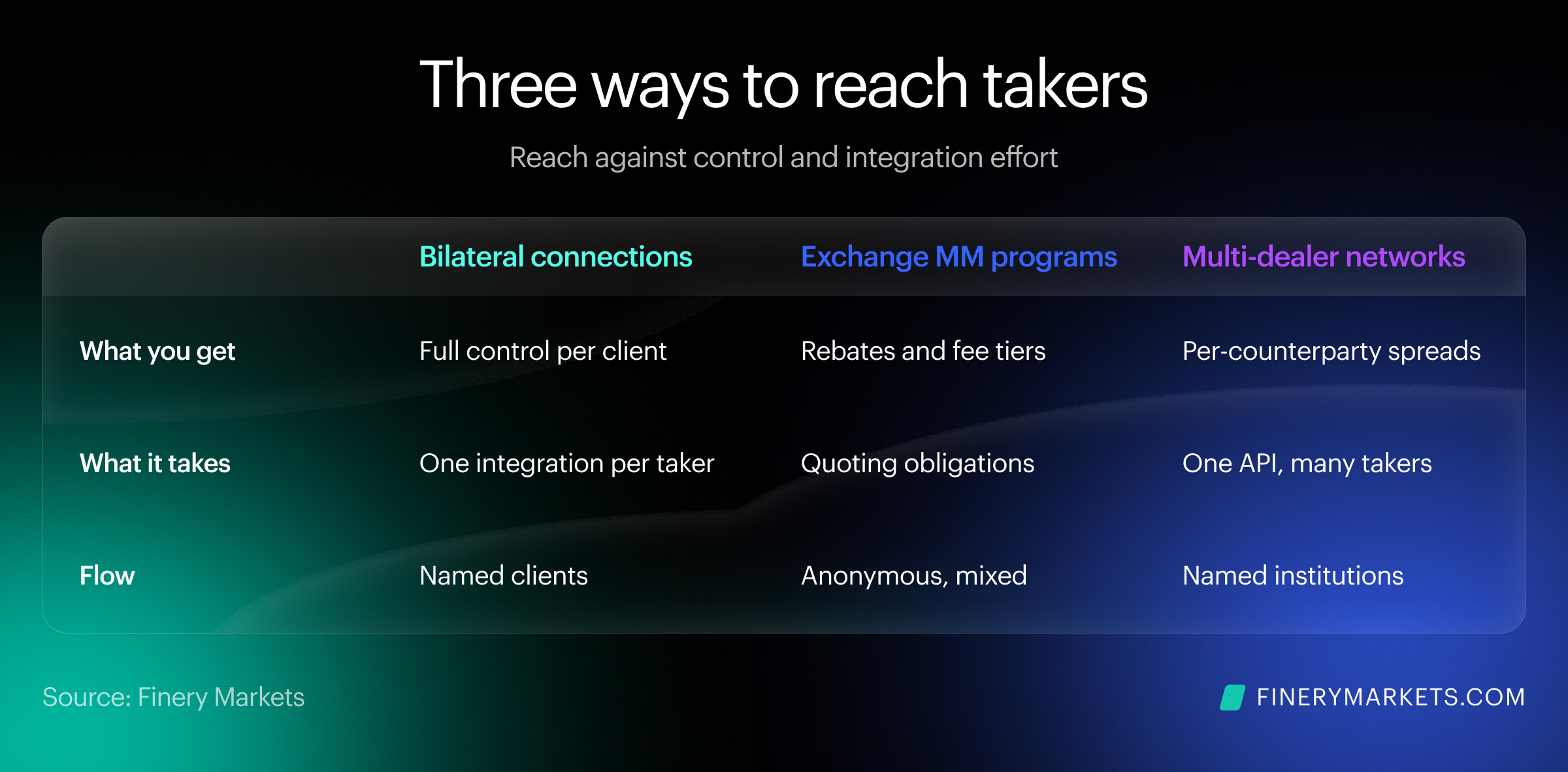
A liquidity provider reaches takers through one or more channels. Each one trades reach against control and integration effort.
Bilateral connections
The provider signs a trading agreement with each taker, agrees credit terms and builds or maintains an API connection to each one. Control is complete: the provider sets prices, limits and settlement terms per client. The cost is integration and onboarding work that grows with every new counterparty.
Exchange market maker programs
Centralized exchanges run programs that pay rebates or lower fees to firms that quote with tight spreads and minimum depth for a set share of the time. The flow is anonymous and mixed, and quoting obligations apply in volatile markets as well as calm ones. These programs suit providers whose edge is speed and hedging efficiency.
Multi-dealer networks and liquidity aggregators
An electronic communication network (ECN), multi-dealer platform or liquidity aggregator connects many takers and providers through one integration and aggregates liquidity from several providers into one view for each taker. The provider streams quotes once and reaches every taker it has agreed to trade with, while keeping per-counterparty spreads and limits. This model cuts onboarding work and gives access to institutional flow that would take years to build bilaterally. How ECNs differ from exchanges is explained in our crypto ECN guide.
More than half of the liquidity providers in our latest survey prefer OTC setups when working with institutions. Off-screen channels let them price larger tickets without showing intent to the whole market.
Why demand for institutional liquidity providers is growing
Institutional flow keeps moving away from public order books. Institutional spot OTC volumes grew 109% in 2025 against 9% for the top 20 centralized exchanges, according to our Crypto OTC Trading Report 2026. Our own research shows the gap widening in 2026: across our network, OTC volume rose 57% year on year in the first nine months while top-20 exchange volume fell 47%.
The takers on the other side are brokers, payment companies, neobanks and banks that need access to crypto prices for their clients without running a trading desk. A brokerage adding crypto to its platform tends to choose its liquidity setup once and revisit it rarely, so providers that are inside it early have an advantage.
Stablecoins have become the main quoting currency in this flow. Stablecoins accounted for 83% of trades by number on our network in the first nine months of 2026. A provider that quotes deep USDT, USDC and EUR stablecoin pairs against fiat and major crypto assets addresses most of what payment companies and brokers trade.
Stress periods show why takers value off-screen liquidity and the price stability it offers. When $20 billion in crypto positions liquidated over 48 hours in October 2025, BTC/USDT and ETH/USDT volume in OTC private rooms on our network grew 107% week on week, against 48% on exchanges, as our analysis of the liquidation crisis shows. Providers that kept quoting through that week won flow that stayed with them afterward.
Reaching institutional flow without building every connection
A new liquidity provider faces a distribution problem before it faces a pricing problem. Each taker needs its own agreement, credit line, API connection and settlement workflow, and a provider with ten counterparties maintains ten of everything.
Finery Markets is the infrastructure through which liquidity providers and takers trade with each other on their own bilateral terms. A provider connects once and streams quotes via FIX 4.4 or WebSocket to payment providers, OTC desks, brokers and neobanks it has selected and onboarded through mutual KYC. Our network includes 20+ institutional providers, including Wintermute, GSR, Flow Traders and Keyrock, plus centralized exchange liquidity. Providers set spreads, limits, lending and borrowing conditions per counterparty, and a 100 millisecond speed bump on the taker side, pre-trade risk checks and credit-screened counterparties protect them from toxic flow. Trades run on bilateral credit lines with pre-funding typically between 0 and 20% of agreed limits.
A provider that wants to serve its own clients can run a master account with sub-accounts through FM Liquidity Match and build a proprietary liquidity pool for selected counterparties. The details for makers are on our page for liquidity providers.
We are a software vendor: we do not trade, hold client assets or act as counterparty to any trade. The provider keeps its own balance sheet and custody.
Risks and limitations
Liquidity provision carries inherent risks that no technology removes. Market risk is the obvious one. A provider holding inventory through a sharp move can lose weeks of spread income in minutes, and correlation between crypto assets rises in sell-offs, which weakens hedges built on related pairs.
Counterparty and settlement risk come next. Post-trade settlement means the provider is exposed to a counterparty between execution and transfer. Credit limits and netting reduce that exposure without removing it.
Operational risk includes stale prices from a failed data feed and wallet errors during settlement. Each one can turn a profitable day into a loss, which is why kill switches and price checks belong in the first release.
Regulatory risk is the slowest and most expensive. Rules for dealing on own account and for capital continue to change on both sides of the Atlantic, and a provider that expands into a new market may need a new authorization before it can quote there.
Outlook for crypto liquidity providers
The next two years favor providers that combine balance sheet with distribution. MiCA's authorization requirement has already reduced the number of firms that can serve EU clients, and the UK's FSMA regime, expected on 25 October 2027, will add a second authorization track for firms serving British counterparties.
Spread compression will continue in the most liquid pairs. Growth for new entrants is more likely in segments the largest firms serve less closely: EUR and other non-USD stablecoin pairs, local fiat corridors, and block-sized RFQ tickets for payment companies and treasuries.
Liquidity provision is a balance-sheet business with an operations problem attached. The firms that become durable liquidity providers will be those whose credit relationships and settlement operations are as well built as their pricing models. In a market where most institutional flow is bilateral, the counterparty network is the asset that takes longest to replicate.
FAQ
How do you become a liquidity provider in crypto?
A firm needs capital for inventory and hedging, a legal entity with the registrations its activity requires, a pricing and risk stack, and counterparties that agree credit lines with it. Most firms start with a few pairs and conservative limits, measure flow quality, then expand to more pairs and larger sizes.
How much capital do you need to be a liquidity provider?
It depends on the pairs and ticket sizes. Regulatory minimums are only a floor: MiCA sets minimum own funds of €125,000 to €150,000 depending on services. Trading capital for inventory, pre-funding and loss buffers is usually far larger and scales with the volume the provider wants to quote.
Can an individual become a liquidity provider?
In DeFi, yes: anyone can deposit tokens into a liquidity pool and earn a share of fees. Institutional liquidity provision is different. Brokers, payment companies and OTC desks onboard firms, not individuals, and expect a legal entity, compliance controls, financial statements and credit standing before they extend trading limits.
Do liquidity providers need a license?
Often, yes. In the EU, exchanging crypto-assets for funds or other crypto-assets is a CASP service under MiCA. In the UK, cryptoasset exchange providers must register with the FCA before starting. The exact requirement depends on the jurisdiction and on whether the firm deals only on its own account.
What is the difference between a liquidity provider and a market maker?
The terms overlap. A market maker usually quotes continuously on a venue, sometimes under spread and size obligations. A liquidity provider may quote only to selected counterparties or on request, often bilaterally and off-exchange. Many firms do both, and institutions use the two terms almost interchangeably.
How do liquidity providers make money?
Mainly from the bid-ask spread, minus the cost of hedging each position. Other revenue includes financing and coin lending, exchange rebates, risk pricing on block trades, and markups when they resell liquidity to their own clients. Flow quality decides profitability, because informed flow erodes spread income.
What is toxic flow for a liquidity provider?
Toxic flow is order flow from traders who know where the price is about to move, such as fast arbitrageurs. The provider fills the trade and the market then moves against it. Providers manage it with per-counterparty pricing, speed bumps, last look or by declining to quote certain takers.


 LinkedIn
 Youtube
 Medium
 Twitter