Low latency trading is the practice of cutting the time between a market event and the order that responds to it, down to milliseconds and, at the top end, microseconds. In the fastest equity markets that gap decides who gets filled. In London Stock Exchange data, the winner of a typical latency race beat the first loser by just 5 to 10 microseconds.
Those races are a large share of trading. In the same data, covering FTSE 100 stocks in 2015, about 22% of trading volume took place in races, and races accounted for about a third of the effective spread investors paid. The authors put the global cost of latency arbitrage in equity markets at about $5 billion a year. Crypto is heading the same way as institutional flow grows: according to our Crypto OTC Trading Report 2026, institutional spot OTC volumes grew 109% year over year in 2025, against 9% for the top 20 centralized exchanges.
Most brokers, OTC desks and payment providers will never compete with high frequency trading firms on microseconds, and few need that competitive edge. Their focus is narrower: where delay costs them money, who carries the risk of a stale price, and which infrastructure keeps fills firm. This article covers how low latency systems are built, what latency costs, how it plays out on crypto venues, and how to judge it when choosing execution infrastructure.
What is low latency trading?
Low latency trading means running trading systems so that market data arrives, decisions are made and orders reach the venue with minimal delay, measured in milliseconds (thousandths of a second) or microseconds (millionths). Ultra low latency usually refers to systems that react in single-digit microseconds or less, which is the territory of specialist market makers and arbitrage firms.
Latency is the delay between two points in a trade's life. The most quoted measure is tick-to-trade: the time from receiving a price update to sending an order in response. Round-trip latency adds the venue's acknowledgment. A desk that measures only one of them can miss where its delay actually sits.
Speed belongs to the whole chain. A fast matching engine behind a slow network, or a fast strategy behind a slow pre-trade check, still produces a slow trade.
How low latency systems are built
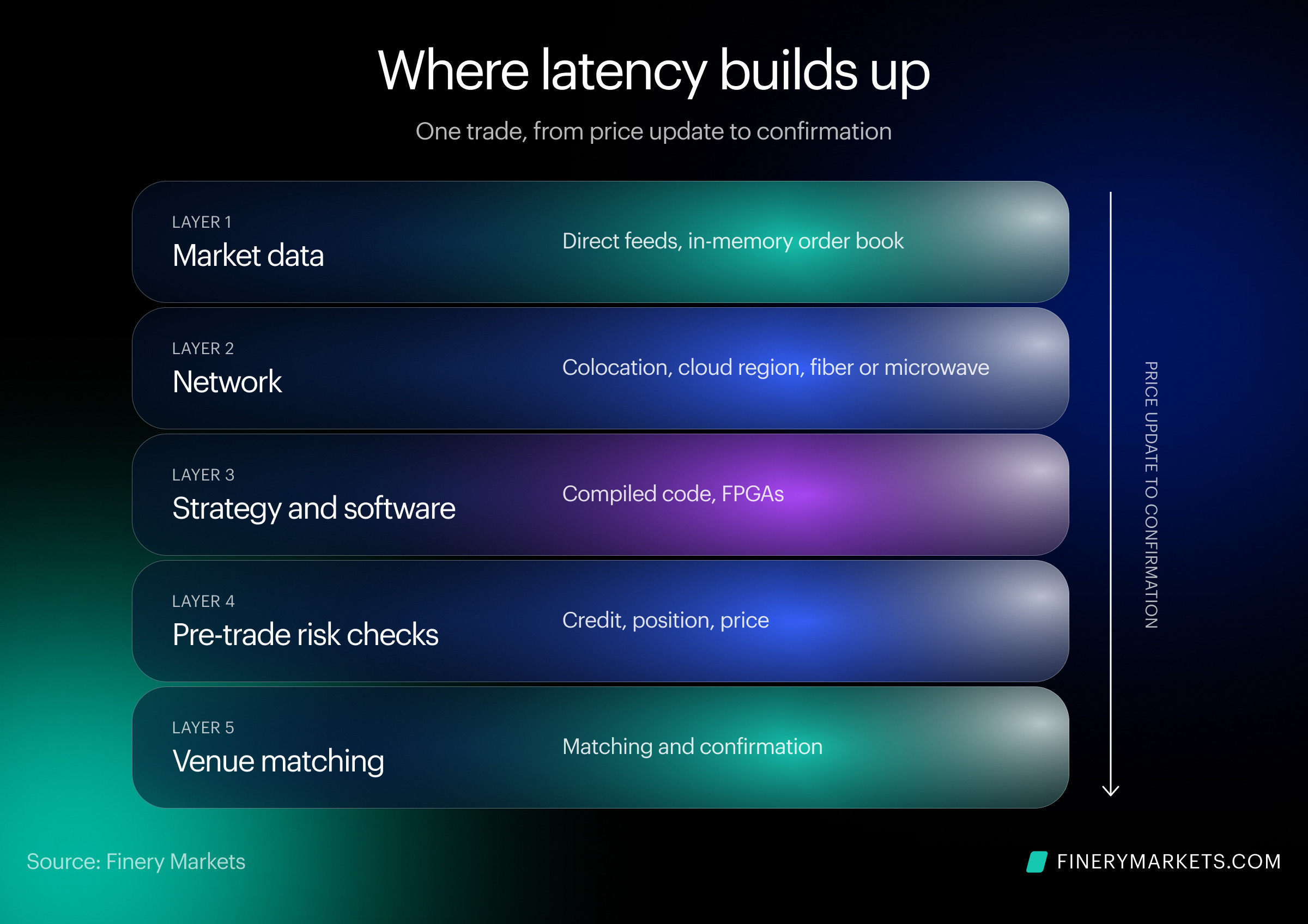
Delay accumulates in layers, and each layer has its own engineering fix. The order below follows a single trade from price update to confirmation.
Market data
A trading system can only react to what it has seen. Firms subscribe to direct venue feeds instead of slower consolidated ones, decode them in hardware where possible, and keep the order book in memory so a price change is visible the moment it arrives. No later layer can execute trades faster than this one delivers data.
Network, colocation and edge computing
Distance sets a hard floor. In their study of the trading arms race, Eric Budish, Peter Cramton and John Shim used 4 milliseconds as the one-way speed-of-light travel time between New York and Chicago. Colocation services place a firm's servers in the same data center as the venue's matching engine, and high speed connectivity between data centers, through dedicated fiber or microwave links, shortens the distance between venues. Edge computing applies the same idea to cloud setups: the strategy runs in the region where the venue's engine runs, which removes network delays across regions.
Strategy and software
Code paths are kept short. Firms use compiled languages, kernel-bypass networking and, for the simplest decisions, field-programmable gate arrays (FPGAs). Analytics and machine learning models usually sit outside the time-critical path, setting parameters that a simpler, faster rule then applies.
Pre-trade risk management
Every order passes credit, position and price checks before it leaves. EU rules require these controls for algorithmic trading, so the engineering task is to make them fast. Integration decides the cost here: good systems run risk management in the same process as order handling instead of calling a separate service.
Venue matching and confirmation
The venue's matching engine, its acknowledgment and the trade report close the loop. In crypto, settlement adds a further step that runs on a different clock: an order can be executed in microseconds while the transactions that move the assets settle hours later.
Why high frequency trading and algorithmic strategies depend on speed
High frequency trading (HFT) is a form of algorithmic trading in which systems send large numbers of orders, often hold positions for seconds or less, and earn money by executing strategies that react before other traders do. EU law defines it precisely. Under MiFID II, an HFT technique combines infrastructure intended to minimise latency (colocation, proximity hosting or high-speed direct electronic access), system-determined order decisions without human intervention, and high message intraday rates. Delegated Regulation (EU) 2017/565 sets that rate at an average of at least 2 messages per second in a single instrument, or 4 per second across all instruments on a venue.
Algorithmic traders rely on speed for three groups of strategies:
- Latency arbitrage: trading against a stale quote after the price has moved elsewhere but before the quote updates.
- Market making: updating or cancelling quotes before a faster trader hits them.
- Cross-venue and cross-instrument trading: capitalizing on fleeting market opportunities between related instruments, such as a futures contract and the matching exchange-traded fund.
The last group shows how short the window has become. Budish, Cramton and Shim found that by 2011 the correlation between the S&P 500 E-mini future and the SPY fund reached 0.50 only at a 142-millisecond interval. At 1 millisecond it was 0.008. Over very short horizons, prices that should move together do not, and the fastest firm captures the gap.
What latency costs: real world examples
The most detailed measurement comes from Matteo Aquilina, Eric Budish and Peter O'Neill, who used message data from the London Stock Exchange to identify races directly, published in the Quarterly Journal of Economics in 2022.
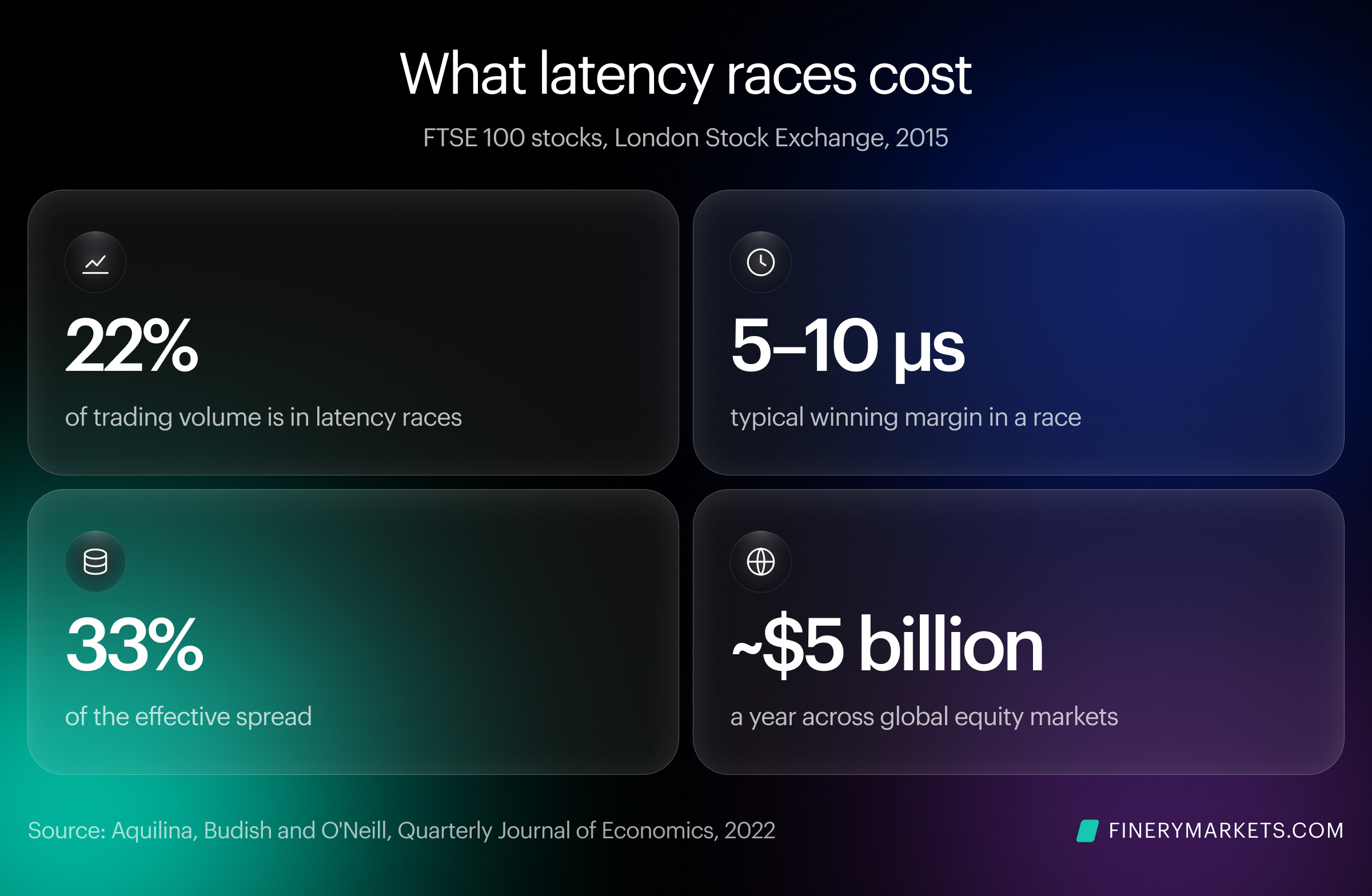
Their findings for FTSE 100 stocks in 2015:
- About 22% of trading volume and 21% of trades happened in races.
- The winner usually beat the first loser by 5 to 10 microseconds.
- Races made up about 33% of the effective spread.
- The "latency arbitrage tax" equaled 0.42 basis points of total trading volume.
- The annual cost was about £60 million in the UK and on the order of $5 billion across global equity markets.
The cost lands on the slower side. A market maker whose quote is picked off loses on that trade and then widens spreads for everyone else. The authors estimate that replacing continuous trading with frequent batch auctions, which remove races, would cut investors' cost of liquidity by 17%.
For a trading desk, an order execution delay shows up as slippage in crypto execution, rejected orders and missed opportunity. A price that was available when the decision was made may be gone when the order arrives.
Low latency on cryptocurrency exchanges
Crypto markets trade around the clock across many venues, with no consolidated tape and no single reference price. Liquidity for the same pair is split across centralized exchanges, OTC desks and electronic communication networks (ECNs), so price gaps between venues appear constantly and close quickly.
The infrastructure differs from equities. Many cryptocurrency exchanges run their matching engines in public cloud regions instead of exchange-owned data centers, so the equivalent of colocation is running servers in the same cloud region. The difference between two traders on the same venue often comes down to where their servers sit. Connectivity runs over REST and WebSocket APIs, and institutional venues add the FIX protocol, the standard in traditional finance.
Institutional flow also behaves differently from the orders of retail investors. In the same report, 40% of surveyed institutions named OTC as their first-choice execution venue. With OTC growth outpacing exchanges, much of that flow is block size, priced by request for quote (RFQ) or streamed quotes, where the price is agreed before execution. For these trades, the taker's own speed matters less than how the liquidity provider protects itself from faster traders.
Latency, last look and execution quality
A liquidity provider that streams a price is exposed to anyone who sees the market move first. Providers protect themselves in two ways. They widen spreads, or they keep a last look: a short window after receiving an order in which they can accept or reject it at the quoted price.
Last look moves latency risk to the taker. A slow or unlucky taker is rejected exactly when the market moves, and the rejection adds its own delay, because the order has to go out again at a worse price. Execution quality therefore depends on fill and rejection rates as much as on execution speed.
A firm order book removes that window. Every resting order is executable at its stated price, and the trade happens on match. To keep makers willing to show firm prices, some venues add a short, fixed delay on the taker side, called a speed bump, so a maker can update a stale quote before a fast taker reaches it.
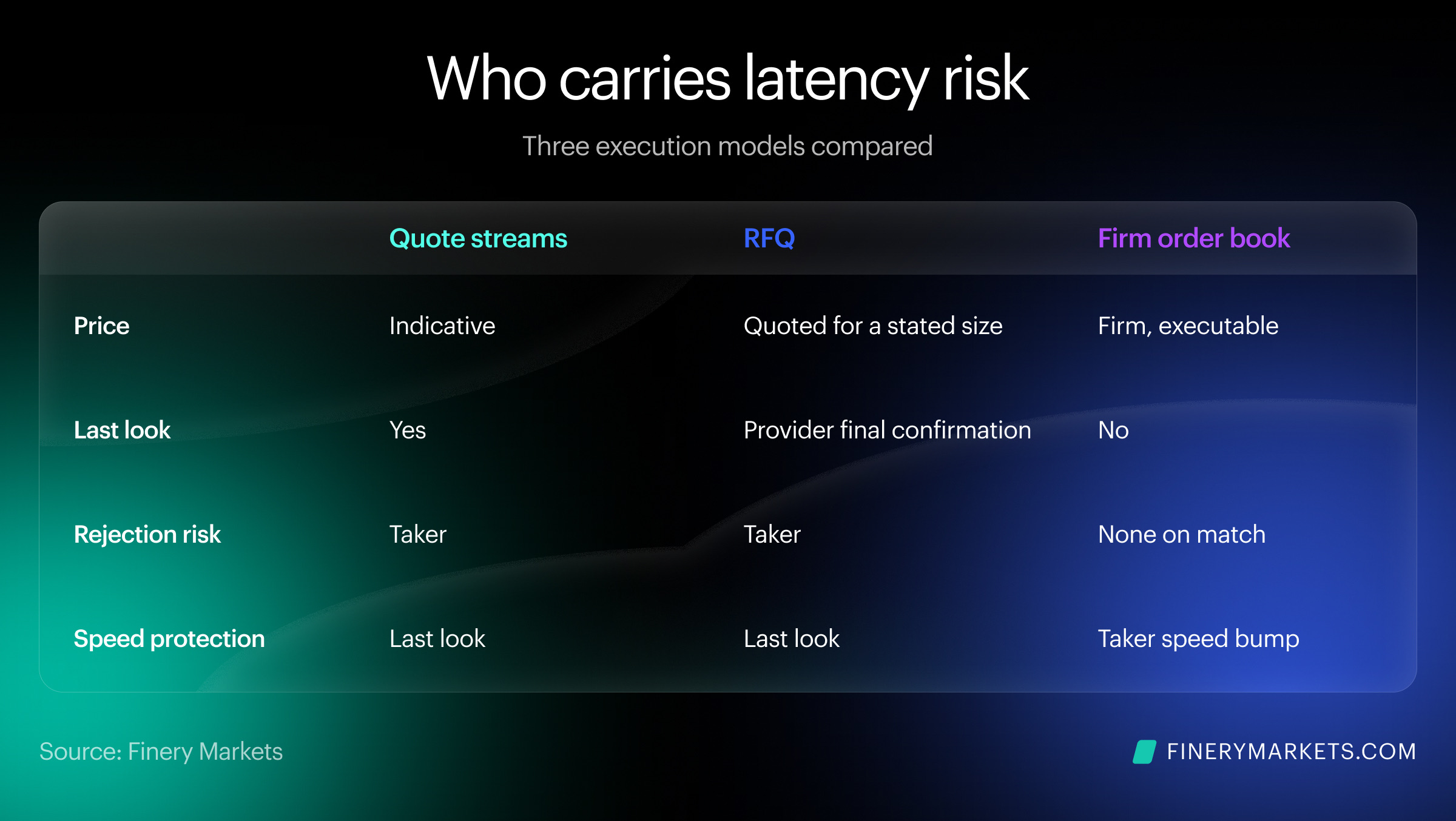
The three common execution models split the risk differently. With quote streams, prices are indicative and subject to last look, so the taker carries rejection risk. With RFQ, several providers quote a stated size, the taker confirms within a set window, and the provider gives final confirmation. With a firm order book, prices are executable without last look, orders match by price-time priority, and any speed bump applies to takers.
How to evaluate an algorithmic trading platform for latency
For a firm comparing liquidity solutions or choosing an algorithmic trading platform, raw speed is one item on a longer list, and the tools around it count as much. The questions that separate providers:
- Tick-to-trade and order acknowledgment times, measured at the 99th percentile as well as the average
- Matching engine latency, throughput and efficiency under load
- Connectivity options (FIX, WebSocket, REST) and where the servers are hosted
- Whether prices are firm or subject to last look, and the venue's rejection rates
- Which pre-trade risk checks run and how much delay they add
- Clock synchronization and timestamp precision for the audit trail
- Uptime record, failover design and the operations team behind them
Clock precision is a regulatory requirement in the EU. MiFID II clock-synchronization rules require firms using an HFT technique to keep business clocks within 100 microseconds of Coordinated Universal Time (UTC). Under Article 17 of MiFID II, those firms must also store time-sequenced records of every order, cancellation and quote, and make them available to regulators on request.
Firm execution for institutional crypto flow
For most brokers, payment providers and OTC desks, latency is a fill problem. An order rejected during a fast market costs more than the milliseconds it took to arrive.
Finery Markets provides the technology for a multi-dealer marketplace in which institutional takers reach aggregated liquidity from many providers through one connection. Our order book carries firm prices with no last look, which means zero rejections, while quote streams and RFQ remain available for larger or less liquid trades. A 100-millisecond speed bump on the taker side protects makers from stale-quote trading, which is what allows them to quote firm prices.
The matching engine processes an order in under 1 millisecond, including the pre-trade risk check, and handles more than 2 million orders per minute. Clients connect over FIX 4.4, WebSocket or REST to AWS-based infrastructure with 99.99% uptime. The execution rules are set out on the firm order book page. Finery Markets is a technology provider: our clients and their liquidity providers are the parties to each trade.
Risks and limits of the speed race
Speed has diminishing returns. Each step down, from milliseconds to microseconds to nanoseconds, costs more in hardware, network links and engineering time, and the advantage lasts only until competitors catch up. For companies that are neither market makers nor arbitrage traders, the extra profit rarely covers the spend.
Faster systems also fail faster, and automated operations need automated limits. An algorithm with a bug can send thousands of orders before anyone looks at a screen, which is why kill switches, order limits and risk management controls sit inside the time-critical path. Each bespoke component adds complexity, monitoring work and another point of failure.
Market design can change the value of speed overnight. Speed bumps, batch auctions and firm-quote rules all reduce what a few microseconds are worth, so trading strategies built only on being first are exposed to rule changes at the venue level.
Where low latency trading goes next
In equities and futures the race is mature. Colocation, microwave links and hardware acceleration are standard among industry leaders, and the remaining gains come in nanoseconds. Crypto is earlier: institutional demand is moving volume to OTC and ECN venues, cloud hosting sets the physical layout, and venues compete on how they handle latency risk as well as on speed.
A desk executing client flow needs predictable fills, prices it can rely on and timestamps it can defend to a regulator. Those properties come mostly from the venue's market model: whether quotes are firm, how makers are protected and how orders are recorded. A desk can buy the fastest servers on the market and still lose more to rejections than it gains in microseconds.
FAQ
What is low latency trading?
Low latency trading is the use of systems that receive market data, decide and send orders with minimal delay, usually measured in milliseconds or microseconds. It matters most for market makers and arbitrage strategies, where the first order to reach the venue gets the fill and slower orders get worse prices or none.
What does latency mean in trading?
Latency is the time delay between two points in a trade, such as a price update arriving and an order reaching the venue. Common measures are tick-to-trade time and round-trip time, which includes the venue's acknowledgment. Network distance, software, risk checks and the venue's matching engine all add to it.
Is low latency trading the same as high frequency trading?
No. High frequency trading is a set of strategies with very high order rates and short holding periods, and it depends on low latency. Low latency is a property of infrastructure, which any trader can use. Under MiFID II, HFT is defined by low latency infrastructure, automated decisions and high message rates together.
How do trading firms achieve low latency?
Firms place servers next to the venue's matching engine through colocation or the same cloud region, use direct market data feeds, and run short code paths in compiled languages or hardware. They also build pre-trade risk checks into the order process so that controls add microseconds instead of milliseconds.
Does latency matter for OTC and RFQ trading?
Less than on an exchange order book, but it still matters. In RFQ trading the price is agreed before execution, so the taker's speed is secondary. Latency affects how quickly providers respond and how long they keep the right to reject, which shows up in rejection rates and pricing.
What is a speed bump in trading?
A speed bump is a short, fixed delay a venue applies to certain orders, usually incoming orders from takers. It gives liquidity providers time to update quotes after the market moves, which reduces stale-quote losses and lets them show firm prices without last look.


 LinkedIn
 Youtube
 Medium
 Twitter