Bitcoin stablecoins are dollar-pegged tokens that depend on Bitcoin in one of two ways: they are issued on the Bitcoin network and its layers, or they are minted against bitcoin held as collateral. The label covers USDT moving over Lightning as well as a vault-based dollar backed by BTC. Bitcoin itself is not a stablecoin.
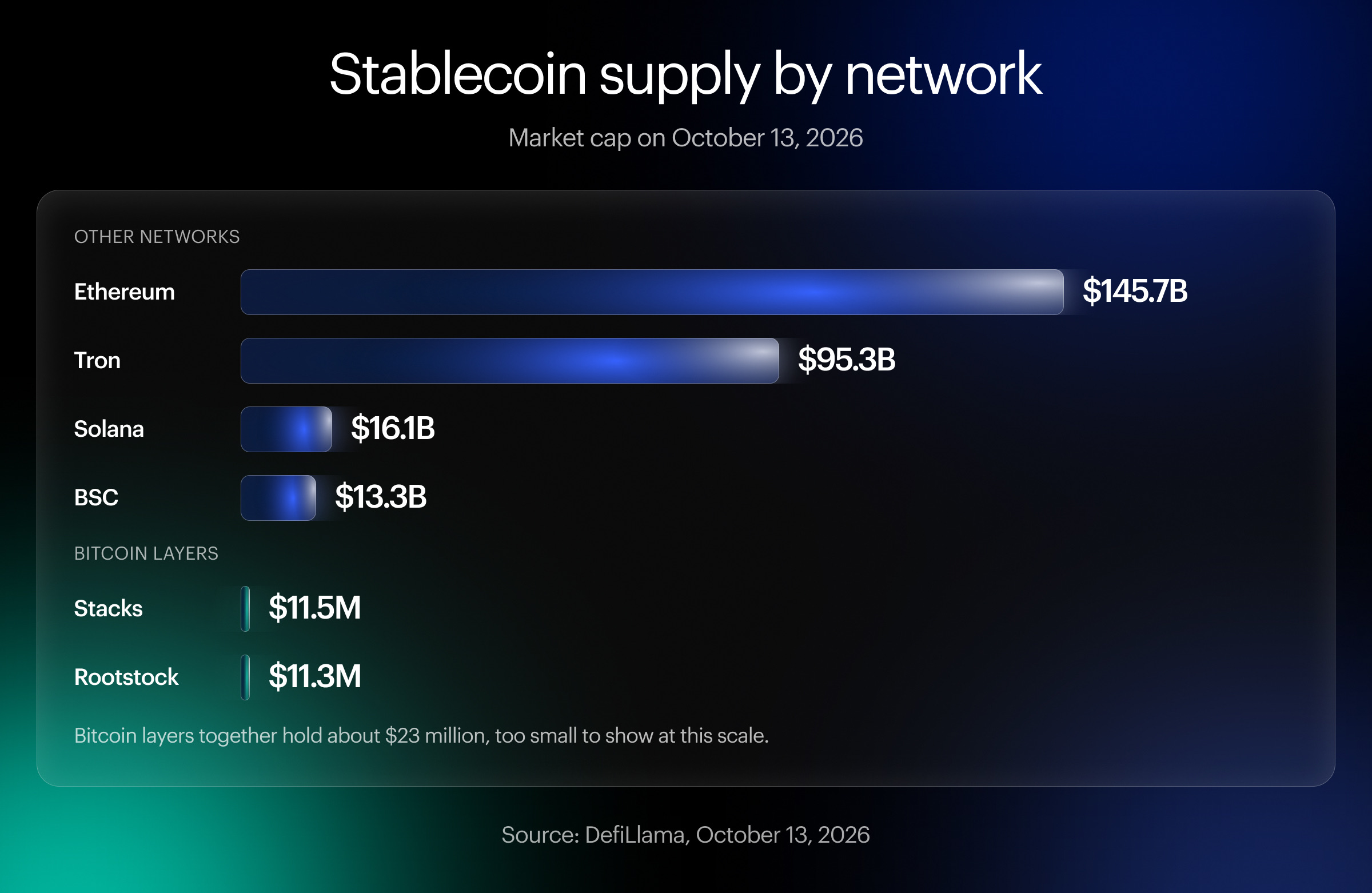
The category is small, and the attention on it is growing. Stablecoins had a combined market capitalization of about $306 billion on October 13, 2026, according to DefiLlama. Ethereum and Tron carried $241 billion of that supply, while Rootstock and Stacks, two Bitcoin smart contract layers, held about $23 million between them. Tether, which launched its first token on Bitcoin in 2014, announced in January 2025 that USDT would return to Bitcoin and Lightning.
A token on a new rail is only useful if it can be priced, hedged, redeemed, and settled at size. This guide is written for trading desks, payment providers, and treasury teams. It explains how the two designs work, how they compare with the fiat-backed tokens that dominate the market, where stablecoin regulation places them, and what financial institutions need in place before handling them.
What are bitcoin stablecoins?
Bitcoin stablecoins are crypto assets designed to maintain a stable value, usually one US dollar, while relying on Bitcoin for either settlement or collateral. Some are issued on Bitcoin or on a layer anchored to it. Others are created as debt against locked BTC. Both give bitcoin-native users a stable asset without moving to another blockchain.
The first group is defined by the rail. USDT on Liquid or over Lightning remains a fiat-backed stablecoin: the reserve assets sit with the issuer offchain, and only the token moves on Bitcoin infrastructure. The second group is defined by the backing. BTC is locked in smart contracts or hedged with derivatives, and the dollar token exists only while that collateral does.
Two things fall outside the definition. Wrapped bitcoin tokens on other chains track the price of BTC, so they carry its price volatility in full. Stablecoins issued on Ethereum, Tron, or Solana against cash reserves have no link to Bitcoin beyond trading against it.
Most stablecoins in the category reference the dollar, in line with the wider market. More than 99% of stablecoins are US dollar-denominated, according to the Bank for International Settlements (BIS).
Bitcoin vs stablecoins: two different instruments
Searches for the term often start from a simpler question: how bitcoin and stablecoins differ. The two are built for opposite jobs.
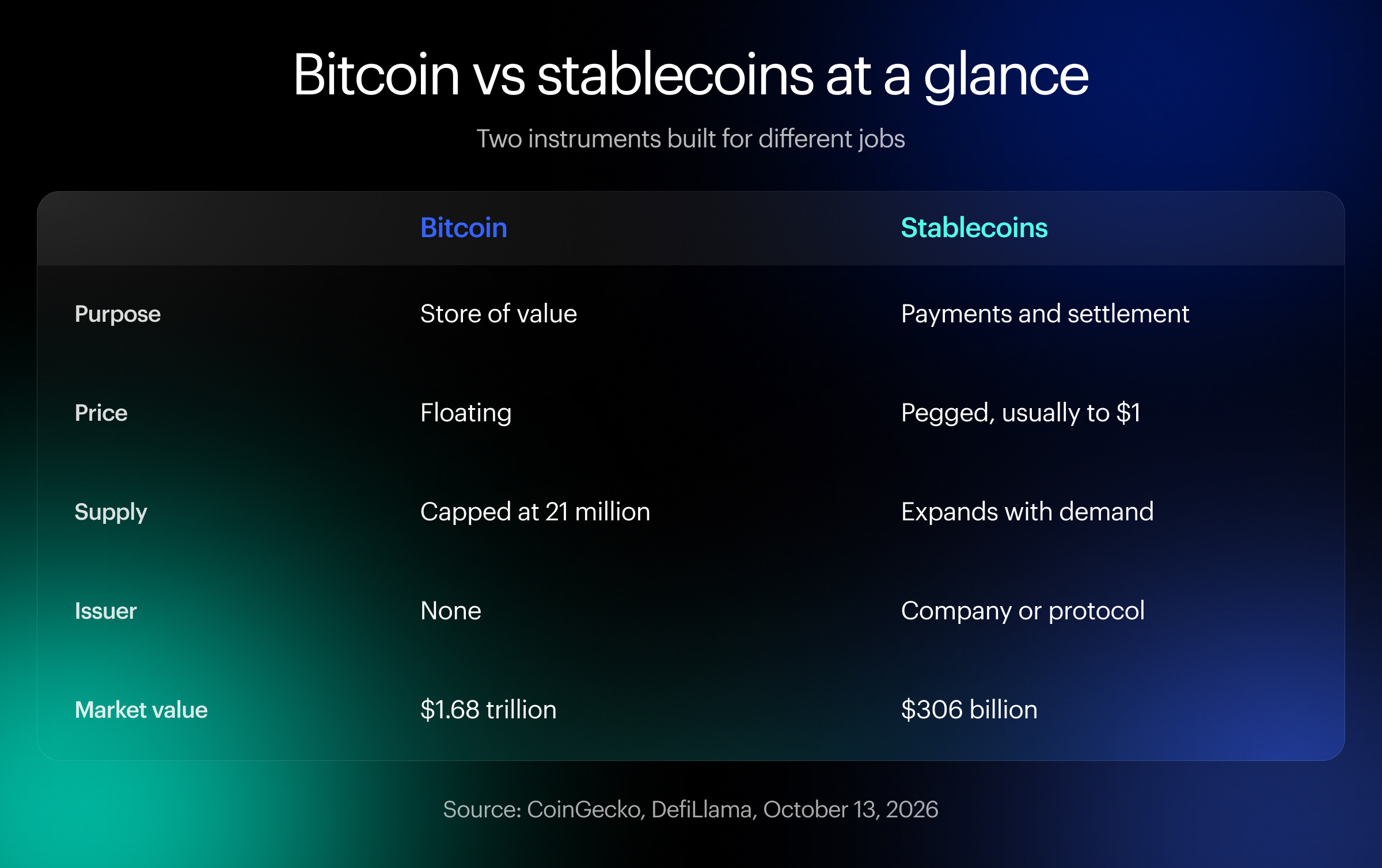
Bitcoin is a store of value with a floating price, often described as digital gold. It runs on its own blockchain, its supply is capped at 21 million coins, no issuer or monetary authority stands behind it, and no reserves back it. Its market value was about $1.68 trillion on October 13, 2026, according to CoinGecko. Large price swings and daily price fluctuations are part of holding it.
Stablecoins are digital money built for payments and settlement. Stablecoin issuers promise redemption at a fixed amount of fiat currency, hold reserves against that promise, and expand or contract supply with market demand. Stablecoins offer price stability at the cost of issuer, reserve, and regulatory exposure that bitcoin does not have.
Neither is better in general. A treasury holds bitcoin for exposure and stablecoins for working capital and margin. Bitcoin stablecoins try to join the two: a dollar unit of account that settles on Bitcoin rails or draws on the largest collateral base among digital assets.
How stablecoins issued on Bitcoin work
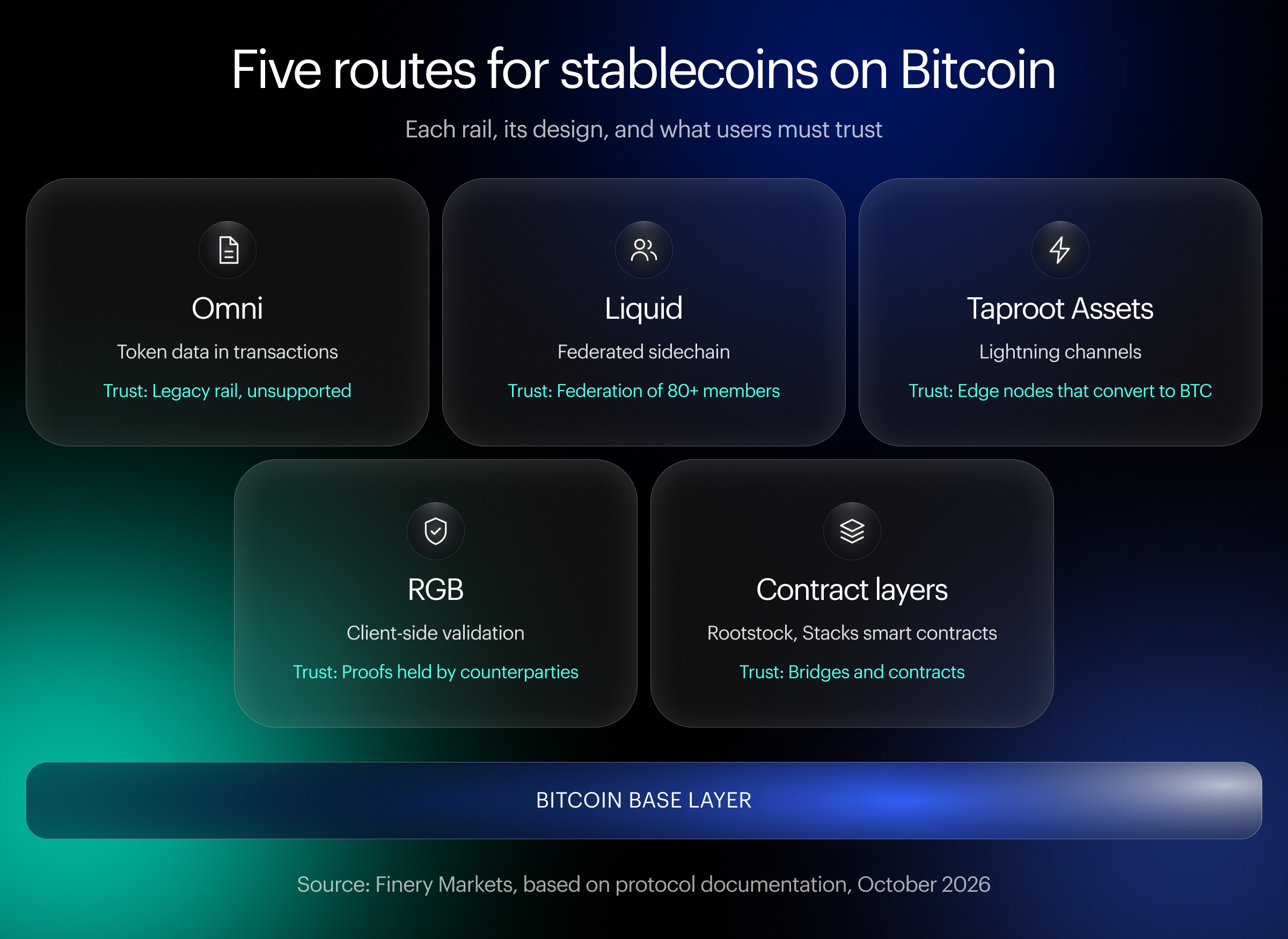
Bitcoin's base layer was not designed for tokens. It has no native smart contracts for balances or transfers of other assets, so stablecoin issuance on Bitcoin depends on additional protocols. Each one makes a different trade between security, speed, and trust.
Omni, the original rail
Tether launched in 2014 on Omni, a software layer that wrote token data into Bitcoin transactions. Exchanges later favored other networks. Tether stopped issuing USDT on Omni on August 17, 2023, citing a lack of demand, and ended issuance and redemption support there in 2025. About $82.9 million of USDT remained on Omni in August 2025, transferable but no longer officially supported.
Liquid, a federated sidechain
Liquid is a Bitcoin sidechain operated by a federation of more than 80 members. Blocks arrive about once a minute, transactions are final after two confirmations, and amounts and asset types are hidden from third parties by default. USDT launched on Liquid on July 29, 2019, with Bitfinex the first exchange to support deposits and withdrawals. The trade-off is trust in the federation that signs blocks and secures the pegged bitcoin.
Taproot Assets and the Lightning Network
Taproot Assets, developed by Lightning Labs, issues assets inside ordinary Taproot transactions. Creating an asset takes one onchain transaction, and ownership proofs are kept offchain and passed between holders. The assets can then be placed in Lightning channels.
A Lightning payment in a stablecoin uses bitcoin as the routing asset. The receiver requests a quote between the stablecoin and BTC, edge nodes convert at that rate, and the payment travels across existing bitcoin channels in between. Lightning Labs describes the result as a decentralized foreign exchange network.
Tether and Lightning Labs announced USDT on Bitcoin and Lightning on January 30, 2025. Taproot Assets v0.6 brought multi-asset Lightning to mainnet in June 2025, and Forbes reported that Tether completed its integration on March 21, 2026. Distribution is still early. The wallet Tether released on April 14, 2026 supported USDT on Ethereum, Polygon, Plasma, and Arbitrum, and carried only bitcoin on Lightning.
RGB and client-side validation
RGB commits assets to Bitcoin transactions cryptographically but validates them offchain between the counterparties, a model called client-side validation. Token data stays off the blockchain, which is meant to make transfers cheaper and more private. Tether announced on August 28, 2025 that it planned to launch USDT on RGB. Its chief executive repeated in September 2026 that USDT on Bitcoin was coming, without naming a date.
Sidechains and smart contract layers
Rootstock and Stacks run smart contracts alongside Bitcoin and host both bridged and locally issued stablecoins. Scale is limited. On October 13, 2026, DefiLlama counted $11.3 million of stablecoins on Rootstock and $11.5 million on Stacks, most of the latter in USDC.
Bitcoin-backed stablecoins: how they differ from fiat-backed stablecoins
The second design changes what stands behind the token. Fiat-backed stablecoins hold traditional assets such as cash, Treasury bills, and money market funds. Commodity-backed tokens hold physical assets such as gold. Crypto-backed stablecoins hold digital assets worth more than the tokens in circulation, and bitcoin-backed stablecoins use BTC for that purpose.
Overcollateralized vaults
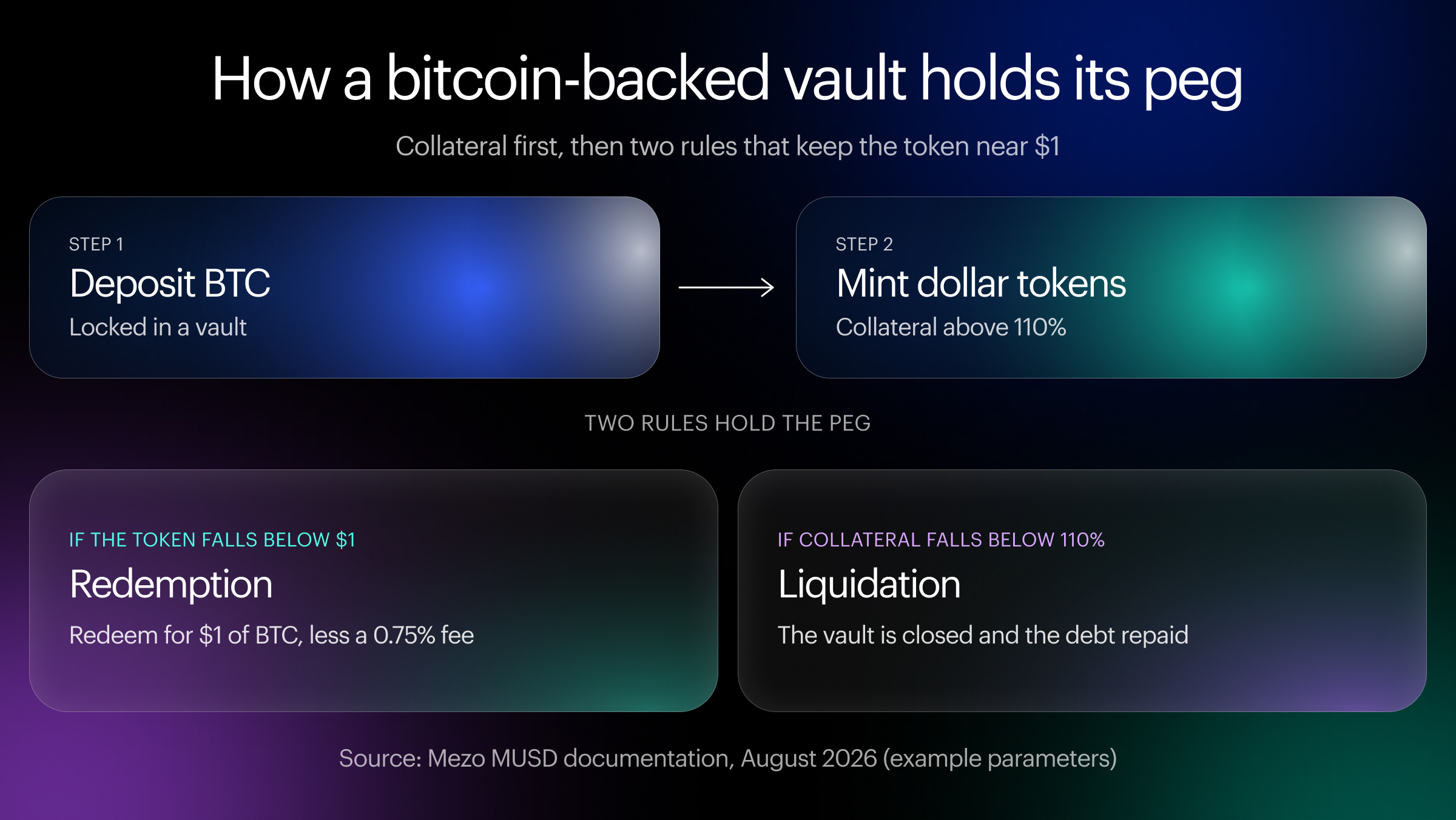
A borrower deposits BTC into a vault and mints dollar tokens against it. The protocol sets a minimum collateral ratio and liquidates positions that fall below it. Mezo's MUSD shows typical parameters: positions must stay above a 110% collateral ratio, borrowing rates are fixed at 1% to 5%, and anyone can redeem MUSD for $1 of BTC, less a 0.75% fee. Redemption pulls the price back when the token trades below its peg.
The model is older than it looks. Money on Chain launched Dollar on Chain (DOC), a bitcoin-collateralized dollar token on Rootstock, in December 2019.
Synthetic dollars
A synthetic dollar holds BTC and opens a short perpetual futures position of the same size. Gains on one leg offset losses on the other, so the combined position stays near its dollar value. Yield comes from futures funding rates. Hermetica's USDh on Stacks follows this approach. These stablecoins rely on derivatives venues staying solvent and on funding staying positive.
Where algorithmic stablecoins fit
Algorithmic stablecoins, sometimes called non-collateralized stablecoins, adjust supply to hold the peg and keep few or no underlying assets. TerraUSD is the reference failure, and bitcoin was part of it. The Luna Foundation Guard held 80,394 BTC on May 7, 2022 and 313 BTC nine days later, after spending its reserve to defend the peg. More than $45 billion in value was erased within a week.
The episode explains how the surviving designs are built. Collateral is locked before tokens are issued, exceeds liabilities by contract, and is liquidated by rule. By late 2025, fiat-backed stablecoins made up about 87% of supply and algorithmic designs less than 0.2%, according to Brookings.
Why stablecoin issuers are returning to Bitcoin
Supply sits where liquidity already is. DefiLlama's chain data for October 13, 2026 shows $145.7 billion of stablecoins on Ethereum and $95.3 billion on Tron, together nearly four-fifths of the market. USDT accounts for about 60% of all supply at $184 billion, and USD Coin (USDC) follows at $72.9 billion.
Three developments explain the renewed interest in Bitcoin rails.
Payment volume on Lightning has grown. River estimated $1.17 billion of Lightning volume in November 2025 across 5.22 million transactions, with the average payment rising to $223 from $118 a year earlier. Larger transfers, such as moving funds between exchanges, now drive the network more than small purchases.
Issuers are funding the infrastructure. Tether joined a $5.2 million round for Ark Labs in March 2026, saying the investment would make it easier to issue, move, and settle stablecoins on Bitcoin.
Institutional trading already settles in stablecoins. In the Crypto OTC Trading Report 2026 we published at Finery Markets, stablecoins' share of institutional OTC volume rose from 23% in 2023 to 78% in 2025. In our review of the first nine months of 2026, stablecoins accounted for 83% of trades by number. When the dollar leg and the bitcoin leg of a trade settle on the same network, a desk removes a bridge and a second chain from its workflow.
Who uses bitcoin stablecoins?
Demand comes from businesses that already operate on Bitcoin rails or hold BTC on the balance sheet.
- Payment providers use Lightning for cross-border payments and can add dollar amounts to infrastructure that already accepts bitcoin.
- Exchanges and OTC desks move dollar balances between venues over Liquid, where transfer amounts stay confidential.
- Bitcoin miners and corporate treasuries borrow dollars against BTC for liquidity management without selling the position.
- Trading firms arbitrage the peg of bitcoin-backed stablecoins, minting when the token trades above $1 and redeeming when it trades below.
- Wallet providers in dollar-short economies let users hold a stable asset next to bitcoin in one digital wallet for everyday transactions.
The requirement in each case matches any other chain. The token has to convert into fiat currency at a known price, on demand, through on-ramps and off-ramps that can handle the volume. That includes cross-border transactions where the payout leg is local currency, the flow described in a stablecoin sandwich.
How does regulation treat bitcoin stablecoins?
The regulatory frameworks that regulate stablecoins classify a token by its issuer and its reserves. The blockchain it runs on barely matters. That works in favor of fiat-backed tokens on Bitcoin rails and against bitcoin-collateralized ones.
The GENIUS Act in the United States
The GENIUS Act became Public Law 119-27 on July 18, 2025. It defines payment stablecoins as digital assets used for payment or settlement that the issuer must redeem for a fixed amount. Permitted reserves are limited to the following:
- Cash and balances at a Federal Reserve Bank
- Demand deposits at insured institutions
- Treasury securities with 93 days or less to maturity
- Certain repurchase agreements backed by Treasuries
- Government money market funds
- Tokenized forms of these assets
Bitcoin is not on the list. Issuers must hold these reserves one-to-one, report them monthly, and refrain from paying interest or yield to holders.
A dollar token from a licensed issuer can therefore circulate on Lightning or Liquid as a payment stablecoin. A token minted against BTC cannot qualify. It sits outside the regime, alongside the algorithmic designs that the Act directs the Treasury to study. The law takes effect on January 18, 2027 at the latest, or 120 days after final regulations if those come sooner.
MiCA in the European Union
MiCA has applied in full since December 2024. A token that references one official currency is an electronic money token. Its issuer must be an authorized credit institution or electronic money institution, and the funds received must be invested in assets denominated in the same currency. Bitcoin collateral does not meet that test, so regulated issuers of single-currency tokens in the EU are confined to the fiat-backed model.
How central banks see private digital money
Central banks remain cautious about private stablecoins of every type. The BIS concluded in June 2025 that stablecoins perform poorly against three tests for serving as the mainstay of the monetary system: singleness, elasticity, and integrity. Several central banks are developing their own digital currencies, and central bank digital currencies remain the public-sector alternative.
Regulatory bodies concentrate on reserve transparency, consumer protection, financial stability, and illicit financial activity. Rails that validate transfers offchain or hide amounts, as RGB and Liquid do, add work for compliance teams that depend on public ledger data.
What do financial institutions need before handling them?
Supporting a bitcoin stablecoin is an infrastructure project. A bank, broker, or payment firm needs the following in place:
- Protocol support: a Lightning node running Taproot Assets, a Liquid node, or an RGB-capable wallet, depending on the rail
- Custody that stores and backs up offchain ownership proofs as well as private keys
- Pricing and liquidity: firm quotes against USD, EUR, and BTC, with depth at institutional size
- A redemption path: who can redeem at par, in what minimum size, and how fast fiat arrives
- Risk controls for collateralized tokens: live collateral ratios, oracle sources, and liquidation rules
- Compliance tooling that covers confidential and client-side-validated transfers
- Reconciliation that treats the same token on different rails as separate instruments
The last point is often missed. USDT on Tron and USDT on Lightning share an issuer and a redemption claim, but they differ in wallets, liquidity, and settlement process. Firms that hold multiple stablecoins across networks need positions and limits per rail.
A token on a new rail still needs a market
A stablecoin issued on a Bitcoin layer starts with no market makers, no order book, and no quoted price against euros or dollars. Until that exists, a desk cannot hedge it and a payment provider cannot settle client flow in it at size. Issuance is the first step, and secondary liquidity decides whether the token gets used.
At Finery Markets, we provide the trading technology that issuers and their counterparties use to build that secondary market. Our network connects stablecoin issuers to institutional liquidity: more than 150 liquidity takers with on- and off-ramp capabilities and institutional liquidity providers, supporting 20 fiat currencies. Trading runs through our firm order book, RFQ, and quote streams, and we can add a new asset-to-stablecoin pair within 24 hours.
The demand profile is visible in our own flow. EUR pairs accounted for 38% of institutional volume on our network in Q1 2026, a sign of how much stablecoin activity is foreign exchange between fiat currencies and tokens. An issuer bringing a token to a Bitcoin rail faces the same requirement: cross rates against the currencies its users hold.
We do not issue stablecoins, hold reserves, or take custody of assets. Our software is non-custodial, and counterparties trade and settle bilaterally through it. For a bitcoin stablecoin, the issuer, the reserves, and the rail remain separate questions from where the token can be priced and exchanged.
Financial risks and limitations
Bitcoin stablecoins carry the financial risks of ordinary stablecoins plus several of their own.
Liquidity is thin, on top of the liquidity risks stablecoins already carry. With about $23 million on Rootstock and Stacks against $95.3 billion on Tron, a large order on a Bitcoin rail moves the price or fails to fill. Thin markets also weaken the arbitrage that holds a peg.
Collateral is volatile. A vault that requires 110% collateral leaves a narrow buffer against market volatility, and falling prices can trigger liquidations that add selling pressure. Stablecoins backed by more volatile crypto assets need wider margins, and bitcoin's own market fluctuations are large enough to test any ratio.
Synthetic designs depend on derivatives markets. Negative funding rates erode the collateral over time, and a failure at the exchange holding the hedge leaves the token exposed.
Trust assumptions vary by rail. Liquid relies on its federation, Lightning stablecoin payments rely on edge nodes for conversion, and bridged tokens rely on the bridge. None of these is equivalent to holding BTC on the base layer.
Issuer support can be withdrawn. Omni holders learned in 2025 that a rail can lose official support while tokens remain on it. For fiat-backed tokens, moving to Bitcoin changes nothing about dependence on centralized issuers, and holders still carry counterparty risk if reserves are mismanaged.
Regulatory status is unsettled for bitcoin-backed tokens. Outside the payment stablecoin regimes, they lack the regulatory safeguards and regulatory oversight that banks and other financial institutions increasingly require before holding a token.
Outlook
The tooling is maturing faster than the supply. Taproot Assets v0.8, released on June 23, 2026, added a developer kit and gave edge nodes order controls familiar from trading desks: limit prices, minimum fill sizes, and immediate-or-cancel execution. That moves Lightning closer to financial infrastructure that traditional finance can evaluate in familiar terms.
Regulation will sort the two designs. Once the GENIUS Act takes effect, fiat-backed tokens from regulated issuers can treat Bitcoin as one more distribution rail in major markets. Bitcoin-backed tokens will develop as collateral and credit instruments, closer to secured lending than to digital payments, and their place in the financial system will depend on how supervisors treat that credit.
Adoption will track market structure. Stablecoin supply left Omni for the networks where it could be exchanged cheaply against dollars and euros, and it will return on the same terms. Bitcoin's stablecoin layer will be judged by quoted depth and redemption certainty well before it is judged by transaction counts, and the digital economy built on it will be as large as that depth allows.
FAQ
What are bitcoin stablecoins?
Bitcoin stablecoins are tokens that hold a steady value against a fiat currency, usually the dollar, and depend on Bitcoin for settlement or backing. One type is issued on Bitcoin layers such as Lightning, Liquid, or RGB. The other is minted against BTC collateral or a hedged BTC position.
Is Bitcoin a stablecoin?
No. Bitcoin has a floating price, a fixed supply, and no issuer or reserves. A stablecoin is pegged to a specified asset, typically one US dollar, and is redeemable through its issuer or its collateral. Bitcoin can serve as the network or the collateral for a stablecoin, but it does not maintain price stability itself.
Are stablecoins better than Bitcoin?
They serve different purposes. Stablecoins suit payments and settlement because they hold their value. Bitcoin suits long-term exposure and collateral because its supply is fixed and no issuer controls it. Most institutional desks hold both and convert between them as needed.
What are the top 3 stablecoins?
By market cap on October 13, 2026, the three largest were Tether's USDT at about $184 billion, Circle's USDC at $72.9 billion, and Sky's USDS at about $7 billion, according to DefiLlama. USDT and USDC are fiat-backed, and together they account for more than four-fifths of all stablecoin supply.
How much is 1 stablecoin worth?
A dollar stablecoin is designed to be worth $1, and the large fiat-backed tokens normally trade very close to it. The price can deviate when reserves are questioned or collateral falls. USDC traded below $1 in March 2023 after its issuer disclosed deposits held at Silicon Valley Bank.
Can USDT be sent over the Lightning Network?
Yes, where wallets and providers support it. Taproot Assets lets stablecoins issued on Bitcoin move through Lightning channels, with edge nodes converting to and from BTC along the route. Tether announced the integration in January 2025, and availability to end users still depends on wallet and provider support.
Are bitcoin-backed stablecoins covered by the GENIUS Act?
No. The Act covers payment stablecoins backed one-to-one by cash, short-dated Treasuries, and similar assets, and bitcoin is not a permitted reserve. A BTC-collateralized token falls outside that regime. The Act directs the Treasury to study non-payment stablecoins, including algorithmic ones.


 LinkedIn
 Youtube
 Medium
 Twitter