


 LinkedIn
 Youtube
 Medium
 Twitter
.jpg)
Trusted by global partners





















An error has occurred. Please try again later or contact customer support for assistance.
We are excited to welcome you as a new subscriber to the Finery Markets newsletter! We appreciate your interest in our updates and insights.
We are confident that you will find our content informative and valuable. We have also sent link to your email.
We are confident that you will find our content informative and valuable. We have also sent link to your email.




Log into required environment
Explore tools
Multi-dealer marketplace
FM Liquidity MatchSaas for electronic trading
FM White LabelB2B White Label Crypto Trading Platform
FM PulseReal-time market data analytics
FM SpaceCounterparty selection
Clients BrokersCrypto-native, FX and multi-asset brokers
BanksTraditional, digital and custodian banks
Payment providersPSPs, payment gateways, on/off ramp
OTC desksCrypto trading desks, retail platforms
Buy-sidePassive funds, hedge funds, asset managers
Liquidity providersMarket makers, proprietary shops
Prime brokersAgency and risk-principle brokers
Stablecoin issuersNext gen of fintech
CustodiansCustodians, crypto vaults, depositaries
Company About Careers Media kit Resources News Insights Reports Case studies Podcasts In the media Education Glossary Referral Legal Imprint Operating rules Privacy Policy Risk Disclosure Tariff Policy Support Contact formFor European institutions and corporate treasuries, accessing onchain liquidity has often meant operating in USD-denominated environments, even when their balance sheets, reporting, and liabilities are in euros. This introduces foreign exchange exposure, operational complexity, and inefficiencies that are incompatible with institutional workflows.

Monerium addressed this gap by issuing EURe, a fully regulated euro stablecoin built for real-world payments, treasury operations, and onchain settlement.
EURe already enabled euro-native value transfer onchain. The next step was supporting deeper liquidity and more predictable execution for larger trades.
Despite the growth of stablecoins, liquidity has remained heavily concentrated in USD pairs. For European participants, this created a structural mismatch.
Operating in USD stablecoins meant introducing FX risk into treasury operations, adding conversion steps, and complicating reporting. Even when euro-denominated stablecoins were available, they often lacked the depth required for institutional transactions.
European treasuries that operate in euros often had to convert into USD stablecoins just to access onchain liquidity. That introduces foreign exchange exposure, adds operational overhead, and complicates internal reporting.


Gísli Kristjánsson
CEO of Monerium
For Monerium, the challenge was clear: EURe needed to be not just euro-denominated, but liquid and easy to trade at size.
Prior to integrating with Finery Markets, trading EURe at size presented significant friction.
Liquidity was fragmented across venues, with limited depth available for large transactions. Executing trades in the €500K–€1M range often led to noticeable price impact, forcing users to break orders into smaller parts and manage execution manually.
This resulted in:
 Significant slippage
Inconsistent pricing
Operational complexity
Lack of predictability
Significant slippage
Inconsistent pricing
Operational complexity
Lack of predictability
Finery Markets strengthened the trading layer around EURe by connecting it to institutional market makers.
By integrating with Finery Markets, EURe pairs gained access to:
 Liquidity aggregated
Smart order routing Predictable pricing, Automated execution
Liquidity aggregated
Smart order routing Predictable pricing, Automated execution With Monerium, users hold EURe in their own wallets and remain in control of their assets at all times. Finery Markets enables access to deep liquidity and professional execution without requiring custody or account creation.
Gísli Kristjánsson
CEO of Monerium
The integration created a streamlined execution flow for euro-denominated trades:
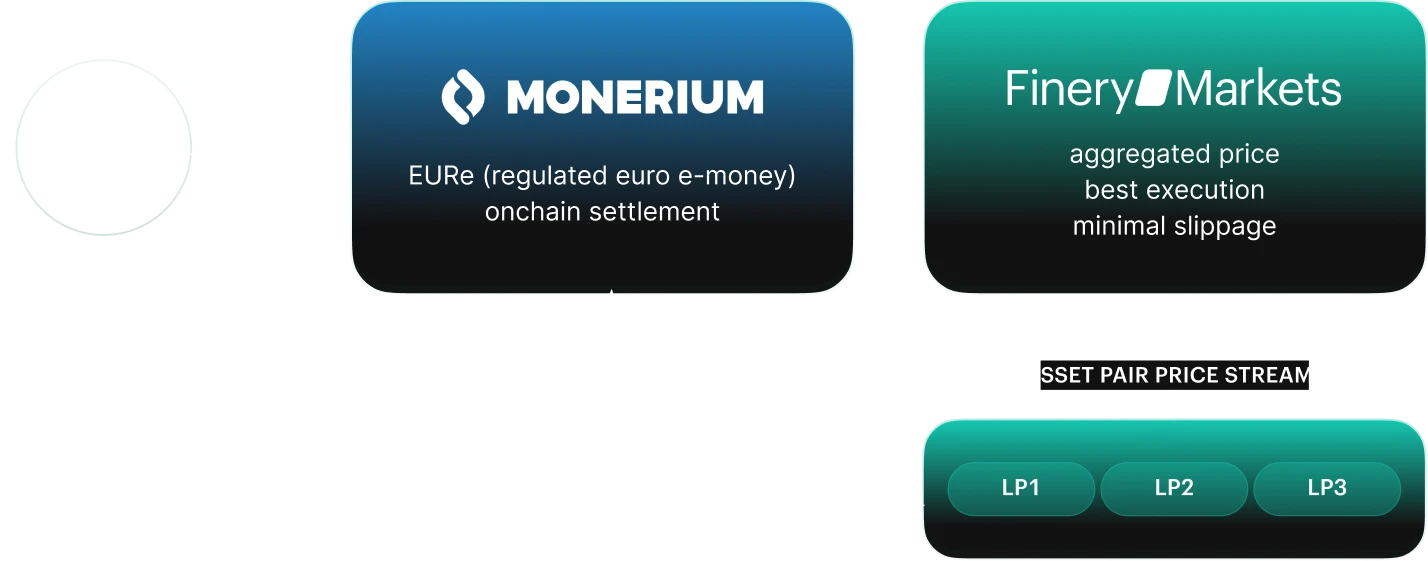
Finery Markets enabled Monerium to scale EURe liquidity across four key dimensions:

Fragmented markets are unified into a single execution layer, providing consistent access to deep EUR liquidity across counterparties.
Trades in the six-figure range can be executed with tight spreads and stable pricing.
Participants retain full control of their assets, aligning with onchain principles while accessing professional trading infrastructure.
A single integration provides scalable access to liquidity, enabling rapid expansion across use cases and counterparties.
The introduction of institutional liquidity providers through Finery Markets has materially improved execution quality for EURe pairs.
The presence of market makers has brought much more predictable execution, even for trades in the six-figure range. Spreads are tighter, slippage is lower, and pricing remains stable throughout the transaction.
Gísli Kristjánsson, CEO of Monerium
With stronger liquidity around EURe, Monerium can better support a range of practical use cases:

Treasury management:
European firms can maintain euro exposure onchain without introducing FX risk

Onchain FX:
Seamless conversion between USD and EUR stablecoins

Euro-denominated treasury allocation:
High-net-worth-individuals can move into EUR onchain without taking unnecessary execution risk

Payroll and operational payments:
Large conversions (e.g., €100K+ salary batches) can be executed instantly and reliably.
With deep liquidity now available for EURe, the role of stablecoins in foreign exchange is beginning to evolve.
For crypto-native companies and funds, stablecoin-based FX offers:
 Faster
  Fewer
Fewer  Greater transparency
 Stablecoin-based FX flows are expected to grow significantly, especially for euro-dollar trades. For crypto-native companies and funds, this route offers faster settlement, fewer intermediaries, and clearer execution.
Gísli Kristjánsson
CEO of Monerium
For Monerium, the next step is clear: expanding this liquidity model across multiple blockchains, enabling euro-denominated execution wherever institutional demand emerges.
By improving liquidity and execution around EURe, this partnership makes it easier to use euros onchain for larger and more time-sensitive transactions.
As onchain markets mature, access to deep and reliable liquidity in multiple currencies will become increasingly important.
Monerium’s legal disclaimer: “Monerium is an electronic money institution authorised in the EEA. EURe and other e-money tokens issued by Monerium represent digital fiat money and do not constitute a form of investment. Nothing in this communication should be interpreted as investment advice, an offer to invest, or a solicitation to buy or sell any financial instrument. Monerium does not pay interest or offer returns on e-money tokens. Holders of e-money tokens issued by Monerium have the right to redeem e-money tokens at par value at any time. Monerium has issued a crypto-asset white paper, which can be accessed on our website www.monerium.com. You can contact us by sending an email to hello@monerium.com.“
Reduce your integration costs and operational risk across multiple access points with our platform
Get started