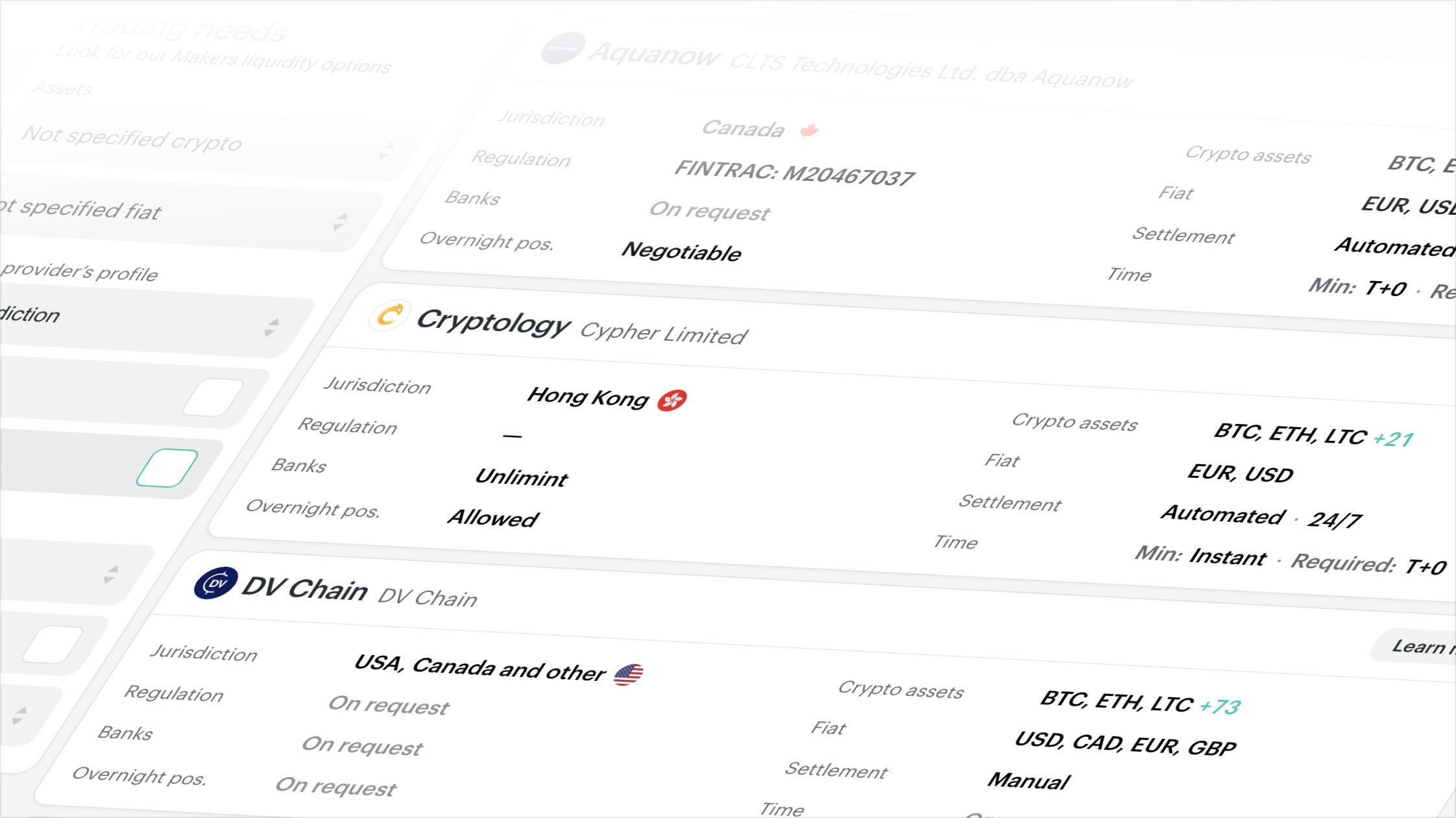
Licences came first, then custody mandates. One hundred days after MiCA's cutoff and a year into bank budgets for digital assets, the execution layer is still the part most institutions have not built, and everything in this edition sits on that gap: two new Finery Markets reports on where MiCA and bank strategies have actually landed, a solution page for banks adding trading to custody, two platform updates on venue connectivity and white-label integration, a shorter route to liquidity for stablecoin issuers, and the conversations our team had over lunch at TOKEN2049.
100 days of MiCA: the wrong number to watch
2,747 crypto registrations under national regimes in 2024. 280 firms on ESMA's first list after the July 1 deadline. That was the MiCA headline, and 100 days on it looks like the less consequential one. The bigger shift is in liquidity. Crypto has spent its whole history priced in dollars, and MiCA opened a race to build native euro liquidity. EURC volume on Finery Markets rose 46x year on year in the first nine months of 2026, yet still accounts for 0.12% of stablecoin flow. Euro stablecoin supply is up 22.6% this year to $848M while dollar supply sat flat, and it remains about 0.3% of the dollar market. Availability came first. Volume is the next test.
The report draws on 16 million institutional spot trades for a 9M 2026 OTC review: OTC volume grew 57% year on year while top-20 centralized exchanges lost 47%, and stablecoins now account for 83% of trades. Banking Circle, Fipto, The Vault, and Sumsub contribute their read on reserves, custody, payments, and compliance, including why most firms that missed the deadline moved behind licensed CASPs rather than leaving the market. The parallel with MiFID II in 2018 is hard to miss: a hard cut-off, congested pipelines, consolidation, and execution migrating to infrastructure built for bank-level scrutiny.
Read the report
The State of Crypto Banking in 2026
89% of banks have budget for digital assets, and 16% have anything in production. Stablecoin supply passed $300B, the OCC has handed 16 trust charters to digital asset firms in ten months, and roughly a fifth of the MiCA register is now banks. Yet most of what the largest institutions have shipped is custody, tokenized deposits, and ETF access. Trading, the part that turns a cost center into revenue, is still the exception.
The report goes bank by bank through JPMorgan, Citi, BNY, Morgan Stanley, Bank of America, Standard Chartered, Société Générale, Deutsche Bank, BBVA, and Revolut: what each launched, why nearly every launch runs on someone else's rails, and where GENIUS, MiCA, the UK regime, and Basel leave banks heading into 2027. It closes on the piece that has to connect for the budget to pay off: an execution layer that lets custody clients trade without moving assets off the platform.
Read the report
Trading infrastructure for banks that already custody digital assets
Custody answers a security question, not a revenue one. The next request from a bank's clients is to trade the assets they hold without moving them to an exchange or broker the bank does not control, and building that in-house means separate bilateral liquidity relationships, each with its own credit line and legal agreement, fragmented pricing that puts best execution at risk, and a multi-quarter post-trade build.
Our new solution page for banks sets out the alternative: one connection to multi-dealer firm liquidity across 200+ crypto and fiat pairs, automated netting and settlement on a schedule the bank sets, role-based access control, exposure limits, and a full audit trail, all non-custodial. Finery Markets never holds, transfers, or has signing authority over client assets. Two deployment models cover the licensing question: a white-label master account where the bank stays the regulated counterparty, or a full white-label network where clients trade with one another and the bank typically avoids the trading license and capital requirements of a broker-dealer role.
See the solution for banks
Enhanced Connectivity Hub: Streamlined Access to Major Liquidity Venues
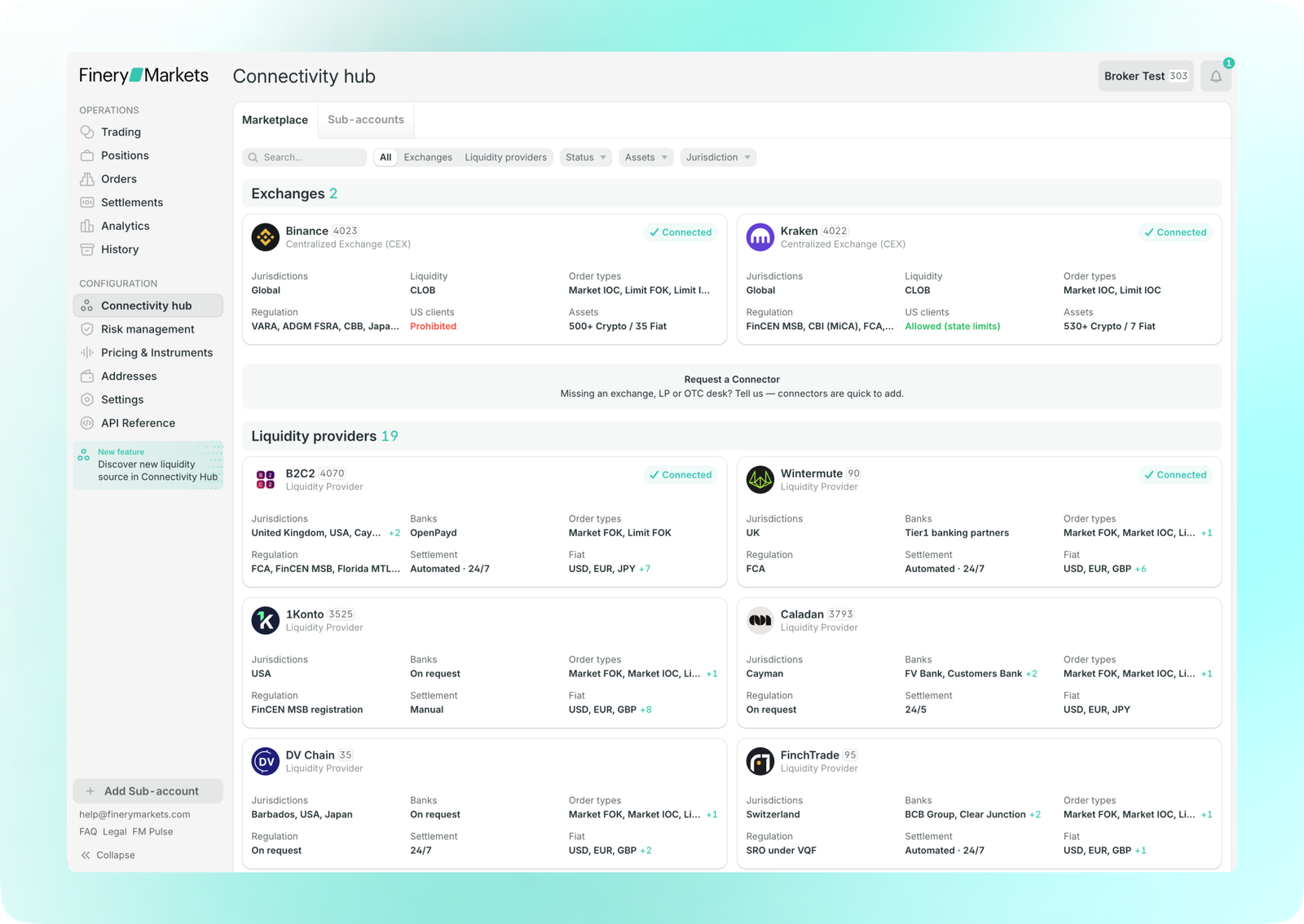
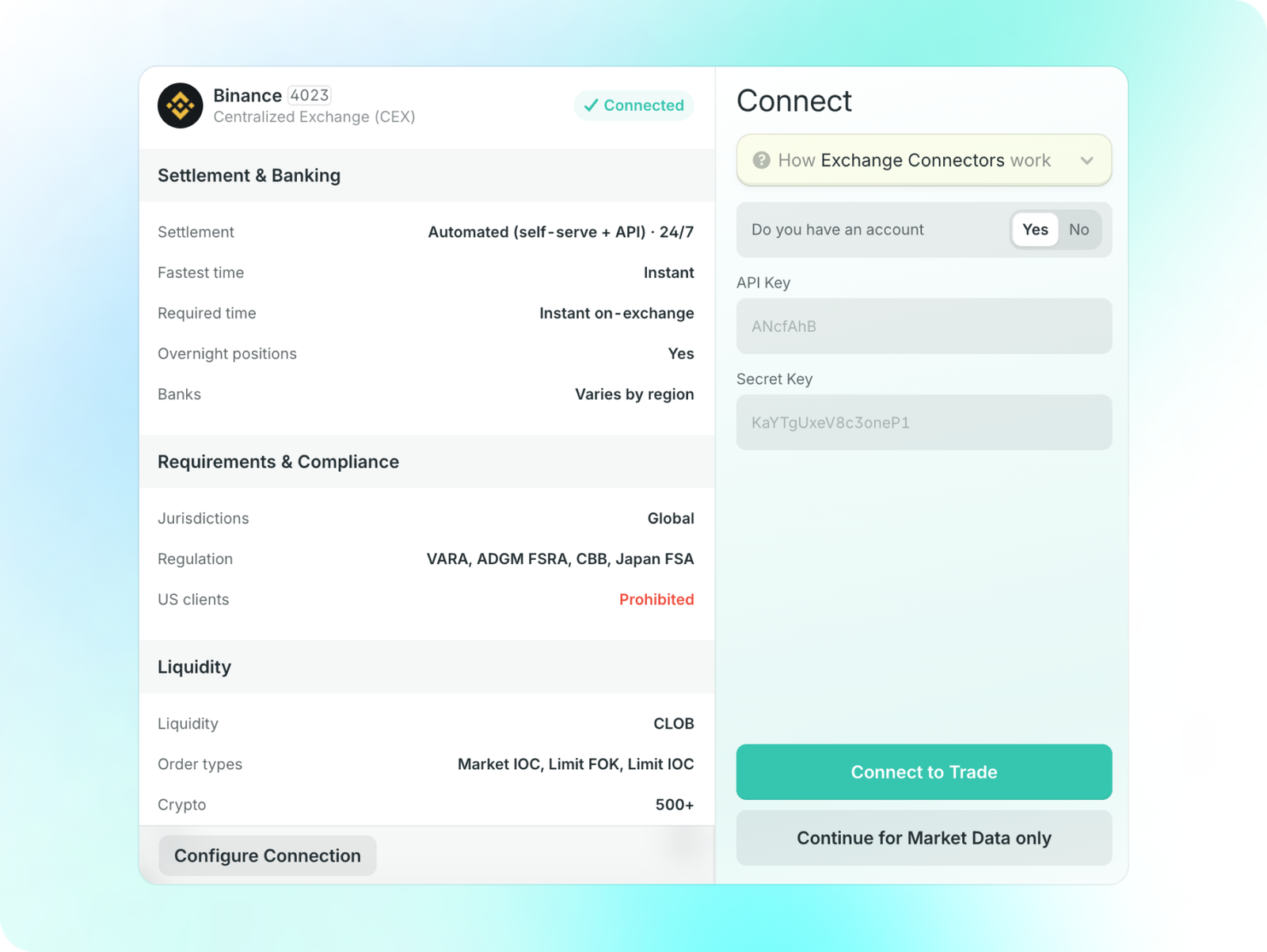
Connecting to liquidity providers and major exchanges through Finery Markets Quote Streams (QS) is now even easier. Institutional participants can now securely store and manage exchange API credentials directly within the Finery Markets GUI, whether connecting to global CEXs like Binance and Kraken or leading OTC market makers.
Why it matters for institutional desks:
- Broader liquidity coverage: By consolidating top-tier LPs and tier-1 exchanges into a single interface, Finery Markets' Smart Order Router (SOR) now accesses key global price discovery venues, capturing over ⅔ of total global crypto liquidity.
- Pre-trade market intelligence: Even without an active venue account, participants can tap into real-time market data across all connected venues. This enables institutional desks to backtest execution strategies, benchmark execution costs, and optimize routing models prior to order placement.
Need access to a specific liquidity source? Contact our team to request custom venue integrations via our GUI.
Embedded white-label stack: accelerated integration with native documentation
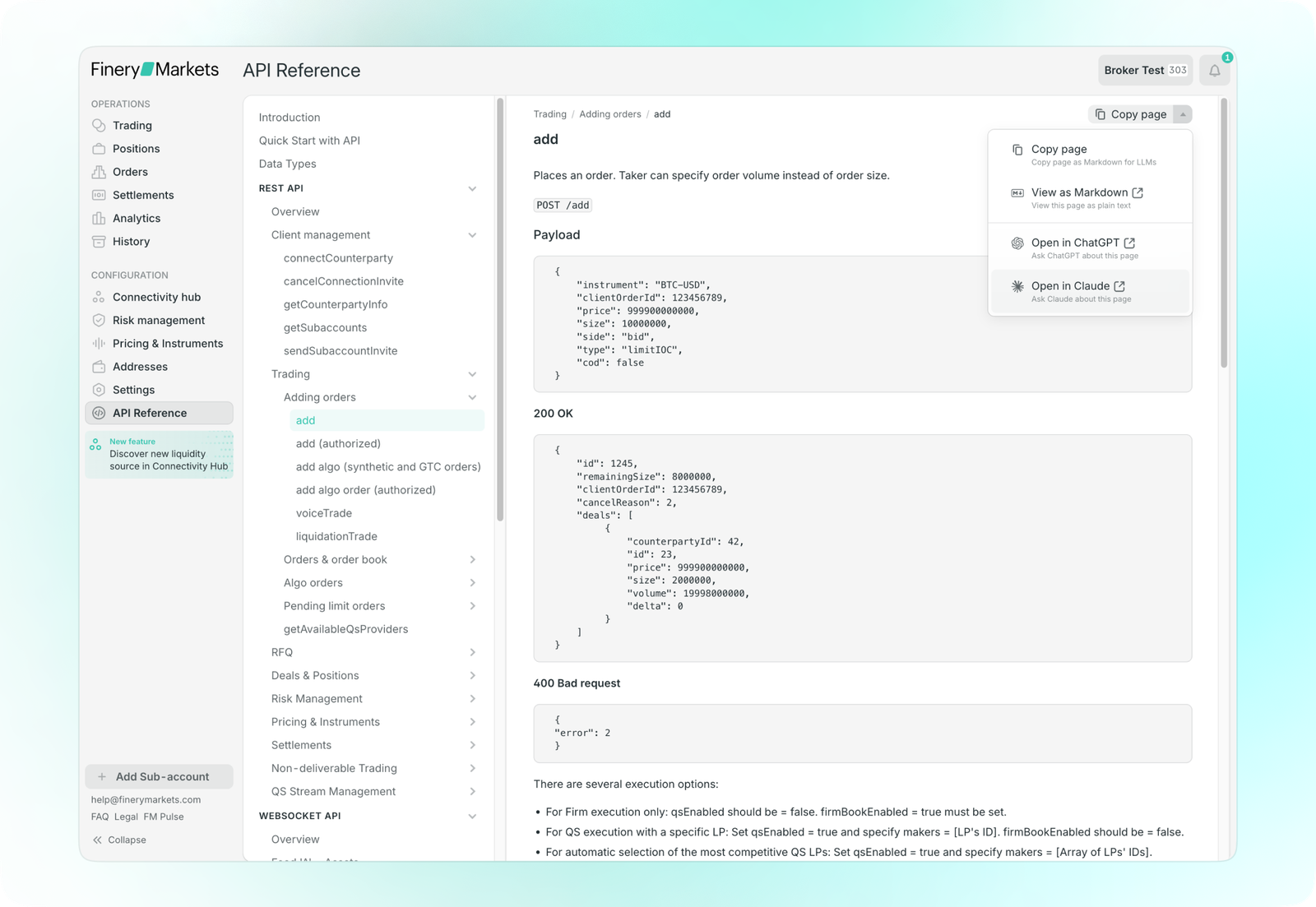
Integrating and deploying into Finery Markets' White Label (WL) trading infrastructure is now faster and more intuitive for institutional clients, custodians, and brokers.
Key technical upgrades:
- Embedded API reference & interactive FAQ: End clients of our WL partners can now access full, production-ready API specifications directly within the branded interface, enabling fully self-serve integration.
- 18.7x faster time-to-market: Building on our AI-powered integration repository, which reduced setup timelines by 18.7x, this update brings integration documentation directly into the user workflow.
- Seamless client onboarding: WL operators can now deliver a fully white-labeled execution environment, from GUI interface to technical API documentation, reducing technical support overhead and streamlining client onboarding.
Explore FM White Label
Stablecoin issuers: liquidity without the listing bill
A listing process, a deposit, a market maker on retainer. That is the standard bill for a new token before its first institutional trade, and it repeats with every venue and every pair. Most of an issuer's liquidity budget goes into keeping markets alive long before real demand shows up.
Stablecoin issuers can skip all three on Finery Markets. The token is added to a network of 150+ institutional participants with a simplified listing, no deposit, and no market maker hired to sit in an order book. Cross-rates come with it: the token is priced against the assets and currencies already trading on the network, so it starts with a set of markets instead of a single USD pair. New pairs go live in about 24 hours.
See the stablecoin issuer solution
TOKEN2049: the liquidity conversations happened over lunch

The most useful conversations on market liquidity at TOKEN2049 Singapore happened a ten-minute walk from the venue. Finery Markets co-hosted a private luncheon with Caladan, Utila, and Stablecoin Insider, and nearly 150 professionals from OTC trading, market making, payments, brokerage, and stablecoin infrastructure joined us.
The pattern across the tables was consistent. Nobody is short of venues. The open questions are routing, settlement, and prefunding, and the firms growing fastest treat those as infrastructure decisions rather than workarounds. Thank you to our co-hosts and to everyone who made the time between sessions.







 LinkedIn
 Youtube
 Medium
 Twitter