Bitcoin opens the week near $63,000, up about 1.5% on Monday, having clawed its way back from a 21-month low below $58,000 in the final days of June. The bounce is real but modest: the asset still sits roughly 40% below its October all-time high, and June closed as the worst month on record for US spot Bitcoin ETFs, which shed about $4.5 billion. A soft jobs report and a more dovish tone from the Fed did more to lift risk appetite last week than anything crypto-native.
More than 140 of the largest names in payments and finance — Visa, Mastercard, BlackRock, Stripe, Coinbase — lined up behind a single, shared dollar stablecoin. Robinhood switched on its own chain. Securitize started trading as a public company. Taiwan passed a licensing regime with 100% stablecoin reserves. The infrastructure is being built and consolidated at speed, largely independent of where Bitcoin trades on any given day.
Welcome to a new week in crypto.
↓
Bitcoin claws back toward $63K after a 21-month low, but the recovery is unconfirmed
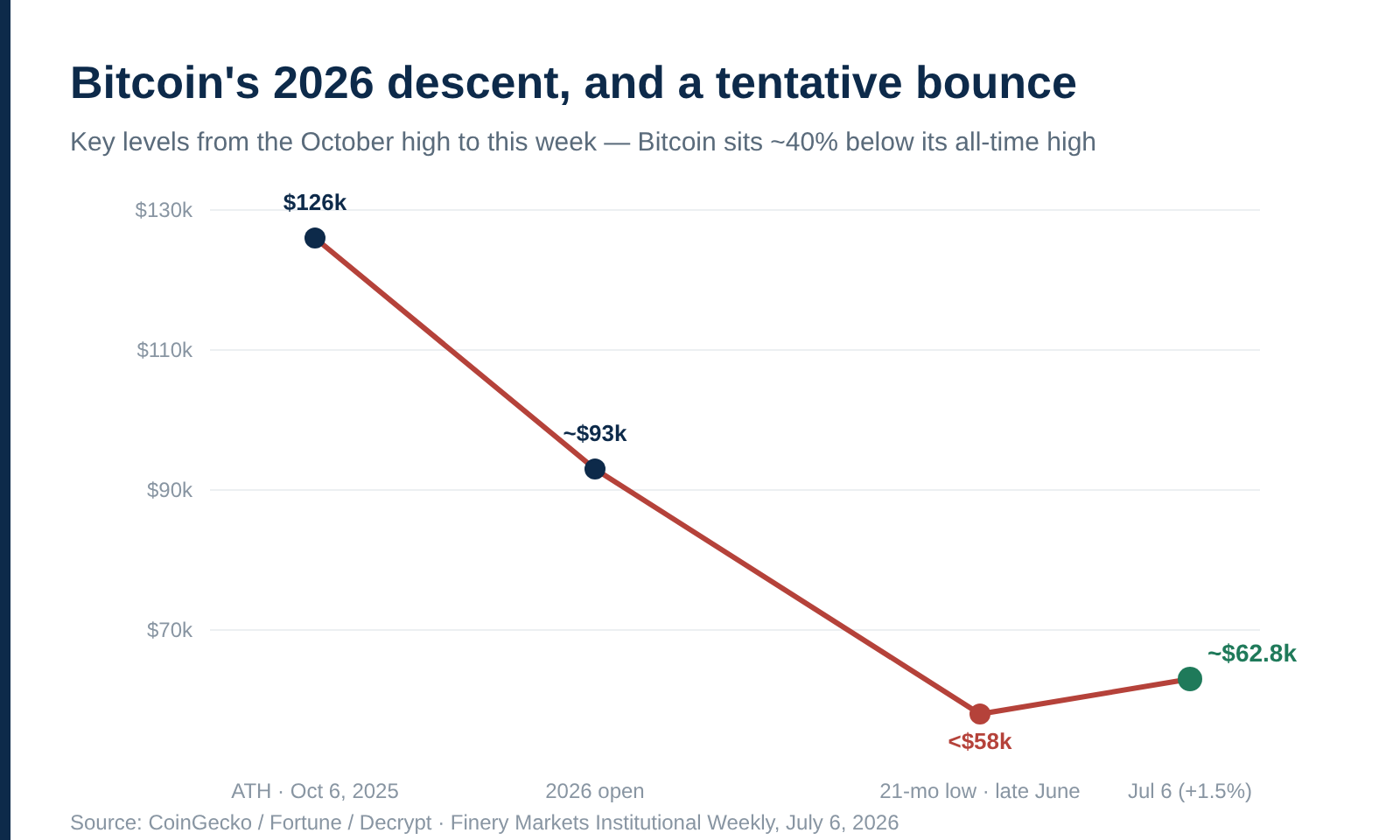
Bitcoin enters the week trading around $62,800, up roughly 1.5% on Monday and well above the 21-month low below $58,000 it printed in the last week of June. Ether sits near $1,730 and Solana around $80. The rebound follows the weakest stretch of the year: Bitcoin began 2026 above $93,000 and remains about 40% below the $126,000 all-time high it set on October 6, 2025.
The catalyst for the bounce was macro, not crypto. The June US jobs report showed just 57,000 nonfarm payrolls added against roughly 110,000 expected, and Fed Chair Kevin Warsh signaled that inflation risks had eased, cooling expectations of further rate hikes and pulling the dollar off its highs. Non-yielding assets like Bitcoin tend to trade inversely to real yields and the dollar, and the shift in rate expectations was enough to spark a relief rally across risk.
Beneath the price, positioning is quietly turning. On-chain data cited by several desks shows large holders accumulated more than 270,000 BTC over the past two weeks, the kind of buying that has historically clustered around local bottoms. Analysts are cautious: HashKey's Tim Sun called the move "only a temporary recovery after the easing of interest rate pressure," with a trend reversal still unconfirmed and Bitcoin's path "constrained by changes in the US dollar, real interest rates, and Federal Reserve policies." Prediction markets remain skeptical, still leaning toward a retest of $55,000 before $84,000.
US spot Bitcoin ETFs snap a 10-day bleed after their worst month ever
US spot Bitcoin ETFs pulled in $221.7 million on July 2, their largest daily inflow in about two months and the end of a 10-day outflow streak that had drained roughly $2.7 billion. Fidelity's FBTC led with $166 million and ARKB added $91.8 million, while BlackRock's IBIT bucked the trend with a $40.4 million outflow, extending a losing run dating to mid-June.
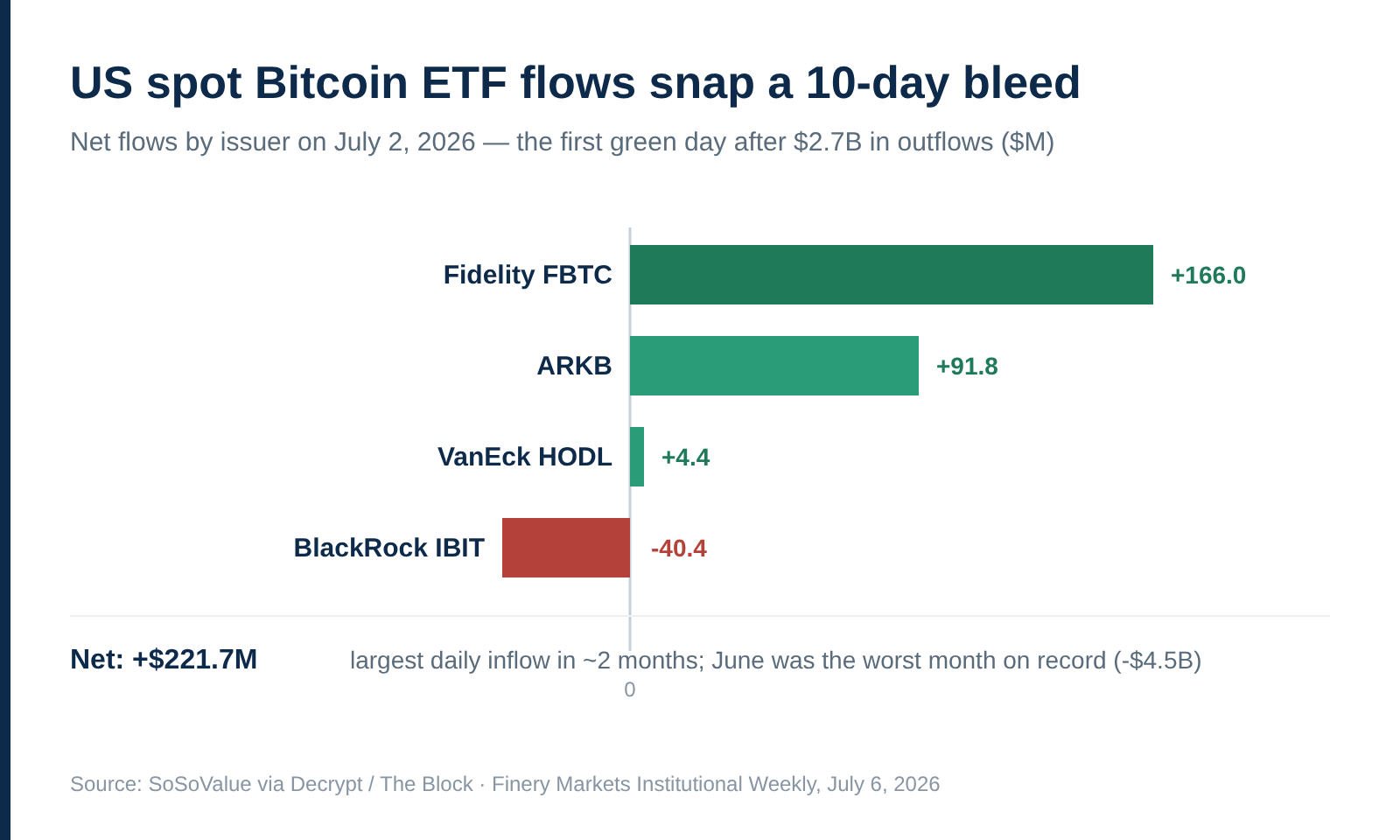
The green day closed out a brutal June. The funds shed around $4.5 billion over the month, the worst on record since the products launched in 2024, as annual growth in their Bitcoin holdings slumped toward zero. The vehicles that absorbed supply through the last cycle spent June doing the opposite. Ethereum ETFs also turned positive, taking in $14.9 million and $29.1 million on consecutive days.
One session does not reverse a quarter. But the flip is a reminder that ETF demand has become the cleanest real-time gauge of institutional appetite, and right now that appetite is hostage to the rates outlook far more than to anything happening on-chain. Watch the flows, not the sentiment.
140+ payment and finance giants back Open USD, a shared stablecoin aimed at Circle
The week's defining move came from the balance sheets, not the charts. More than 140 companies — including Visa, Mastercard, American Express, Discover, BlackRock, BNY, Standard Chartered, US Bank, BBVA, Stripe, Coinbase, Ripple, Galaxy, Google, Shopify and IBM — announced they are backing Open USD (OUSD), a dollar stablecoin governed by an independent entity called Open Standard rather than a single issuer. Businesses will be able to mint and redeem OUSD with no fees or volume limits, and most of the yield earned on reserves will flow back to participating partners after a management fee. Launch is planned for later this year, with native issuance on the Tempo network and support signaled across Solana, Stellar, Base and Polygon.
The structure is the point. Existing stablecoins concentrate reserve income with the issuer; OUSD is engineered to distribute it across a consortium whose board is made up of the partner businesses themselves. Visa's crypto head Cuy Sheffield framed it as "a shared stablecoin designed for the global financial system," while Stripe said it intends OUSD to become the default stablecoin for businesses on its platform. It is a direct challenge to the economics that made stablecoin issuance the most profitable business in crypto. Circle shares fell nearly 16% on the news.
For institutions pricing stablecoin flow, a shared-standard token backed by the card networks and largest asset managers changes the competitive map. But issuance is only half the equation. A stablecoin still has to be quoted, routed, executed and settled against fiat and other tokens, and a broad consortium adds counterparties and corridors rather than removing the need for infrastructure to clear them. The reserve-yield fight is being decided in boardrooms; the execution layer is still where the flow actually moves.
Robinhood flips on its own chain, backed by $51B in custody and Bitstamp
Robinhood launched Robinhood Chain, assembling into one architecture the pieces it spent 2025 acquiring: Bitstamp for exchange infrastructure, WonderFi for Canadian licensing, and tokenized product experiments in Europe. The network is backed by roughly $51 billion in crypto custody assets, with holdings tokenized on Robinhood's own chain, traded through its wallet, and connected to partnered perpetuals. HOOD shares rose about 8% on the launch.
The strategic logic mirrors the OUSD move: a brokerage that once routed crypto trades to third parties now wants to own the settlement rails end to end. Vertical integration — custody, tokenization, trading and leverage under one roof — is becoming the default ambition for the larger consumer platforms, not a differentiator.
The open question is whether captive, single-operator chains fragment liquidity further or concentrate it. For institutional counterparties, more branded venues mean more places where the same dollar of liquidity can sit isolated, which raises rather than lowers the premium on connectivity between them.
Securitize debuts on the public market and tokenizes its own stock
BlackRock-backed Securitize began trading as a public company on July 2 following its SPAC merger, at a valuation of about $1.25 billion, with roughly 71% of the deal's cash pool retained rather than redeemed. Shares rose around 3% on debut. In a fitting flourish, the tokenization firm said it will issue a tokenized version of its own equity.
Securitize is the plumbing behind much of Wall Street's tokenization push, servicing over $4 billion in assets including BlackRock's BUIDL fund. Its listing is a live market test of whether investors will pay for the infrastructure thesis itself, not just the tokenized products it enables. A 3% pop is a measured yes rather than a euphoric one, which fits a market still trading heavy.
Taken with OUSD and Robinhood Chain, the through-line is clear: the tokenization and stablecoin narratives are maturing from pilots and filings into capitalized, public, revenue-generating businesses. That is the difference between a cycle built on price and one built on rails.
The IMF warns tokenization could move risk from banks to code
The International Monetary Fund cautioned that tokenization — the technology underpinning the RWA and stablecoin build-out — could pull risk out of regulated banks and into smart-contract code that no supervisor directly controls. The warning lands as tokenized real-world assets remain a small, thinly traded market, worth roughly $32 billion, against more than $300 billion parked in stablecoins.
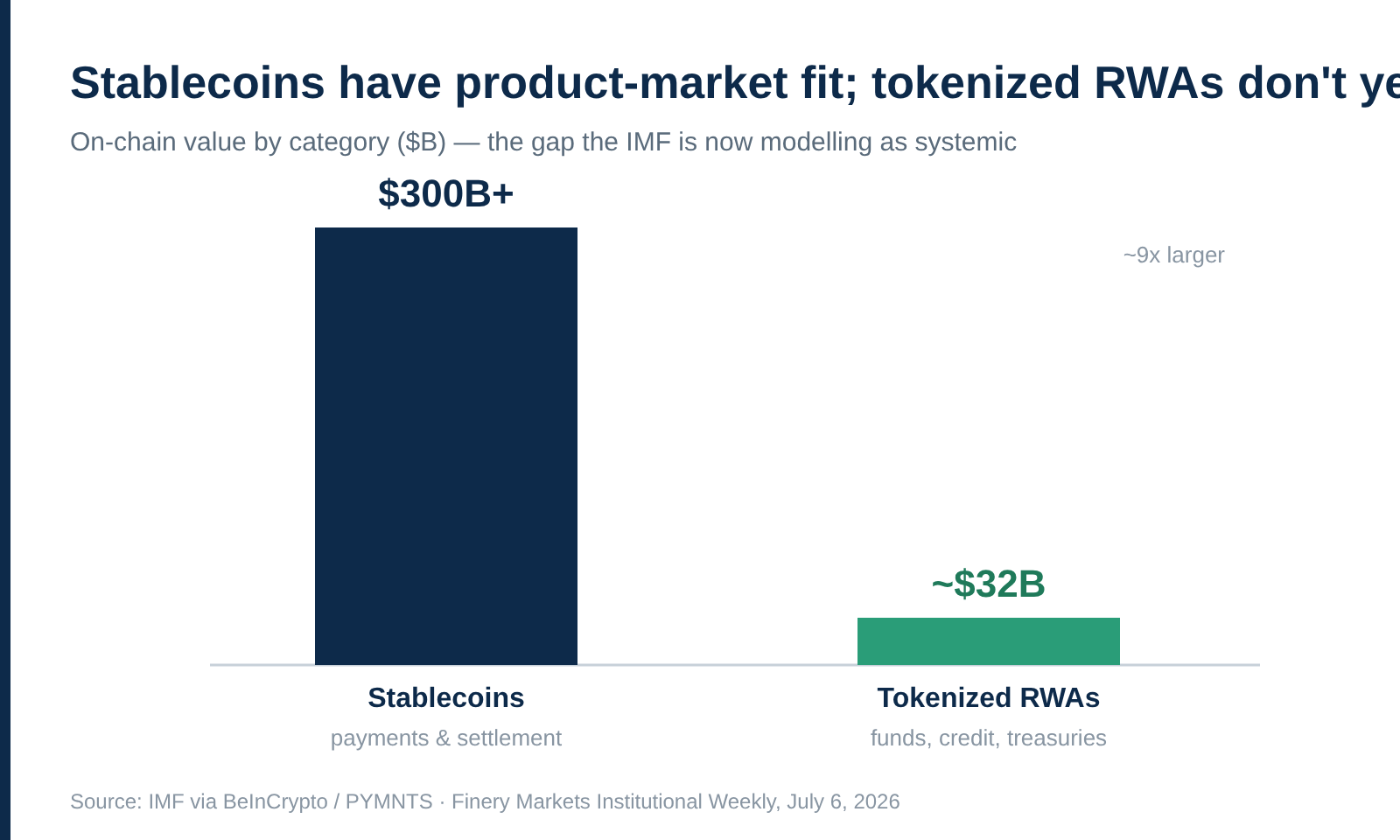
The gap between those two numbers is the story. Stablecoins have found genuine product-market fit in payments and settlement; the broader tokenization of funds, credit and treasuries is still mostly potential. The IMF's concern is that as the latter scales, disintermediation could outrun the regulatory perimeter, concentrating operational and liquidity risk in infrastructure that behaves differently under stress than a bank does.
For institutions, the caution cuts both ways. It validates that tokenization is significant enough for the IMF to model as systemic, and it flags that controls, settlement finality and counterparty discipline — not just the act of putting an asset on-chain — are what will determine whether tokenized markets are trusted at scale.
Taiwan passes a sweeping crypto law with 100% stablecoin reserves
Taiwan's legislature approved its Virtual Asset Service Act on July 1, sending it to President Lai Ching-te for signing within ten days. The law requires every virtual asset service provider — across seven categories including exchanges, custodians, transfer firms, underwriters and lenders — to obtain a license from the Financial Supervisory Commission before operating. AML-registered platforms get a 12-month window to apply and up to 21 months to secure full approval.
Stablecoin issuers face the highest bar. They must win approval from both the central bank and the FSC and hold 100% reserves at all times, with unlicensed issuance punishable by up to seven years in prison and fines up to NT$100 million (about $3.14 million).
Taiwan joins a widening list of jurisdictions — the EU under MiCA, and now several Asian markets — moving from principle to hard licensing with reserve mandates at the center. The pattern for institutions is consistent: full-reserve, licensed, supervised counterparties are becoming the baseline requirement for routing flow, not a premium feature.
Russia readies its digital ruble for September, even as demand looks thin
Bank of Russia Governor Elvira Nabiullina said the country is "ready for the widespread use of the digital ruble," with systemically important banks and large retailers on track to accept the CBDC by a September 1 deadline set in law last year. The central bank is also weighing smart contracts for businesses and piloting digital wallets on bank balance sheets.
The demand picture is less convincing. An independent survey cited by The Moscow Times found Russians "do not understand why they need a third form of money" beyond cash and bank deposits, and the central bank is offering banks a token commission — about 0.67 rubles, less than a US cent, per payment — to participate.
The contrast with the US is sharp. Washington spent last month debating a CBDC ban through 2030, and President Trump ultimately declined to sign the housing bill that carried it. Where Russia is mandating a state digital currency into existence, the US is legislating to keep one out — and the private sector is filling the gap with stablecoins like OUSD. Two models of digital money are now being built in parallel, and institutions will have to operate across both.
Gillibrand moves to bar officials from meme coins after Trump's $1.2B crypto year
Senator Kirsten Gillibrand, one of the more pro-crypto Democrats, is renewing a push to bar elected officials and their spouses from issuing or promoting digital assets, including meme coins. The trigger was a disclosure that President Trump earned more than $1.2 billion from crypto ventures last year, including over $635 million from his Solana-based meme coin alone.
Gillibrand called the ban "a commonsense requirement that should get broad bipartisan support," tying it to a broader ethics campaign that has also targeted congressional stock trading and wagers on prediction markets. The politics matter for market structure: ethics provisions have been a sticking point on the Clarity Act, the market-structure bill the industry wants passed. Galaxy researchers now put its 2026 odds at roughly 50-50, citing a shortage of legislative time rather than disagreement on substance.
For institutions, the meme-coin sideshow is noise, but the legislative calendar is not. A clear US market-structure framework would define custody, disclosure and trading rules for everything above the meme-coin tier, and its slipping odds keep a layer of regulatory uncertainty over the market's most institutional segments.
A $6M Summer.fi exploit reopens the DeFi security question
Security firm Blockaid flagged a roughly $6 million exploit at DeFi protocol Summer.fi on Monday, after the displayed APY on an affected LVUSDC vault briefly spiked to an absurd 2.08 million percent. Summer.fi, formerly Oasis.app, is the front-end for an on-chain vault system that routes deposits across yield sources like Aave and Morpho; its SUMR token fell about 5% even as the broader market rose.
The incident is the second recorded DeFi exploit of July and follows a rough June, when crypto platforms lost roughly $75.9 million across 40 hacks, with the Humanity Protocol breach the largest single loss. The pattern is familiar: automated, composable yield infrastructure remains the softest surface in crypto, and the losses keep landing in the tens of millions.
For institutional allocators weighing on-chain yield, the takeaway is unchanged but reinforced. Smart-contract risk is a live, recurring cost of doing business in DeFi, and it argues for execution and settlement environments where counterparty and operational risk are controlled rather than inherited from whatever protocol a vault happens to route into.







 LinkedIn
 Youtube
 Medium
 Twitter